
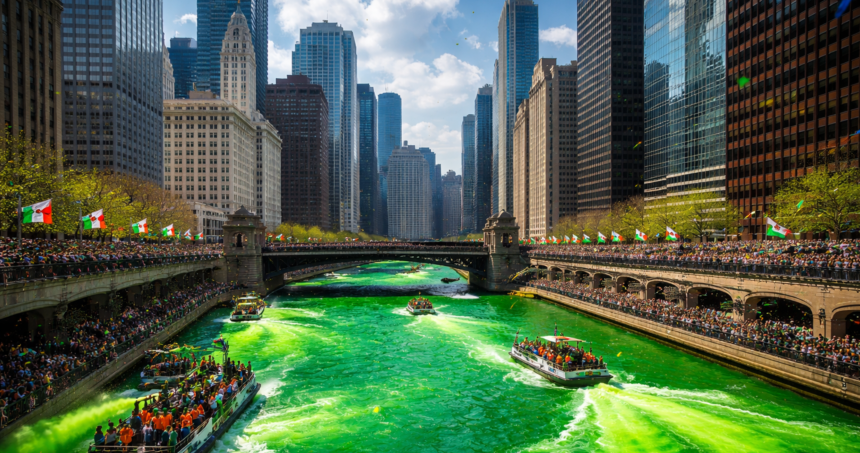
Every year in mid-March, the city of Chicago becomes the center of one of the world’s most unusual holiday spectacles when the Chicago River is transformed into a bright emerald green to celebrate St. Patrick’s Day. The tradition once again drew thousands of residents and tourists in March 2026, when the river was dyed early in the morning ahead of the city’s famous St. Patrick’s Day parade and festivities. Crowds gathered along bridges and riverwalks across downtown Chicago to watch the water change color, marking the start of the annual celebrations honoring Irish culture and heritage.
The dyeing of the Chicago River has become one of the most recognizable St. Patrick’s Day traditions in the United States. Typically held on the Saturday before March 17, the event is performed by members of the Chicago Journeymen Plumbers Local Union 130, who release a special green dye from boats moving along the river. Within minutes, the normally dark water turns a vivid shade of green, creating a dramatic contrast against the city’s skyline and attracting photographers, families, and tourists from around the world.
The reason behind the celebration is tied to the significance of St. Patrick’s Day itself. The holiday commemorates St. Patrick, the patron saint of Ireland, and is observed every year on March 17. Although its origins are religious, the day has evolved into a global celebration of Irish culture featuring parades, music, food, and displays of the color green. In cities with large Irish-American populations, such as Chicago, the celebrations are particularly vibrant.
More Read

Chicago’s famous green river tradition dates back more than six decades. The idea first emerged in the early 1960s when city officials were trying to locate illegal sewage discharges flowing into the river. Plumbers used a bright green dye to trace leaks in pipes and waterways. When Stephen Bailey, a leader in the plumbers’ union and co-chair of the St. Patrick’s Day Parade Committee, noticed how striking the dye looked in the water, he proposed using it as part of the city’s holiday celebrations. In 1962, the river was deliberately dyed green for the first time, and the event quickly became a beloved tradition.
Initially, large quantities of dye were used, turning the river green for several days. Over time, however, organizers reduced the amount and adopted safer materials to protect the environment. Since 1966, the dye mixture has been vegetable-based and environmentally tested. Today the exact formula remains a closely guarded secret known only to members of the plumbers’ union. The dye usually colors the river for several hours, although traces of the green shade can linger for a day or two.
On the day of the event, boats carrying union members move along the river while workers pour a powder that initially appears orange but turns bright green once it mixes with the water. Spectators lining the bridges watch as the color spreads quickly across the river’s surface, producing the famous emerald effect that symbolizes Ireland’s nickname, the “Emerald Isle.” The transformation often happens within minutes, making it one of the most dramatic holiday displays in the country.
The dyeing of the river also serves as the unofficial opening ceremony for Chicago’s St. Patrick’s Day festivities. Shortly after the river turns green, the city hosts its major downtown parade along Columbus Drive, featuring marching bands, Irish dance groups, decorated floats, and community organizations. Neighborhood parades and cultural events continue throughout the weekend, celebrating Irish heritage and bringing together residents from across the city.
Over the years, the tradition has become a symbol of Chicago itself. Images of the bright green river flowing through the city’s skyscrapers have been widely shared in global media and travel campaigns. While some environmental groups have criticized the practice, city officials and organizers maintain that the modern dye is safe and used in small amounts. For most residents, the event remains a source of pride and a sign that spring celebrations have begun.
Today, more than sixty years after it began, the dyeing of the Chicago River continues to capture the imagination of millions. Each March, the moment the water turns emerald marks the start of a festive weekend filled with music, parades, and Irish traditions, turning the heart of Chicago into a sea of green in honor of St. Patrick’s Day.