Federal agents across the United States were recently informed that the Federal Bureau of Investigation would no longer open cases into confrontations involving Immigration and Customs Enforcement officers, a quiet procedural change with potentially far reaching implications for civil rights oversight and the balance of power inside the federal security apparatus. The reported guidance concerns allegations of assault and other violent encounters between immigration agents and members of the public during enforcement operations, situations that historically could trigger FBI scrutiny when questions arose about excessive force or possible violations of federal law.
What Has Reportedly Changed
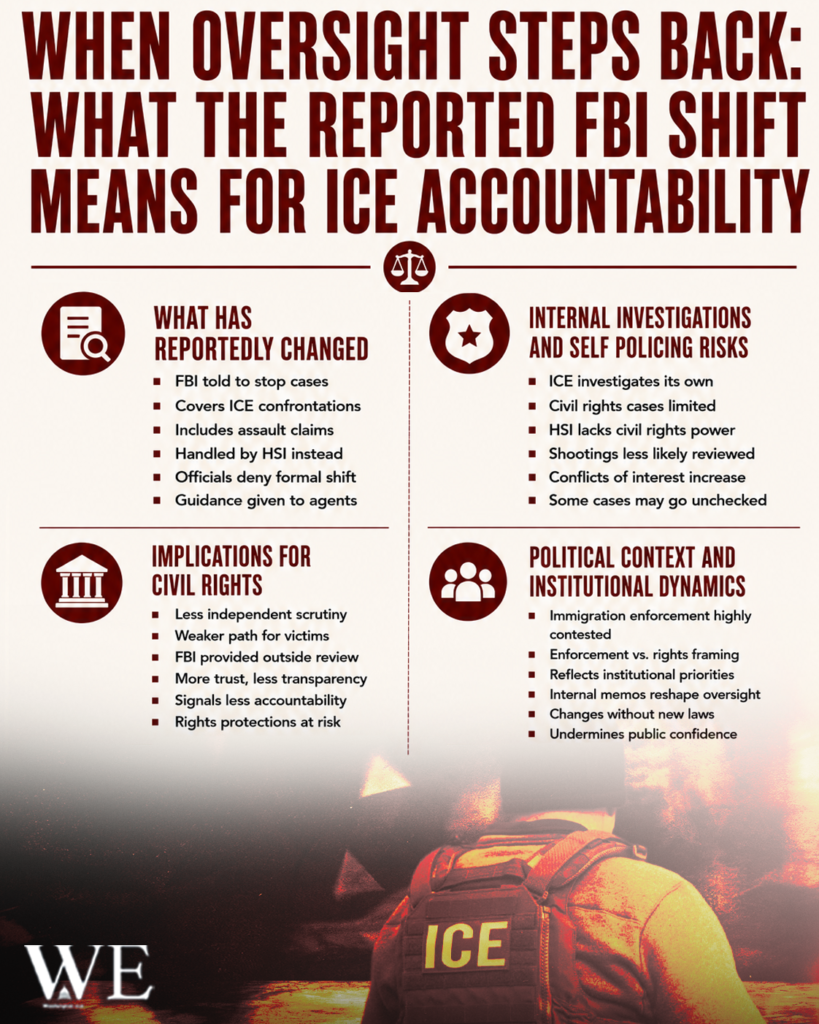
According to reporting that draws on briefings given to agents, the FBI guidance instructs personnel that they should stop initiating investigations into altercations involving Department of Homeland Security immigration agents, including ICE, even in cases framed as assaults on federal officers. Responsibility for such matters would instead fall to Homeland Security Investigations, an investigative arm housed within ICE that already handles a broad portfolio of criminal cases related to immigration and customs enforcement. Senior officials have publicly rejected the idea that a formal policy shift has taken place, yet multiple outlets describe similar language being circulated to agents in recent days, suggesting that operational practices may be changing regardless of the public denials.
Internal Investigations and the Risk of Self Policing
The most immediate concern raised by legal advocates and former officials is that placing primary responsibility for inquiries into violent confrontations in the hands of ICE itself risks turning potential civil rights investigations into internal disciplinary matters, or even leaving some incidents unexamined. Homeland Security Investigations does not have authority to pursue federal civil rights prosecutions, which means that shootings of unarmed individuals or allegations of excessive force by immigration agents would be far less likely to be evaluated through the lens of constitutional protections and federal criminal standards if the FBI steps aside. This structural gap creates a scenario in which the same agency that conducts raids, arrests, and removals could also be the primary arbiter of whether its own conduct merits legal scrutiny, a model that scholars of policing and accountability often view as vulnerable to conflicts of interest.
Implications for Civil Rights and Federal Authority
From a civil rights perspective, the reported change narrows one of the basic pathways through which people who face serious harm during immigration enforcement can hope to see their cases independently evaluated by criminal investigators. In the past, allegations that agents assaulted detainees or used lethal force could generate FBI case files that were separate from internal DHS reviews, creating at least some distance between frontline enforcement and potential criminal accountability. Removing that external layer could signal to immigration personnel that their actions are less likely to be questioned by outside investigators, even as communities most directly affected by enforcement already express distrust in the fairness and transparency of existing complaint mechanisms.
Political Context and Institutional Dynamics
The reported guidance surfaces at a moment when federal immigration enforcement remains intensely contested, with the Trump administration facing ongoing criticism over detention practices, removals, and the broader climate surrounding migrants and asylum seekers. Decisions about which agency investigates potential abuses are not just technocratic adjustments but reflections of institutional priorities, influencing whether confrontations at the border or in interior enforcement are treated primarily as security events or as possible civil rights violations. For observers of American governance, the episode highlights how internal memoranda and investigative charts, often invisible to the public, can reshape the practical meaning of oversight and accountability without requiring new legislation or formal public rules.
A Quiet Shift with Lasting Questions
If the FBI ultimately maintains this stance, the long term consequences will likely unfold case by case as future confrontations are handled inside DHS rather than by outside criminal investigators, leaving courts and Congress to decide whether existing frameworks are sufficient. For now, the reported guidance raises fundamental questions about how the United States distributes authority to scrutinize the conduct of its own security agencies, and whether the mechanisms designed to protect civil rights can remain robust when one key actor steps back from the field.