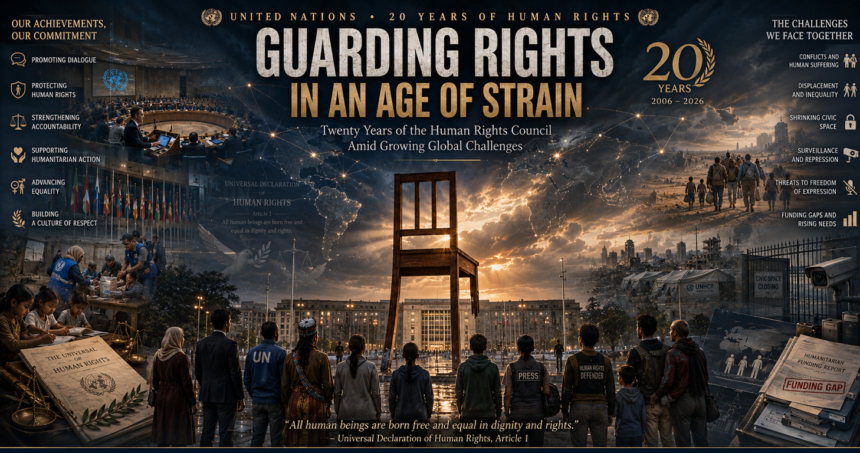
The twentieth anniversary of the Human Rights Council arrives at a moment when rights protection is simultaneously more institutionalized and more precarious than at any time since its creation. Two decades after replacing the Commission on Human Rights, the Council now operates in an environment marked by entrenched conflicts, shrinking civic space and a severe funding crunch that tests the resilience of the UN human rights system. The question is no longer whether the Council exists as a forum, but whether its current design and political economy are fit for the crises it faces.
From Renewal to Systemic Overload
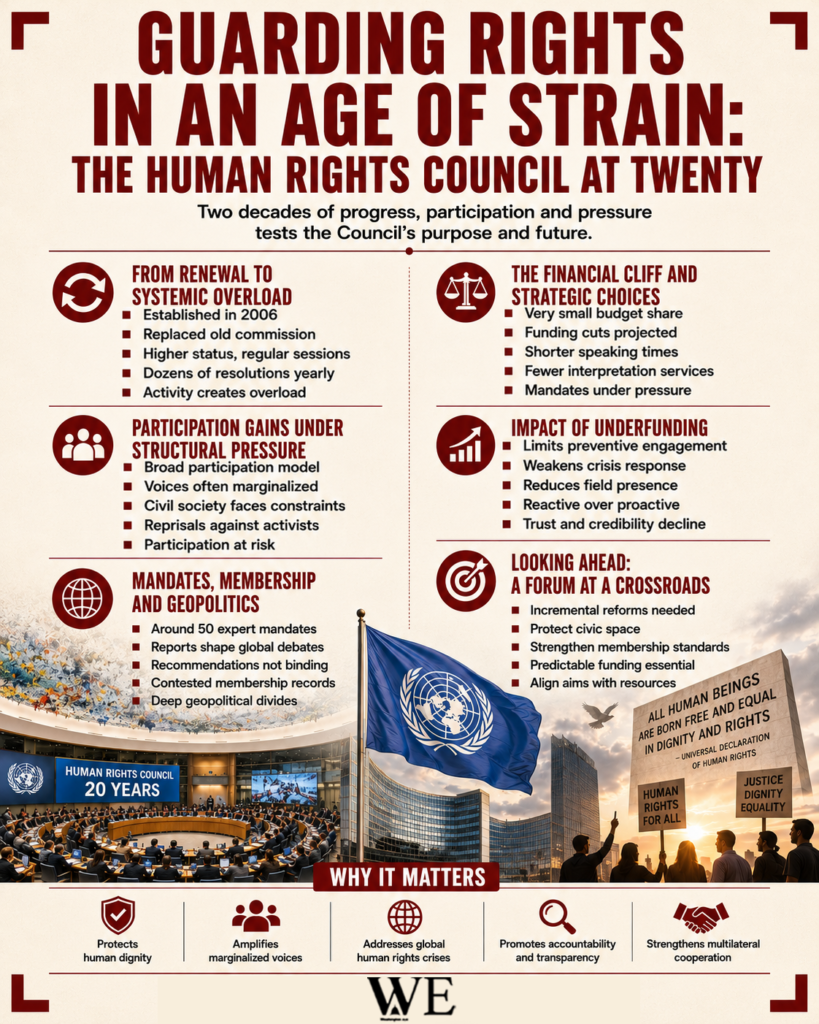
When the General Assembly established the Council in 2006, it was framed as a corrective to the perceived politicization and selectivity of its predecessor, with higher institutional status and regular sessions to deliver more consistent scrutiny. Early expectations emphasized avoiding narrow political point scoring and improving the credibility of membership and procedures. Two decades later, the Council is busier than at any point in its history, routinely considering dozens of resolutions per session on country situations and thematic issues ranging from freedom of religion to the right to a healthy environment. This density of activity signals normative vitality, yet it also creates systemic overload that can diffuse attention and hamper follow up. For states and rights holders, the implication is a widening gap between standard setting and effective implementation, particularly where political will and resources are limited.
Participation Gains Under Structural Pressure
One of the Council’s notable achievements is the institutionalization of broad participation through state delegations, special procedure mandate holders and civil society, including Indigenous peoples, victims and youth representatives. This model of deliberation has given visibility to voices often marginalized in traditional diplomatic forums and has helped embed a culture of interactive dialogue. At the same time, civil society organizations report growing constraints on access, reprisals against activists and a general trend of shrinking civic space that affects who can safely engage with the Council. These pressures risk turning participation into a formal rather than substantive achievement, especially for defenders from authoritarian contexts. If engagement is chilled by fear or procedural barriers, the Council’s ability to function as an early warning and accountability arena is weakened, with long term consequences for prevention and trust in multilateral human rights diplomacy.
Mandates, Membership and Geopolitics
Special rapporteurs and other independent experts now number around fifty and act as a frontline mechanism for documenting violations and amplifying neglected issues. Their reports have shaped global debates on education, assembly, digital rights and environmental justice, among many others. Yet the non binding nature of their recommendations, combined with selective cooperation from states, underscores the wider challenge of non enforceability that has characterized the Council since its inception. Membership practices also remain contested, as states with serious human rights records continue to sit on the body, complicating efforts to build consistent coalitions for strong action. Layered on top of this are sharp geopolitical divides over situations such as Ukraine and Palestine, where accusations of bias coexist with claims that certain crises receive disproportionate attention. These dynamics risk normalizing stalemate and dilution of resolutions, affecting both the deterrent power of scrutiny and the credibility of the Council’s universal peer review mechanism.
The Financial Cliff and Strategic Choices
The most acute new challenge is material rather than normative. Human rights remain one of the UN’s three pillars, but the system continues to receive a very small fraction of the regular budget, historically under five percent and now facing projected cuts amid a broader liquidity crisis. In practice, this has already translated into shorter speaking times, reduced interpretation services and pressure on special procedures to scale back travel and reporting. If current trends continue, the Council will be forced into hard choices over which mandates to sustain and how to prioritize among emergencies and chronic situations. This resource scarcity is not only an administrative problem, it is a strategic one: underfunding can entrench reactive approaches, undermine preventive engagement and reinforce perceptions that the international community is more willing to adopt resolutions than to invest in their implementation.
Looking Ahead: A Forum at A Crossroads
At twenty, the Human Rights Council is neither a failing experiment nor a fully effective safety net. It has become an indispensable site for dialogue and standard setting, yet its capacity to secure compliance and protection is constrained by politics, membership and finances that it does not control. The coming years will likely hinge on incremental reforms that strengthen early warning, safeguard civil society space, sharpen membership criteria and secure more predictable funding, rather than on any wholesale redesign. For observers and practitioners alike, the key task is to treat the anniversary less as commemoration and more as a prompt to align the Council’s ambitions with the resources and political strategies needed to make its promise of rights protection tangible in a turbulent world.