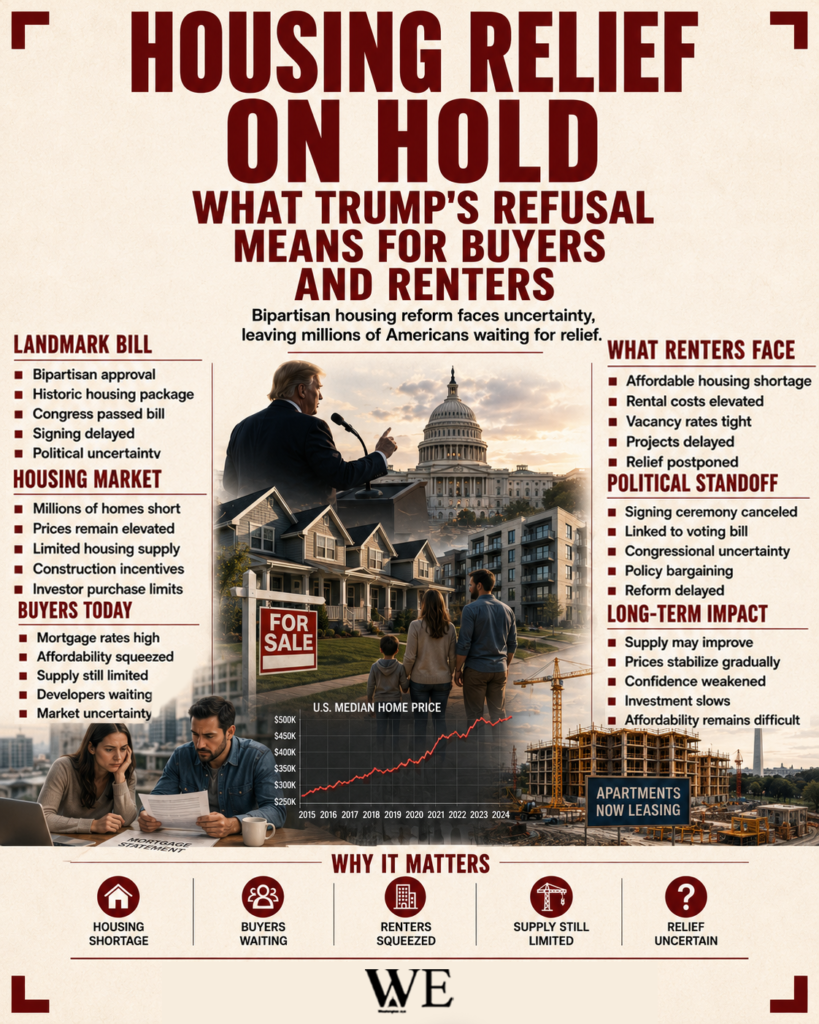
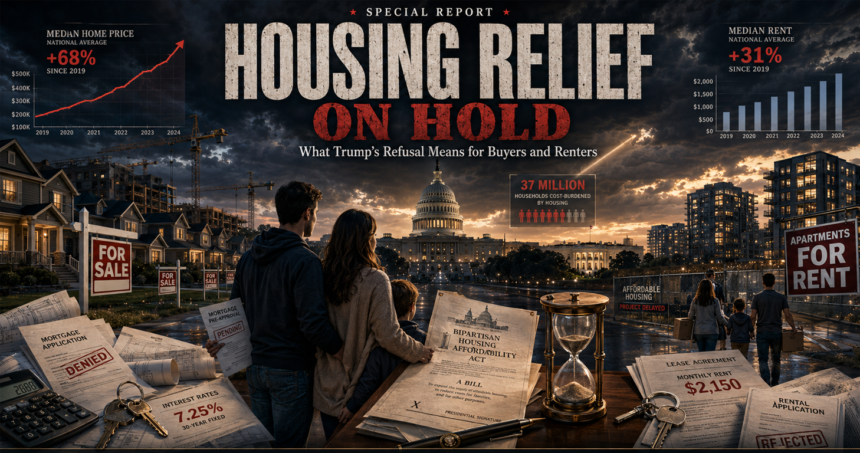
President Donald Trump’s decision not to sign a rare bipartisan housing affordability bill has injected fresh uncertainty into an already strained housing market at a moment when costs for buyers and renters are near historic highs. The move transforms what had been billed as a landmark policy achievement into a political bargaining chip and leaves families unsure whether promised relief will materialize soon enough to matter.
A Landmark Bill Stalled at the Finish Line
The legislation known as the 21st Century Road To Housing Act has been described as one of the most comprehensive federal housing packages in decades, with provisions aimed at lowering costs and expanding supply across the United States. It passed both chambers of Congress with broad bipartisan majorities, reflecting rare cross party agreement that high rents and home prices have become a central cost of living concern for voters.
Trump canceled a planned signing ceremony and announced that he would not sign the bill until Congress passes the Save America Act, a voter identification and election measure that does not currently have sufficient support to advance. Under the Constitution, if Congress remains in session and the President neither signs nor vetoes the bill, it could still become law automatically after ten days, which leaves the legislation in a state of legal and political uncertainty.
What is at Stake for Housing Costs
At the core of the bill is a strategy to address the persistent shortage of homes, which many economists view as a primary driver of rising prices. Provisions include incentives and regulatory changes intended to encourage new home construction as well as limits on how many single family homes large institutional investors can purchase in markets where local buyers are already being priced out.
The underlying problem is sizable. National estimates point to a housing shortfall that runs into the millions of units, which means that demand continues to exceed supply and gives sellers and landlords sustained pricing power. Median home prices remain elevated and income needed to afford a typical home is substantially higher than what many households earn, while renters face tight vacancy rates and high monthly costs, especially in rapidly growing metropolitan areas.

Immediate Implications for Homebuyers
For prospective buyers the most immediate effect of the refusal to sign the bill is uncertainty rather than an abrupt shift in prices. Financial markets and homebuilders had anticipated a clearer policy direction from Washington, and the delay may influence when developers choose to initiate projects or secure financing if they are unsure whether new federal incentives will actually take effect.
If the bill eventually becomes law, even without a presidential signature, its emphasis on expanding housing supply could gradually reduce price pressures in some areas, though experts expect any impact to unfold over several years. In the meantime buyers must still navigate elevated mortgage rates and high list prices, and some may postpone entering the market if they anticipate that additional supply and slightly improved conditions are on the horizon.
What this Means for Renters
Renters may experience the consequences in more gradual ways. The legislation contains measures to expand affordable rental options, including support for construction and rehabilitation of housing in communities facing acute shortages or recovering from economic shocks or disasters.

Without clarity on the status of the bill, state and local authorities cannot rely on the anticipated federal resources to accelerate projects designed to increase the stock of affordable rental units. Since rents typically adjust slowly, the absence of new federal backing could make recent modest easing in some markets fragile and leave low and moderate income renters exposed to continued high housing cost burdens.
Political Bargaining and Policy Credibility
Trump’s decision to link the housing bill to adoption of the Save America Act illustrates the use of prominent legislation as leverage to pursue broader political objectives in this case changes to voting rules and election administration. Congressional leaders had framed the housing bill as proof that they were responding to everyday economic pressures, and the sudden shift complicates that narrative.
This outcome may shape perceptions of policy reliability. If stakeholders see major bipartisan agreements as vulnerable to last minute reversals, they may become more cautious about investing political and financial capital in future federal housing initiatives. For households, the risk is that structural reforms intended to address supply constraints and affordability are delayed or diluted by unrelated disputes, prolonging a period in which buyers and renters are already under strain.
In the short term, the unresolved status of the bill highlights a gap between recognition of a national housing affordability problem and the consistent implementation of policies to address it. Whether that gap narrows will depend on how Congress and the White House choose to resolve this standoff and whether they prioritize translating bipartisan legislative work into concrete outcomes for households.