The late night reversal by Senate Republicans on a war powers resolution concerning the ongoing conflict with Iran underscores how fragile congressional efforts to reclaim authority over the use of force remain when confronted with direct presidential pressure.
A Sudden Turn in the Upper Chamber
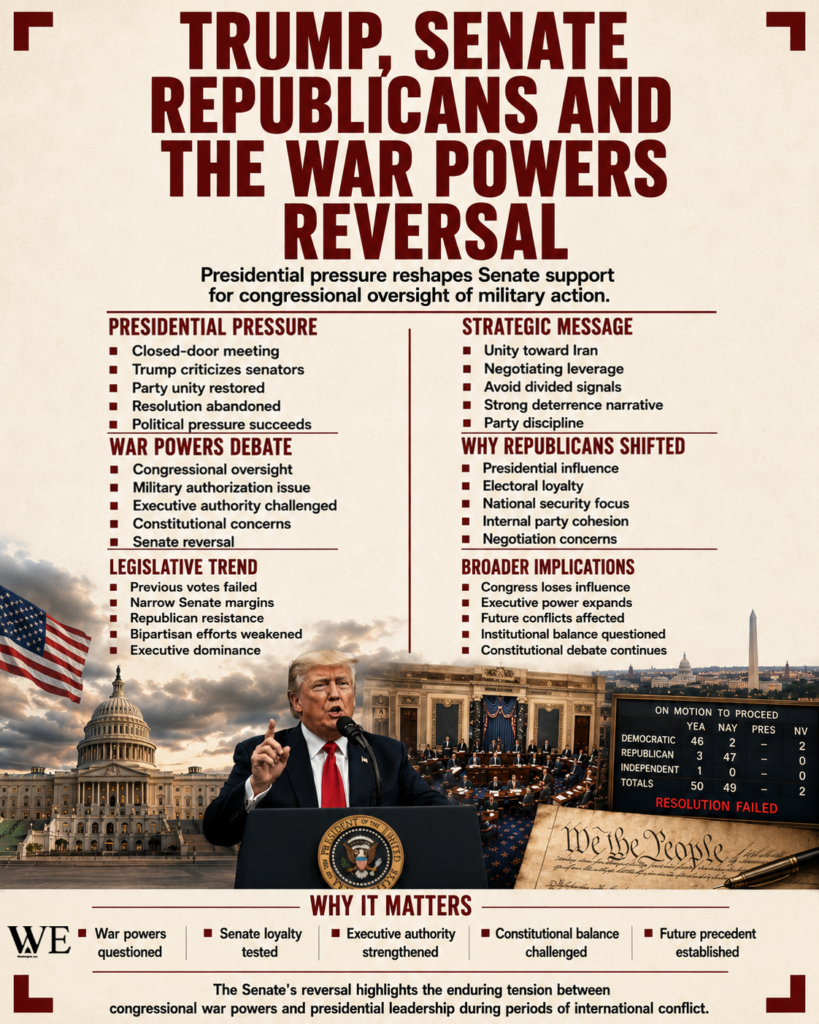
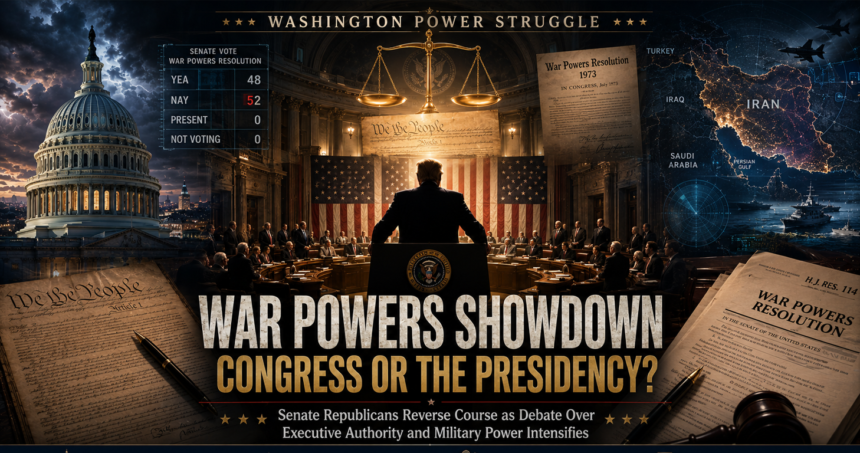
According to reporting, several Republican senators had initially supported advancing a war powers resolution that would require President Donald Trump to seek congressional authorization for continued military operations against Iran. After a tense closed door meeting at the Capitol in which Trump sharply criticized those in his party who backed the measure, the Senate held another vote and Republicans ultimately rejected the resolution. The reversal followed a broader pattern in recent months in which measures aimed at constraining Trump’s Iran policy have repeatedly failed despite some early bipartisan support.
Presidential Pressure and Intraparty Discipline
Reports describe the Capitol meeting as confrontational, with Trump berating Republican senators for backing what he views as constraints on his conduct of the Iran war and warning that such votes could undermine his negotiating position. In subsequent comments, Trump argued that the war powers vote was “meaningless” and suggested that it signaled division to Tehran at a sensitive moment in talks over ending the conflict. Republican allies echoed this framing, contending that visible congressional dissent could embolden Iran or prolong the war rather than hasten a settlement. The rapid shift by some Republicans between procedural and final votes highlights how party cohesion around the president can override earlier gestures toward institutional independence.
War Powers and A Pattern of Legislative Retreat
The failed resolution fits into a series of attempts this year to limit Trump’s authority over the Iran conflict that have been blocked in the Senate. Previous efforts that would have required withdrawal of United States forces or mandated explicit authorization for further strikes were defeated by narrow margins, often 51 to 47 or 53 to 47, with most Republicans opposing the measures and only one or two crossing party lines. Sponsors have repeatedly framed these proposals as efforts to restore Congress’s constitutional role in authorizing the use of force, while critics within the president’s party have emphasized the need for flexibility in dealing with Iran’s capabilities and regional escalation. The latest reversal therefore signals not an isolated episode but part of a consistent reluctance by the Senate majority to enforce statutory limits on the executive in matters of war and peace.
Strategic Messaging to Iran and Domestic Audiences
Trump’s public characterization of the earlier war powers vote as “meaningless” while simultaneously warning that it could complicate negotiations with Iran reveals a dual message aimed abroad and at home. To foreign audiences, the administration has emphasized that the United States retains resolve and is not constrained by internal divisions, even as Congress debates its own role. Domestically, the president and his supporters present resistance to war powers resolutions as a defense of American leverage and deterrence, framing legislative constraints as signals of weakness that might encourage adversaries. This narrative places political pressure on lawmakers who may be wary of being portrayed as undermining the national position in the midst of ongoing hostilities.

Implications for Institutional Balance and Future Conflicts
The Senate’s decision to reject the Iran war powers resolution after a direct intervention by Trump carries implications that go beyond the immediate conflict. First, it reinforces a trend in which formal war powers debates end with Congress affirming or at least not effectively challenging de facto presidential control over extended military operations, making future authorizations or constraints less likely. Second, it signals to future presidents that strong partisan loyalty in the Senate can blunt institutional pushback even when some members initially express concern about the scope of executive authority. Finally, it complicates efforts by lawmakers from both parties who argue that Congress must reassert a more active role in decisions about when and how the United States enters and sustains conflicts, especially in an environment where military engagements can evolve rapidly without formal declarations of war.
In the end, the episode highlights the tension between constitutional design and contemporary party politics, as senators navigate the tradeoff between institutional prerogatives and loyalty to a president who remains central to their electoral and policy agendas.