The life sentence handed to Pakistani activist and doctor Mahrang Baloch marks more than a single court verdict. It encapsulates the collision between a long running campaign against enforced disappearances and an entrenched security state that increasingly treats dissent as a security threat.
A Life Shaped by Disappearance
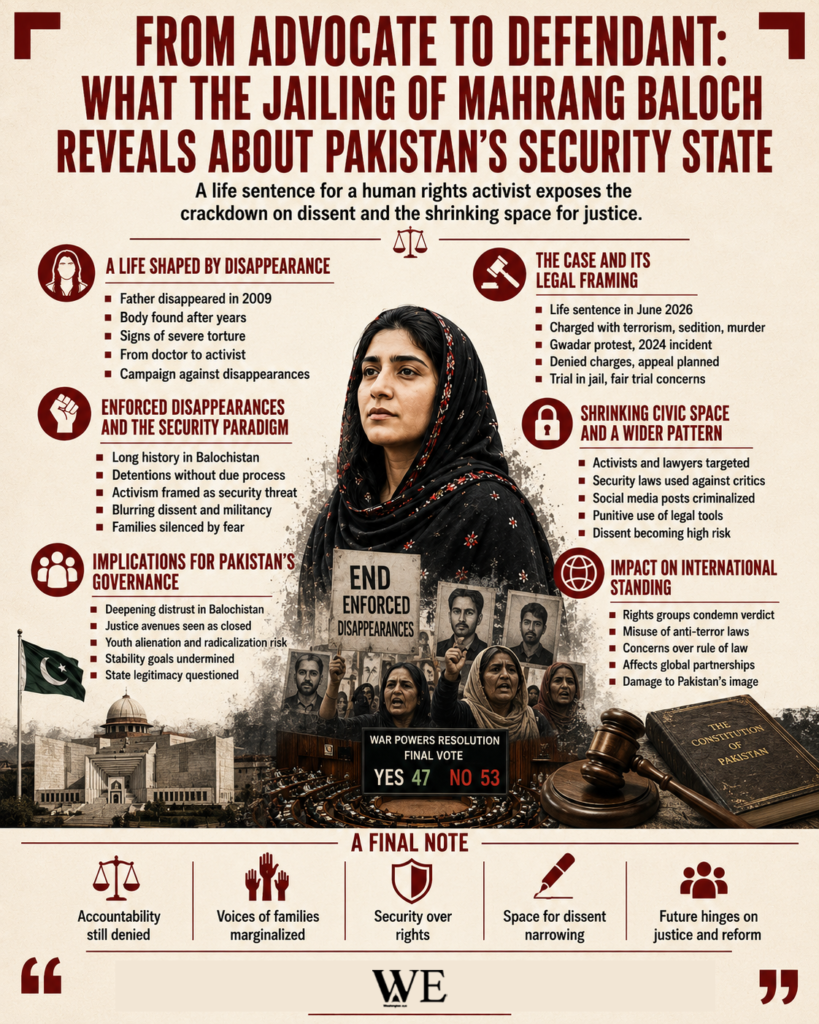
As a teenager, Mahrang Baloch began searching for her father, Abdul Ghaffar Langove, a political activist who vanished in 2009 in Balochistan after being allegedly detained by security forces. Nearly three years later, her family was informed that his body had been found in Lasbela district in southern Balochistan, with signs of severe torture. This experience moved her from medicine into full time activism focused on enforced disappearances in one of Pakistan’s most militarized provinces.
Her activism centered on organizing families of the missing and demanding accountability for abductions attributed by rights groups to Pakistani security agencies in Balochistan. International organizations and domestic human rights bodies have long documented patterns of such disappearances, arguing that counterinsurgency policies have blurred the line between combatants and civilians.
The Case and its Legal Framing
In June 2026 an anti terrorism court sentenced Mahrang Baloch and fellow activist Sibghat Ullah Shah to life in prison, finding them guilty of terrorism, sedition, and murder related to the death of a paramilitary officer during a 2024 protest in the port city of Gwadar. Prosecutors argued that a member of the Federal Constabulary, Shabbir Ahmed, was beaten to death by a crowd at a demonstration organized by the Balochistan Unity Committee and that both activists shared a common intention in this unlawful assembly.
Both defendants denied the charges, announced plans to appeal, and boycotted the trial, arguing that the proceedings were unfair and that they were not given a meaningful chance to challenge the evidence. According to Amnesty International, the trial was conducted inside a jail, was concluded rapidly, and relied on Pakistan’s broad anti terrorism framework, raising concerns about compliance with international fair trial standards.
Enforced Disappearances and the Security Paradigm
The verdict must be read against a long backdrop of enforced disappearances in Balochistan and other parts of Pakistan. Human rights groups have documented cases over many years in which activists, students, and suspected militants were detained without due process, sometimes later found dead, and often never seen again. Islamabad has typically justified these practices as part of counterinsurgency and counterterrorism operations in a province where separatist and militant violence has targeted security forces and infrastructure.
The tension lies in the legal framing of activism as a security threat. By charging Mahrang Baloch under terrorism and sedition provisions, the state sends a signal that mobilizations around disappearances can be construed as enabling or aligning with militant agendas. This blurs the boundary between peaceful advocacy and violent insurgency and risks discouraging families of the missing from seeking redress through public protest.
Shrinking Civic Space and A Wider Pattern
The case follows a broader pattern of pressure on human rights defenders in Pakistan. Earlier in 2026 a court sentenced a prominent human rights lawyer and her husband to 17 years in prison over social media posts deemed hostile to the state and security institutions, applying cybercrime and anti state provisions in a way that rights organizations described as punitive toward dissent. International observers and domestic watchdogs have warned that such prosecutions normalize the use of security laws against critics rather than focusing them on clearly defined acts of violence.
In this context, the life sentence for Mahrang Baloch can be seen as part of a tightening environment where legal tools originally justified in terms of national security are increasingly deployed against those who scrutinize the conduct of security agencies. This trend complicates Pakistan’s commitments under international human rights treaties that require safeguards for freedom of expression, assembly, and due process even in counterterrorism contexts.
Implications for Pakistan’s Governance and International Standing
Domestically, the ruling risks deepening distrust between the state and communities in Balochistan who already view the central government and security forces with suspicion. When an activist known for advocating nonviolent accountability is prosecuted as a terrorist, many in the region may interpret this as confirmation that institutional avenues for justice are effectively closed. This could alienate younger generations in Balochistan and push some toward more radical forms of resistance, undermining the state’s stated goal of stability.
Internationally, the case may complicate Pakistan’s relationships with partners that emphasize human rights in their foreign policy. Organizations such as Amnesty International and the Human Rights Commission of Pakistan have already framed the verdict as a misuse of anti terrorism laws and a setback for fundamental rights. Continued prosecutions of high profile activists could influence external assessments of Pakistan’s rule of law, with potential implications for development cooperation, security partnerships, and its broader global image.
A Final Note
The jailing of Mahrang Baloch is not only about a single activist or a single protest in Gwadar. It exposes an unresolved dilemma in Pakistan’s political order: how to reconcile security driven governance in regions like Balochistan with the legal and moral demands of accountability for missing citizens and alleged abuses by the state. The outcome of her appeal and the public debate it generates will be an important indicator of whether Pakistan’s institutions can recalibrate this balance or whether the space for rights based activism will continue to narrow.