
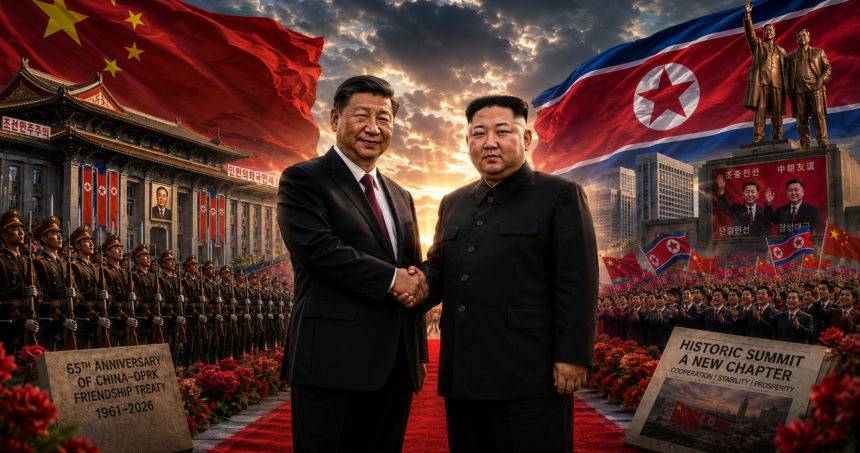
Chinese President Xi Jinping arrived in Pyongyang this week for a rare state visit to North Korea, marking his first trip to the country in nearly seven years and signaling a renewed effort to strengthen ties between Beijing and Pyongyang amid shifting geopolitical dynamics in East Asia. The two-day visit, held at the invitation of North Korean leader Kim Jong Un, has drawn global attention due to its timing and strategic implications.
Xi was welcomed with full state honors upon his arrival in Pyongyang. According to state media reports, Kim Jong Un personally received the Chinese leader at the airport, where a military band, honor guard, and ceremonial salute marked the occasion. Crowds waving Chinese and North Korean flags lined the streets, while banners celebrating the friendship between the two neighboring countries decorated the capital. Xi was accompanied by senior Chinese officials, underscoring the significance Beijing attaches to the visit.
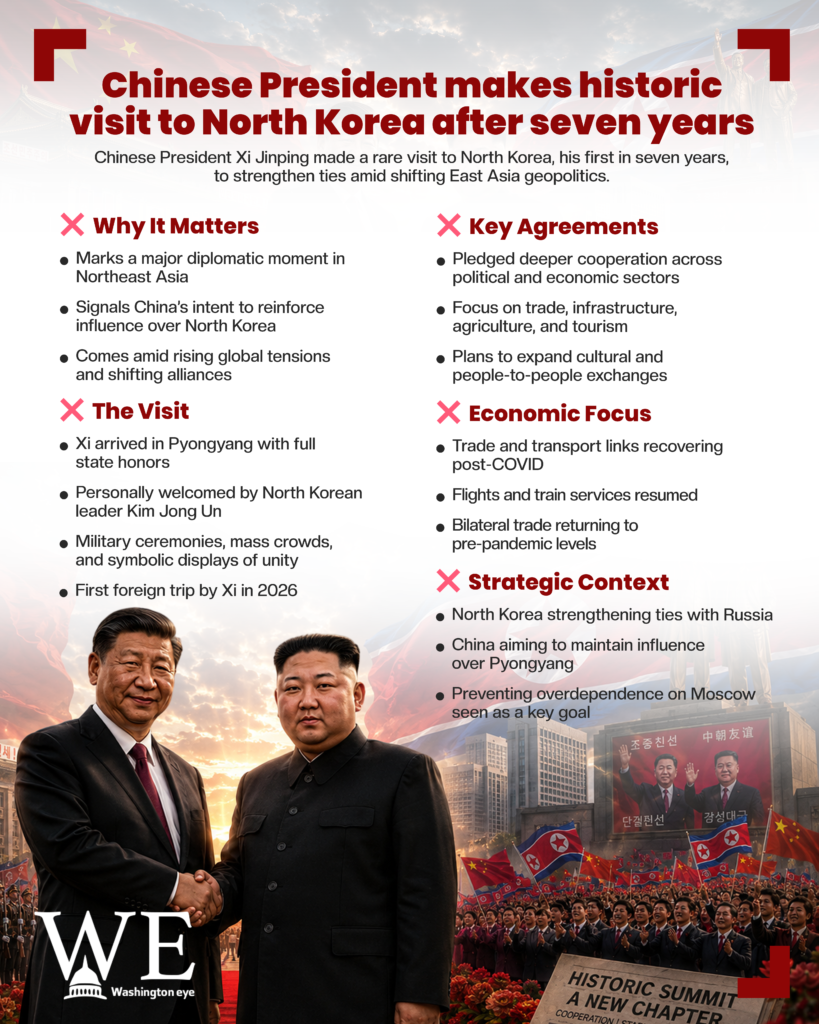
The visit is particularly notable because Xi has significantly reduced overseas travel in recent years, making North Korea his first foreign destination of 2026. Analysts say the decision reflects Beijing’s desire to reaffirm its influence on the Korean Peninsula and strengthen one of its most important strategic partnerships. Ahead of the trip, Xi described China-North Korea relations as standing at a “new historical starting point,” emphasizing the need for deeper cooperation and long-term stability.
During summit talks, Xi and Kim pledged to expand cooperation across political, economic, cultural, and diplomatic spheres. Both leaders reaffirmed the importance of maintaining close communication and enhancing collaboration in areas such as trade, infrastructure, agriculture, tourism, and people-to-people exchanges. The meeting also coincides with the upcoming 65th anniversary of the friendship treaty between the two nations, further highlighting the symbolic value of the visit.

Economic cooperation was a major focus of discussions. Following years of disruption caused by the COVID-19 pandemic, trade and transportation links between the two countries have gradually resumed. Direct flights and passenger train services have restarted, and bilateral trade has reportedly returned to pre-pandemic levels. Xi encouraged greater exchanges between citizens and businesses, signaling China’s willingness to support North Korea’s economic development while maintaining regional stability.
The visit comes at a time when North Korea has been deepening its relationship with Russia. Since the outbreak of the war in Ukraine, Pyongyang and Moscow have strengthened military and economic cooperation, leading some analysts to suggest that China may be concerned about losing influence over its long-time ally. Experts believe Beijing wants to ensure that North Korea remains within its strategic orbit and does not become overly dependent on Russia for economic assistance and security cooperation.
Regional security issues also loom large over the visit. Although neither side publicly focused on North Korea’s nuclear weapons program, the issue remains central to international concerns. Kim has repeatedly emphasized expanding North Korea’s nuclear capabilities, while China continues to advocate stability and dialogue on the Korean Peninsula. Observers note that Beijing prefers to avoid public confrontation over the nuclear issue while maintaining leverage over Pyongyang through economic and diplomatic engagement.
International reactions to the visit have been mixed. Some analysts view the summit as a natural effort by neighboring countries to maintain strong diplomatic ties and promote economic cooperation. Others see it as part of a broader alignment among states seeking to challenge Western influence and reshape regional power structures. The visit follows recent diplomatic engagements involving China, Russia, and the United States, adding another layer of complexity to an already tense geopolitical landscape.
From a critical perspective, the visit raises questions about the future balance of power in Northeast Asia. Critics argue that closer China-North Korea cooperation could complicate efforts to address security concerns, particularly regarding missile tests and nuclear development. Others contend that engagement and dialogue are more effective than isolation in promoting stability. Whether the summit produces concrete policy outcomes or remains largely symbolic, it clearly demonstrates that both Beijing and Pyongyang continue to view their relationship as strategically important.
As Xi concluded his visit, both governments portrayed the summit as a success and a reaffirmation of their long-standing friendship. In a region increasingly shaped by geopolitical rivalry, economic uncertainty, and security concerns, the rare meeting between Xi Jinping and Kim Jong Un may have implications that extend far beyond the borders of China and North Korea.