

Saudi Arabia is stepping up as the dominant external power broker in Yemen after the United Arab Emirates (UAE) pulled out its remaining forces in late 2025, reshaping the Saudi-led coalition and reopening questions about who controls Yemen’s fractured institutions, armed groups, and resource-rich southern provinces. The shift comes as a fragile truce with the Iran-aligned Houthi movement in the north holds unevenly, while the south, long the arena of Saudi-Emirati competition, faces renewed political churn and intermittent violence.
The UAE’s latest withdrawal was not a sudden exit from Yemen’s decade-long war, but the sharpest drawdown since it began reducing its footprint years earlier. This time, however, the departure followed open coalition tensions tied to the UAE-backed Southern Transitional Council (STC), a southern separatist force that has repeatedly clashed with Saudi-aligned units and the internationally recognized Yemeni government camp. Late-2025 escalations, reported airstrikes, accusations over arms routes, and competing influence in key ports, pushed the coalition’s internal rift into the open, culminating in Abu Dhabi’s decision to pull out remaining “counterterrorism” units and Riyadh’s move to consolidate control.
With the Emirati role reduced, Saudi Arabia has pivoted to what officials and analysts describe as “cash and clout” state-building: funding salaries, underwriting security arrangements, and trying to fold a patchwork of armed factions into a more unified command structure. Reuters reported Riyadh has deployed close to $3 billion in support aimed at rebuilding state capacity and keeping allied forces and civil servants paid, an approach intended to stabilize areas outside Houthi control and prevent southern fragmentation from derailing any wider settlement.
The timing is critical. Yemen’s internationally backed camp is not a single actor: it includes the Presidential Leadership Council (PLC), government ministries, tribal networks, and multiple armed formations that often answer to local commanders more than national institutions. After weeks of deadly clashes in the south, the PLC announced a new cabinet, an attempt to project administrative normalcy, but also a sign of how quickly Yemen’s political map can change when coalition backing shifts.
Why is Saudi Arabia escalating now? Part of the answer lies in risk management. Riyadh wants to prevent a south that splinters into rival mini-states or militia zones, especially around strategic ports and border areas, while also limiting the Houthis’ leverage in any future talks. Yemen’s southern and eastern governorates are not only geographically vast; they include key coastline access and areas associated with oil and gas infrastructure and transit routes. When the UAE played an outsized role in southern ports and security forces, Saudi Arabia often had to negotiate influence rather than command it. The UAE pullout removes that counterweight, but it also leaves Riyadh holding the bill, and the responsibility, for coherence.
Saudi Arabia’s strategy also appears political as much as financial. Reuters reported Riyadh has used incentives, including elite accommodations and funding, to bring southern leaders closer, and has signaled openness to political arrangements that would have been taboo earlier, including some form of southern self-determination in the longer term, depending on how the Houthi conflict resolves. Critics see this as pragmatic bargaining; supporters argue it acknowledges realities on the ground after years of war and failed centralization. Either way, it underscores that Saudi policy is shifting from a “restore the old Yemen” goal toward a “manage Yemen’s partitions” approach.
The impact on Yemenis is double-edged. In the short run, salary payments and a clearer chain of command can reduce infighting, reopen services, and keep local economies functioning. In the medium term, a security system funded externally can deepen dependency and empower armed actors who become stakeholders in a war economy. Analysts also warn that buying stability is expensive, and Saudi domestic budget pressures could test how long Riyadh can bankroll Yemen’s fragmented governance without a durable political settlement.
Regionally, the Saudi-UAE rupture in Yemen is increasingly viewed as part of wider competition for influence along Red Sea routes and across the Horn of Africa. European and regional analysts argue the Yemen file now sits inside a broader contest over ports, shipping security, and political alignment, meaning Yemen’s internal balance can be pulled by external priorities beyond Yemen itself.
For the Houthis, coalition infighting has often been a strategic gift: it weakens the anti-Houthi front and complicates negotiations. Riyadh’s consolidation could, in theory, create a more disciplined counterpart for talks, yet a harder Saudi line in the south could also inflame local grievances and trigger new confrontations, especially if separatist ambitions and local identities are suppressed rather than accommodated. Yemen’s war has repeatedly shown that military calm does not automatically produce political consensus.
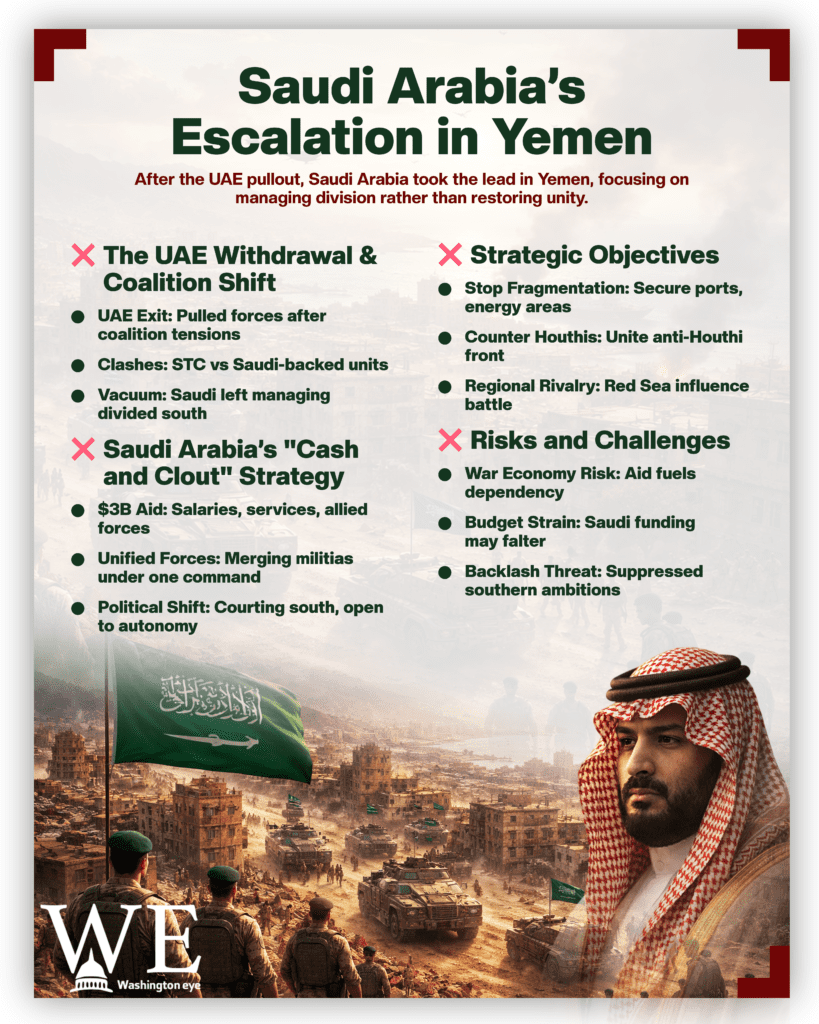
Whether Saudi Arabia’s expanded role becomes a bridge to settlement or a deeper entanglement will depend on three moving tracks: the durability of the truce with the Houthis; Riyadh’s ability to align southern forces without provoking backlash; and whether external funding translates into institutions rather than just payrolls. For now, the UAE pullout has made Saudi Arabia the central outside actor in Yemen, by choice, by circumstance, and by the vacuum left behind.