International film icon Jackie Chan has once again sparked global conversation after reiterating that he plans to leave his estimated $400 million fortune to charity, not to his children. The statement, which has resurfaced in recent news and interviews, reflects the Hong Kong–born superstar’s long-held belief in self-reliance, discipline, and social responsibility, values that have defined both his personal life and decades-long career in cinema.
The announcement traces back to Chan’s public comments over the years, particularly during interviews in China and Hong Kong, where he made it clear that his wealth would be donated to charitable causes after his lifetime. While the statement is not a sudden policy shift, its renewed circulation has reignited debate worldwide about inheritance, privilege, and philanthropy, especially when it comes from one of the most recognizable faces in global entertainment.
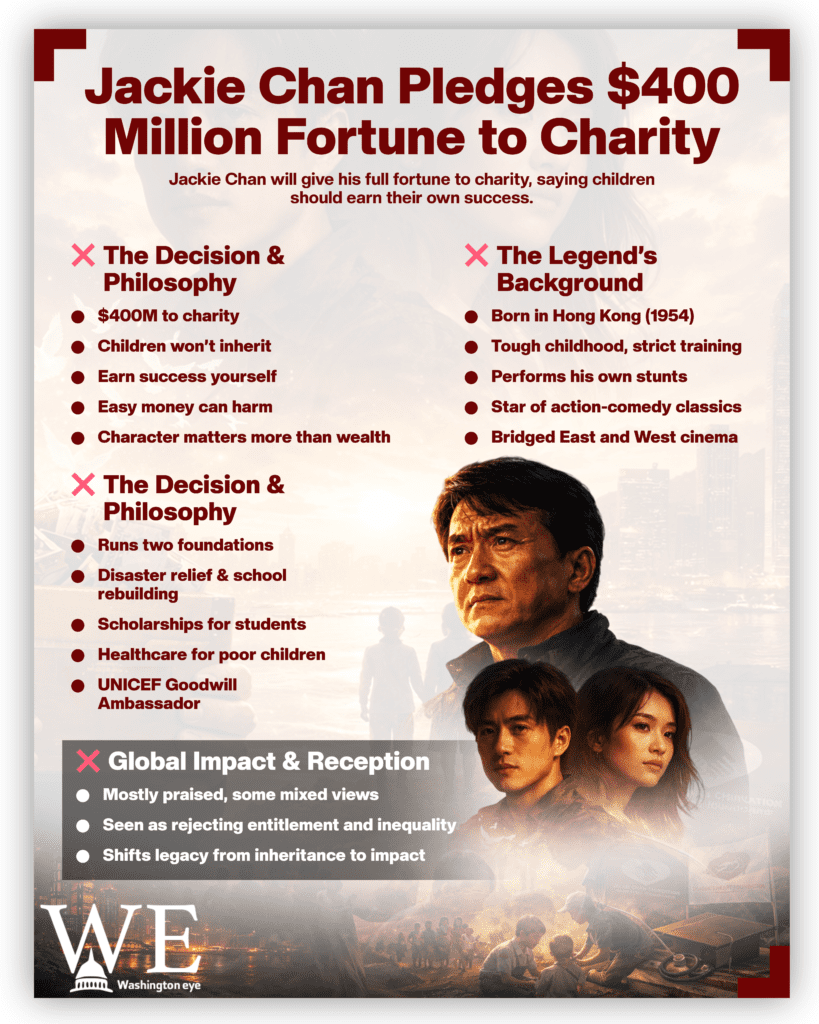
Jackie Chan, born Chan Kong-sang in Hong Kong in 1954, rose from a difficult childhood to become one of the most successful action stars in film history. Trained rigorously at the China Drama Academy, he endured years of physical hardship, which later shaped his work ethic and philosophy. Chan has often said that his upbringing taught him the value of hard work, something he believes cannot be passed down through money alone.

Speaking on the issue, Chan has been quoted as saying that if his son is capable, he can make his own money, and if not, inheriting wealth would only do him harm. This statement underscores Chan’s belief that wealth without effort breeds dependency rather than character. His decision applies to his family, including his son Jaycee Chan, an actor and singer, and his daughter Etta Ng, with whom his relationship has been distant. Despite public scrutiny of his personal life, Chan has remained firm that financial inheritance is not a substitute for responsibility or purpose.

The $400 million fortune, an estimate based on his earnings from films, endorsements, production ventures, and global brand partnerships, will instead go to charitable foundations and social causes. Chan has long been involved in philanthropy through the Jackie Chan Charitable Foundation and the Dragon’s Heart Foundation, which focus on disaster relief, education, healthcare, and support for underprivileged children across Asia and beyond. From rebuilding schools after earthquakes to funding scholarships, his charitable footprint already spans decades.
Jackie Chan’s fame extends far beyond box-office numbers. He is regarded as a cultural bridge between East and West, having successfully transitioned from Hong Kong cinema to Hollywood without losing his identity. Films such as Drunken Master, Police Story, Rush Hour, Rumble in the Bronx, Shanghai Noon, and The Karate Kid remake cemented his status as a global action-comedy legend. Known for performing his own stunts, often at great personal risk, Chan has suffered countless injuries, reinforcing his image as a hardworking, no-shortcuts performer.
Beyond cinema, Chan has also served as a UNICEF Goodwill Ambassador, using his fame to advocate for children’s rights, disaster victims, and social welfare. His charitable stance on inheritance aligns with a broader philosophy: success should benefit society, not merely family lineage. In an era where celebrity wealth is often passed down generationally, Chan’s decision stands out as a deliberate rejection of entitlement culture.

Public reaction to the renewed news has been mixed but largely respectful. Many have praised Chan for setting an example of accountability and generosity, calling his move inspirational in a world marked by rising inequality. Others have debated whether parents have an obligation to secure their children’s financial futures. Still, even critics acknowledge that Chan’s transparency has sparked an important conversation about wealth, values, and legacy.
As Jackie Chan continues to be celebrated not only as a martial-arts innovator but also as a humanitarian, his decision reinforces the idea that true legacy is not measured in money left behind, but in lives uplifted. Whether through cinema or charity, Chan’s influence remains global, and enduring.