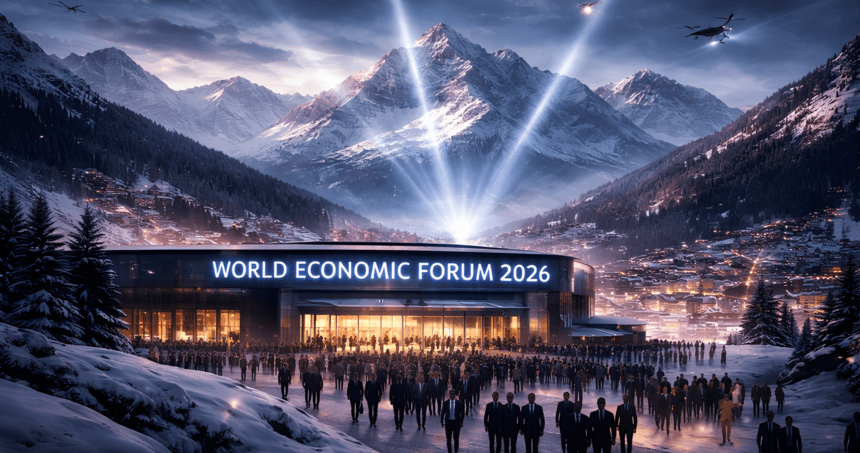
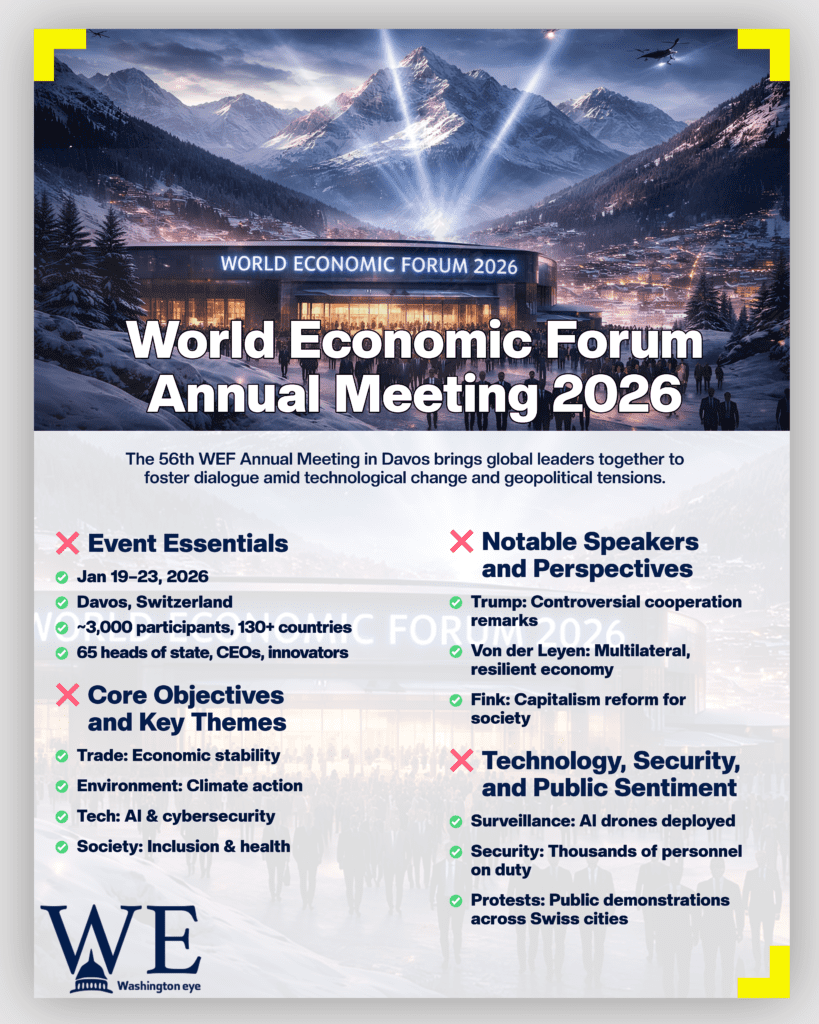
The 56th World Economic Forum (WEF) Annual Meeting opened on January 19, 2026, in the alpine resort town of Davos-Klosters, Switzerland, bringing together global political, business, and civil society leaders for five days of high-level discussions aimed at addressing the world’s most pressing challenges. The meeting, held under the theme “A Spirit of Dialogue,” runs through January 23 and is seen as a strategic platform for shaping international policy and cooperation amid rising geopolitical tensions and rapid technological transformation.
Davos has been the annual host of the World Economic Forum since its inception in 1971 by economist Klaus Schwab, originally as the European Management Symposium. Over more than five decades, the event has evolved into the premier convening of leaders from government, business, academia, international organizations and civil society, reflecting Switzerland’s tradition of neutrality and providing a secluded setting conducive to candid, forward-looking dialogue.
This year’s gathering expects nearly 3,000 participants from more than 130 countries, including around 65 heads of state and government, senior executives from major global corporations, influential thinkers, innovators, civil society activists and youth representatives focused on inclusive solutions for a rapidly changing world.

The central objective of the 2026 meeting is to foster constructive conversation and practical cooperation at a moment when global challenges are deeply interconnected, from geopolitical rivalry and economic uncertainty to climate change and the ethical frontier of artificial intelligence. Organizers say the WEF aims to “enable real dialogue, problem-solve around shared challenges and highlight innovations driving the future.”

Among the headline topics are global economic stability, technology and innovation, energy transition and climate action, trade and global value chains, and inclusive prosperity for communities left behind by rapid economic shifts. Beyond these, sessions explore AI governance, cybersecurity, health investment gaps, women’s empowerment, and geopolitical risks emerging in the Arctic and beyond.
Prominent leaders are already taking the stage. U.S. President Donald Trump delivered a high-profile address in Davos this week, underscoring his administration’s priorities and drawing attention for controversial remarks on international cooperation. Trump’s participation has sparked debate among attendees and observers, further emphasizing the blend of economic and geopolitical discourse at this year’s forum.
European leaders, including European Commission President Ursula von der Leyen and other heads of government and industry, are using the platform to advocate for strengthened multilateral ties and economic resilience. Sessions featuring CEOs of major global firms, such as BlackRock’s Larry Fink, emphasize the need for capitalism to evolve in ways that deliver broader societal benefits and address rising public distrust in traditional institutions.

Davos 2026 also highlights the profound influence of technology and artificial intelligence on global systems. With sessions like “AI at Scale” and discussions on AI’s ethical governance, leaders recognize both the opportunities and risks posed by rapid innovation. These debates occur against a backdrop where digital sovereignty, data infrastructure and workforce disruption by automation are top concerns for national economies.
Security and public sentiment around the forum have been notable this year. In preparation for the event, the town of Davos saw enhanced security measures, including AI drone surveillance and thousands of personnel to ensure the safety of visiting dignitaries. Meanwhile, protests in Swiss cities underscored polarized public views on global leadership, particularly in relation to U.S. participation and geopolitical statements made in the run-up to Davos.
The forum’s broader importance lies in its ability to catalyze action and partnerships that transcend national borders and sectors. Although critics contend that Davos has traditionally favored elite interests, organizers have worked to expand engagement through initiatives like the Open Forum, which invites broader audiences and civil society representatives into the discussion.
Historically, Davos has been a site of notable milestones, from economic policy coalitions and climate finance initiatives to global vaccine alliances, illustrating the forum’s long-standing role as both a think tank and an incubator of global policy frameworks. In 2026, as complex risks mount from economic fragmentation, climate urgency and geopolitical competition, the WEF Annual Meeting remains a focal point for multilateral problem-solving and consensus-building.
As the meeting progresses toward its conclusion, stakeholders will be watching closely for tangible commitments and partnerships that can translate dialogue into measurable outcomes, particularly in areas such as sustainable development, technology governance and international cooperation in an increasingly contested global landscape.