
In a high-stakes legal confrontation that has drawn international attention, Prince Harry, the Duke of Sussex, has returned to the United Kingdom to take on the publisher of the Daily Mail and Mail on Sunday in a landmark privacy trial at London’s High Court. The case, which began on Monday, 19 January 2026, pits the former senior royal against Associated Newspapers Limited (ANL), a major British media organisation, accusing it of decades-long unlawful information gathering that breached the privacy of him and other high-profile figures.
Prince Harry’s decision to be physically present at the Royal Courts of Justice for this trial marks a significant moment in what has become one of his most enduring battles with the British tabloid press. The case, expected to last nine weeks, is the latest in a series of legal actions he has initiated against UK media organisations, following previous lawsuits against Mirror Group Newspapers and a settlement with News Group Newspapers.
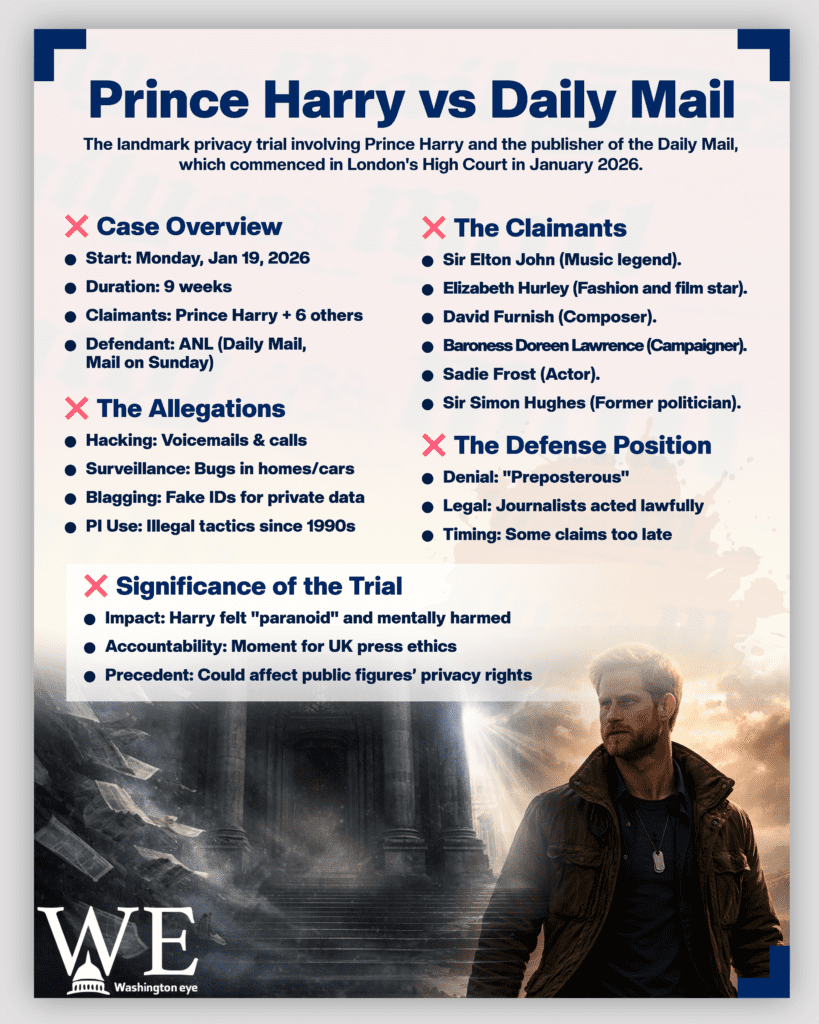
Harry is not alone in this legal fight. He is joined by six other well-known public figures, including music legend Sir Elton John, fashion and film star Elizabeth Hurley, actor Sadie Frost, campaigner Baroness Doreen Lawrence, composer David Furnish, and former politician Sir Simon Hughes. All claimants allege that stories about them published by ANL titles were based on information obtained unlawfully through tactics such as phone hacking, voicemail interception, eavesdropping on private conversations, deception and blagging (using false identities to trick third parties into handing over private data).
The origins of this lawsuit trace back to October 2022, when Prince Harry and his co-claimants lodged their action against ANL. They formally accused the publisher of engaging in systemic information gathering, some of it dating back to the early 1990s, that violated their right to privacy and personal dignity. ANL has steadfastly denied all allegations, calling the claims “preposterous” and arguing that its journalists obtained material through legitimate sources and lawful means.

Inside the courtroom, legal teams have begun laying out detailed accounts of how the alleged practices were carried out. Harry’s barrister has told the court that the publisher hired private investigators to intercept voice messages, place listening devices in vehicles and homes, and use impersonation to access confidential medical, financial and personal information. According to claimants’ lawyers, these actions were part of a “clear, systematic and sustained” pattern of misconduct at ANL titles.
On the first day of the trial, cameras captured Prince Harry arriving in a navy suit, flanked by his legal team and representatives of the other claimants. The duke’s presence at the High Court was widely seen as a testament to his determination to challenge what he describes as intrusive and psychologically damaging media behavior. Harry has publicly explained that repeated coverage by tabloids, including Daily Mail stories, made him “paranoid beyond belief,” and that the alleged invasions of privacy had a profound impact on his mental well-being and personal relationships.
For many observers, the trial represents not just a personal battle but a broader confrontation over press ethics and media accountability in the UK. Privacy lawsuits against newspaper publishers have a long and complex history in British law, particularly in the aftermath of the News of the World phone-hacking scandal. Harry and his legal team are attempting to extend this scrutiny to the Daily Mail’s parent company, which remains one of the most influential voices in British journalism.

ANL, for its part, responded to the trial’s opening by dismissing the allegations and signalling a vigorous defence. In court filings and public statements, the publisher has contended that many of the challenged articles were based on lawful reporting and that the claims against it are unfounded. It has also questioned the timing of the lawsuit, arguing that some allegations were brought too late, though judges have allowed the case to proceed.
As the trial unfolds, Prince Harry is scheduled to be one of the key witnesses, expected to give his testimony later this week. The outcome of this case could have significant implications for media practice in the UK and the legal rights of public figures to protect their private lives. It will also be a psychological and symbolic milestone for the duke, whose relationship with the British press and the royal institution has been strained for years.
In a world where media influence and privacy laws are increasingly scrutinised, Prince Harry vs Daily Mail has become a defining moment in the ongoing debate over how far a free press should be allowed to intrude into personal lives in the pursuit of news.