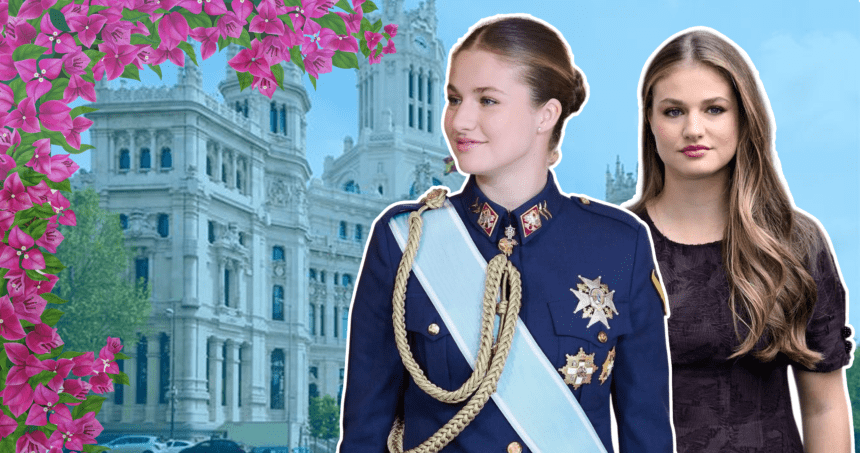
Spain’s Crown Princess Leonor, now 20, is increasingly at the centre of a national conversation about monarchy, identity and the country’s political divides, as she prepares for the day she will inherit the throne and become Spain’s first queen regnant in more than 150 years.
Leonor de Borbón y Ortiz, the eldest daughter of King Felipe VI and Queen Letizia, is the heir presumptive under Spain’s modern succession rules. Her eventual accession would make her the first woman to reign in her own right since Queen Isabella II, whose rule ended in 1868 after she was deposed and later lived in exile.
The headlines around the princess’ “future queen” status come as she moves through a carefully choreographed path of constitutional milestones and state training designed to present continuity in a parliamentary monarchy that has existed, intermittently, through periods of dictatorship, republicanism and restoration. Spain’s monarchy was restored in 1975, following the end of Francisco Franco’s dictatorship, and Juan Carlos I later abdicated in 2014, handing the crown to Felipe VI.

A key public turning point for Leonor came on her 18th birthday, when she swore allegiance to Spain’s constitution in parliament in a nationally televised ceremony filled with pageantry. At the time, the event underscored both the institution’s staying power and its political sensitivity: some republican politicians and certain nationalist representatives boycotted the ceremony, reflecting long-running tensions over the monarchy’s role in modern Spain and the country’s territorial debates.

Since then, the palace has leaned into a narrative of preparation and service. Leonor studied for an International Baccalaureate in Wales before beginning a three-year military training programme, an expectation for Spain’s heir, who will one day serve as commander-in-chief of the armed forces. She started her training at the General Military Academy in Zaragoza in August 2023, a move closely followed by Spanish media and framed as a rite of passage rather than royal privilege.
Her itinerary has been designed to signal national unity across institutions: army training followed by naval instruction, then air-force education. Spanish and international reports have highlighted her progression through different branches and locations, portraying a young heir learning discipline, protocol and the symbolic weight of a crown that no longer governs but still represents the state.
Leonor’s personal profile also matters to how the institution is perceived. Felipe VI married Letizia, once a journalist and news anchor, in 2004, a modernising match that helped reshape the public image of the monarchy. Their elder daughter’s rise has been cast by some commentators as another generational reset, especially after reputational damage linked to past royal scandals and broader European debates about the relevance of monarchies in the 21st century.

For supporters, Leonor embodies stability: a constitutional monarch-in-waiting who can serve as a non-partisan symbol above political conflict. For critics, her prominence revives questions about hereditary power in a democracy and whether Spain should eventually revisit the model of head of state. Those arguments are unlikely to fade, especially in a country where debates over national identity, regional autonomy and the memory of past upheavals remain politically potent.
Historically, the “150-year” framing points to Isabella II’s deposition in 1868 and the long interval in which Spain had kings, brief republican periods, and a dictatorship, but no reigning queen in her own right. Leonor’s eventual accession would therefore be both a personal milestone and a symbolic one, closing a historical loop while opening a new chapter for the Bourbon monarchy in a society that is younger, more plural and far more openly divided about the institution than in previous generations.
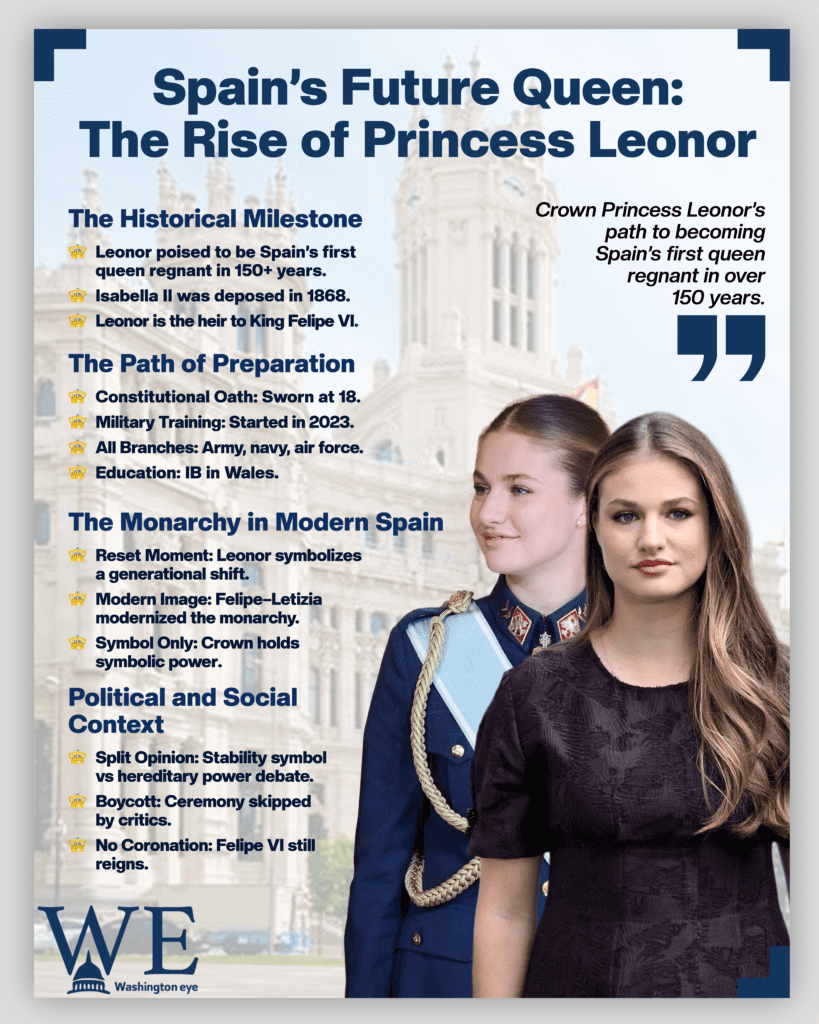
For now, there is no coronation date. Felipe VI remains on the throne, and Leonor’s role is preparatory, built around constitutional duty, military formation, and carefully staged public appearances. But as she enters her twenties, Spain’s future queen is no longer a distant figure in waiting; she is a living political and cultural symbol, watched closely by supporters who want a steady crown and skeptics who want a different kind of state.