History is vast, layered, and often overwhelming, stretching far beyond any single nation or era. Yet, when viewed through key turning points, moments where human decisions altered the course of societies, it becomes possible to glimpse how the modern world was formed. From the earliest written records to the upheavals of the twentieth century, history is less a straight line and more a series of decisive breaks that reshaped power, ideas, and human life.
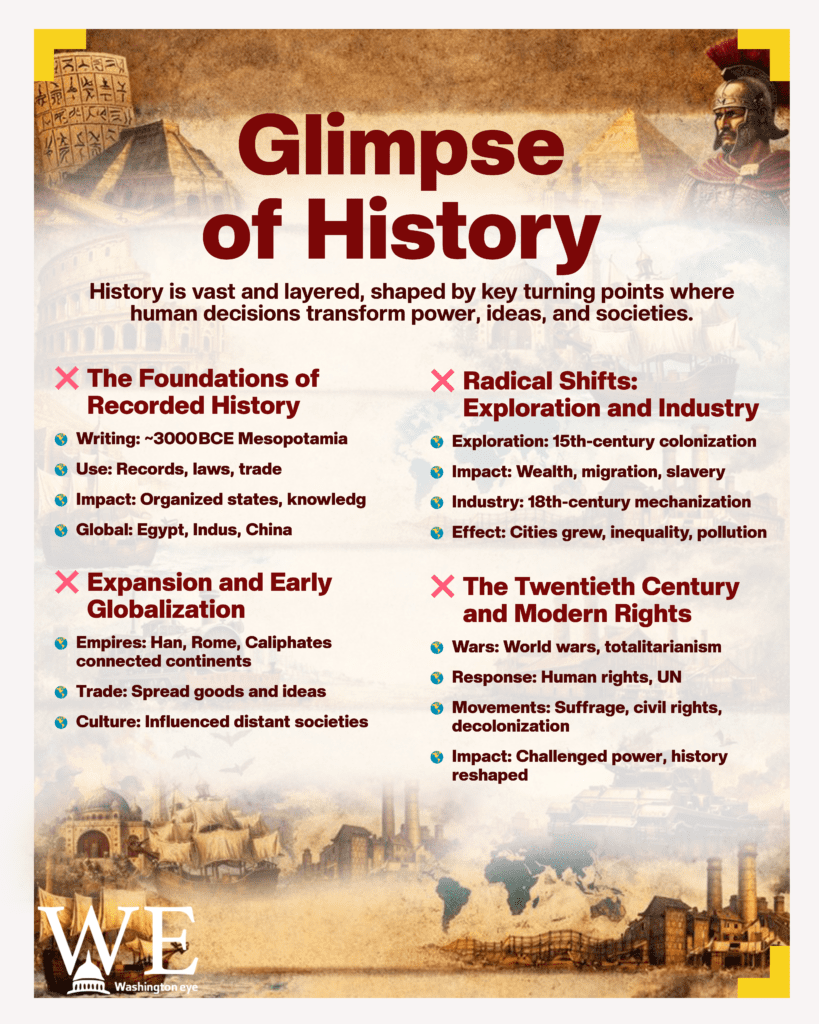
The earliest recorded history begins with writing itself, around 3000 BCE in Mesopotamia, where clay tablets captured laws, trade, and governance. Writing transformed memory into record, allowing civilizations to organize states, enforce authority, and transmit knowledge across generations. Similar developments appeared independently in ancient Egypt, the Indus Valley, and China, marking the shift from prehistory to structured human society.
As empires expanded, history became global in consequence. The rise and fall of powers such as the Roman Empire, the Han Dynasty, and later the Islamic Caliphates connected continents through trade, conquest, and ideas. Roads, sea routes, and knowledge networks carried goods and beliefs, from mathematics and medicine to religion, binding distant regions into early forms of globalization. These exchanges shaped cultures far beyond their places of origin.

A major rupture came with the European Age of Exploration from the 15th century onward. What began as maritime curiosity evolved into colonization, redrawing maps and hierarchies. The encounter between Europe, Africa, Asia, and the Americas triggered unprecedented movement of people, wealth, and violence. Colonial rule and the transatlantic slave trade left deep political and social scars that still influence global inequalities today.

The Industrial Revolution marked another decisive shift. Beginning in Britain in the late 18th century and spreading worldwide, it replaced agrarian life with mechanized production. Cities expanded, labor systems changed, and technology accelerated time itself. While industrialization brought progress and wealth to some, it also produced exploitation, class divisions, and environmental damage, tensions that continue into the present.
The twentieth century stands as one of history’s most intense chapters. Two World Wars, the Holocaust, and the rise of totalitarian ideologies, most notably Nazism under Adolf Hitler, demonstrated how modern technology combined with extremist ideas could lead to mass destruction. These events forced the world to confront questions of human rights, responsibility, and collective memory, leading to institutions like the United Nations and international laws aimed at preventing future atrocities.
Beyond wars and revolutions, history is equally shaped by quieter forces, social movements, cultural shifts, and the resistance of ordinary people. The struggle for civil rights, women’s suffrage, decolonization, and freedom of expression showed that history does not move only through rulers and armies, but also through collective voices demanding change. These movements challenged long-standing power structures and redefined who gets to be seen, heard, and remembered in historical narratives.

Seen from one perspective, history is a record of power, who held it, who lost it, and who paid the price. Yet it is also a record of learning. Each catastrophe reshaped global consciousness, pushing societies to redefine justice, borders, and human dignity. A glimpse of history, therefore, is not about memorizing dates, but about understanding how past choices echo into the present.