
In a move tech users have long awaited, Google has quietly begun allowing Gmail users to change their @gmail.com email address without losing their existing account, data, or connected services, a dramatic shift from the company’s decades-old policy that treated email usernames as permanent. The new capability, spotted this week in updated Google support documentation and rolling out gradually in select regions, marks one of the biggest changes to Gmail since its launch in 2004.
For years, Gmail users who regretted their original email, whether it was a whimsical teenage handle or an outdated professional address, faced two unsatisfactory choices: continue using the old address forever, or create a completely new account and painstakingly migrate emails, contacts, photos, Drive files, subscriptions, and login credentials linked across Google services. That challenge made the email address itself a digital tattoo, lasting long beyond its relevance.
Now, that permanence is beginning to fade. According to official Google support pages that have been updated in multiple languages and markets, users may soon see an option in their Google Account settings to edit their “email address that ends in @gmail.com.” If available for a user’s account, clicking the edit icon will let them choose a new Gmail username and apply it without creating a separate account.

Importantly, the feature isn’t yet globally available to all users at once. Google has said the rollout will be gradual, meaning some account holders will see the option immediately while others will not yet have access. Early indications suggest that the feature is first appearing in markets like India, where a Hindi-language support page detailing the process was spotted before wider documentation.

The mechanics of the update aim to balance convenience with continuity. When a user changes their Gmail address, their original email automatically becomes a permanent alias linked to the same Google account. Emails sent to either the old or new address arrive in the same inbox, and both can be used for signing into Gmail, Google Drive, YouTube, Maps, and other Google services. Account contents, including past emails, photos, contacts, calendars, and cloud files, remain untouched and accessible after the change.
Google has also set sensible limitations to prevent abuse and confusion: accounts can only make this change once every 12 months, and users are capped at a total of three address updates across the lifetime of the account (meaning up to four different Gmail addresses over time). Additionally, after a change, users cannot delete the new address or create brand-new Gmail accounts with the old address for at least a year.
Tech communities have greeted the news with widespread enthusiasm, noting that the feature solves a real and longstanding pain point. Many users grew up with Gmail addresses they no longer feel represent them, whether tied to outdated nicknames, early internet persona quirks, or life changes like marriage and career shifts, and have spent years wishing for a way to “reset” their inbox identity without disruption.

Security experts, however, urge caution alongside excitement. Because changing email addresses can be exploited by bad actors if not properly safeguarded, some cybersecurity commentators have warned of emerging phishing risks and emphasized the importance of verifying alerts directly through official Gmail settings rather than third-party communications.
Meanwhile, early adopters and tech influencers have taken to social platforms to share their reactions. Many have posted screenshots showing the new “edit email” pencil icon within their Google Account dashboards, while others have celebrated the feature as long-overdue, particularly for professionals who might otherwise need to disassociate from an unprofessional or awkward email handle in resumes, portfolios, and client communications.
Consumer advocates see this update as part of a broader shift in how digital identity is managed online. Email addresses are no longer just functional tools for communication; they are integral parts of users’ professional identities, social media footprints, and digital footprints across the internet. Giving users flexibility to update that identity within a single account framework, experts say, represents a meaningful step in modernizing legacy internet services.
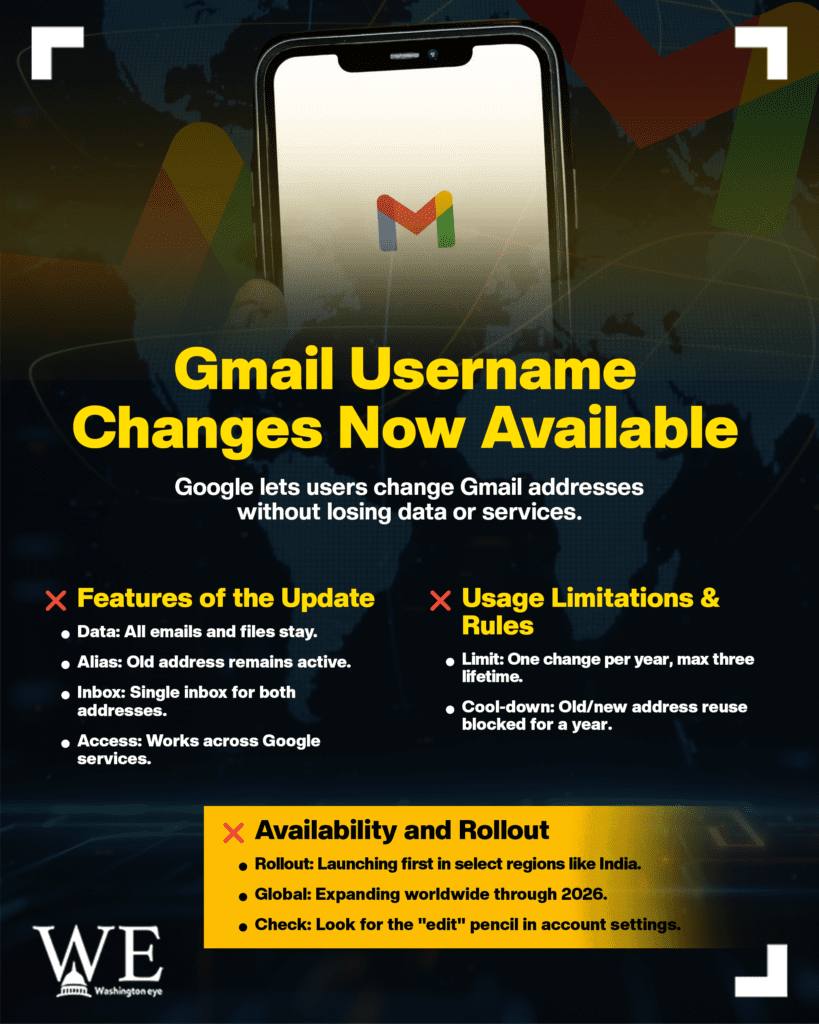
While Gmail’s announcement has been low-key (there’s no major press conference or fanfare), the implications are significant. For the vast global user base, billions strong, the ability to change an email address without data loss could reshape how people think about long-term digital identities. As the rollout continues into 2026, Google plans to extend the feature to more users worldwide and refine the experience based on early usage and feedback.