

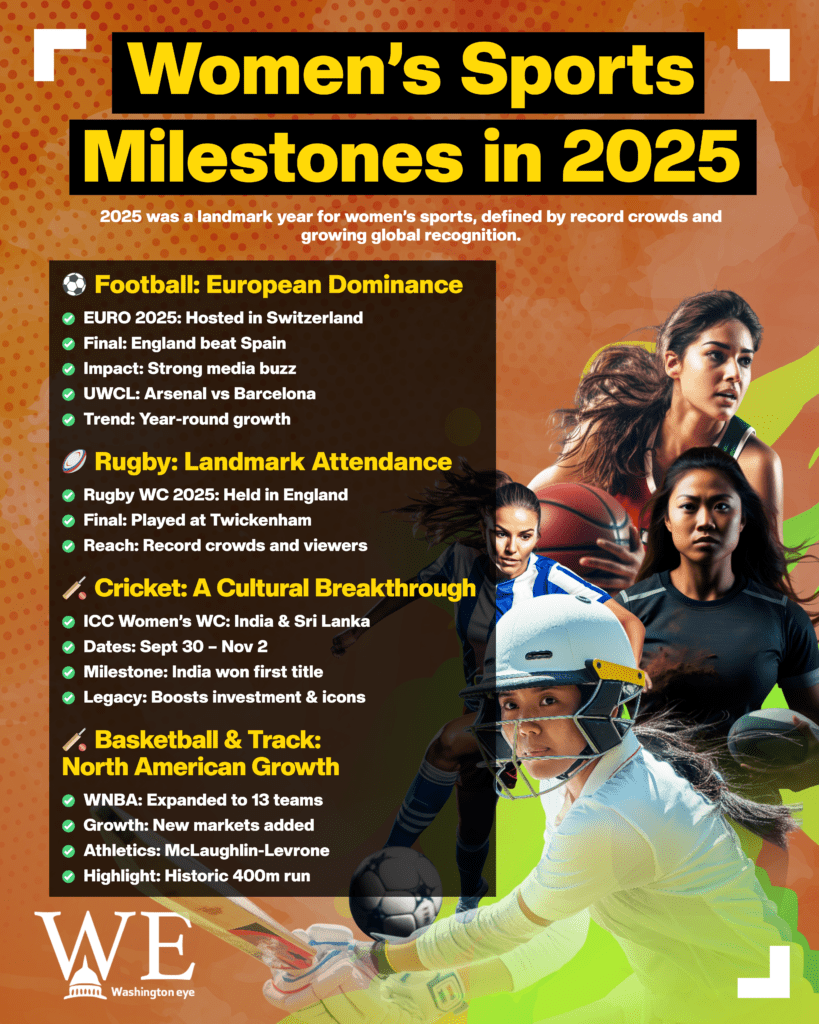
Women’s sport in 2025 didn’t hinge on one defining moment, it arrived in waves, across continents and competitions, as packed stadiums, prime-time broadcasts and long-awaited titles reset expectations for what women’s leagues and tournaments can draw, earn and inspire. From Switzerland’s summer of football to England’s rugby showpiece, and from India’s home-soil cricket triumph to the WNBA’s continued expansion, the year became a marker of mainstream momentum, not just progress.
The year’s most visible European stage was UEFA Women’s EURO 2025 in Switzerland, played from 2–27 July across eight host cities, culminating in a final in Basel. England defended their continental crown, edging Spain on penalties after a 1–1 draw, a result that underlined both the competitive depth in Europe and the tournament’s status as a major sporting event rather than a niche festival. For Switzerland, hosting meant more than tourism and sell-out nights: it offered a template for how compact, multi-city women’s tournaments can deliver week-after-week spectacle and sustained media attention.
Club football delivered its own headline in late spring. The UEFA Women’s Champions League final on 24 May in Lisbon put Arsenal on the sport’s biggest club stage against holders Barcelona, another signal that women’s club football is no longer dominated by one predictable storyline. The match was framed by UEFA as a marquee event, reflecting how the women’s game is increasingly marketed with the same “must-watch” language and occasion-building once reserved for men’s finals.

In England, the Women’s Rugby World Cup became a landmark for scale. The tournament ran 22 August–27 September and set new benchmarks for live audiences, building to a final at Twickenham watched by tens of thousands in person and millions on TV. World Rugby’s event hub and year-end reporting from major outlets captured the tone: women’s rugby wasn’t just growing, it was proving it could fill the country’s most iconic venues and convert “event crowds” into repeat fans.

Cricket delivered one of the year’s most culturally resonant breakthroughs. The ICC Women’s Cricket World Cup, staged in India and Sri Lanka from 30 September to 2 November, ended with India winning their first Women’s World Cup title, a milestone with ripple effects far beyond a trophy lift. In a country where cricket shapes celebrity, sponsorship and youth dreams, a home World Cup win can rapidly accelerate participation, investment and mainstream coverage for women players, shifting them from “successful athletes” to national sporting icons.
In North America, women’s basketball kept widening its footprint. The WNBA grew to 13 teams and the league’s expansion narrative continued, both through new markets and through the emergence of additional women’s basketball products that aim to complement, not compete with, the WNBA calendar. Reuters’ year-end snapshot also pointed to a broader ecosystem forming: new leagues and formats launching, more media-rights ambition, and investment flowing into women’s sport as a category rather than a one-off campaign.
Individual performances also fed the year’s sense of “historic normal.” In track, Sydney McLaughlin-Levrone’s 400m headline time, described by Reuters as the fastest in four decades, fit the pattern: women’s sport in 2025 was not short on greatness; it was getting better at putting greatness in front of the biggest possible audience. And in football, the player market and star rankings continued to tilt global attention toward the women’s game as a year-round product, not just a tournament spike.

Taken together, 2025’s milestones share a common theme: women’s sport is increasingly being treated like sport, full stop. Bigger crowds help justify bigger venues; bigger venues create bigger broadcasts; bigger broadcasts attract bigger sponsorships; and the cycle strengthens everything from grassroots participation to professional pathways. The year didn’t “arrive” in women’s sport; it made it harder to argue it hasn’t already arrived.