
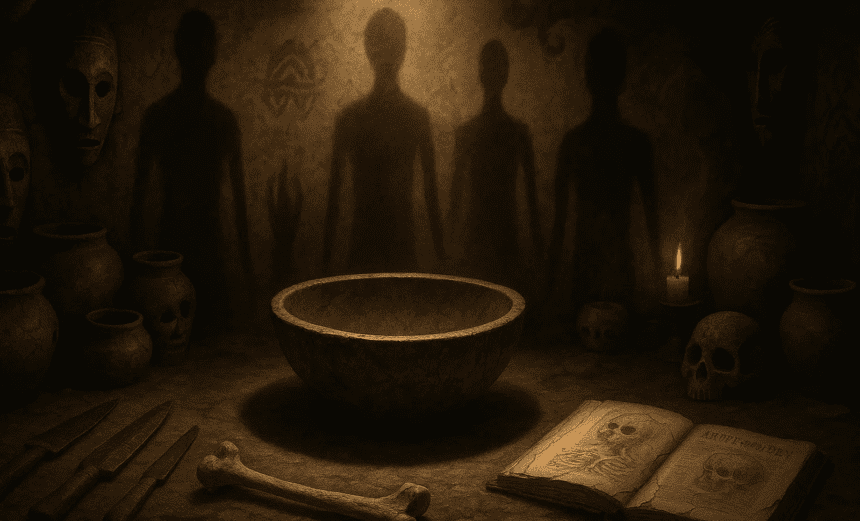
“Cannibalism, the act of humans consuming the flesh of other humans.”
It remains one of the most disturbing and taboo practices throughout history. Archaeological discoveries in Paleolithic Europe, particularly in Spain and France, show cut marks on human bones indicating ritualistic or nutritional cannibalism tens of thousands of years ago. Similar evidence appears in early Neanderthal communities, while historic civilizations such as the Aztecs and various tribes across Oceania, Africa, and South America practiced cannibalism for spiritual, social, or warfare-related reasons.
Among these practices, anthropologists distinguish between endocannibalism, in which communities consumed their own dead as a funerary honor, and exocannibalism, where enemies were eaten to symbolize power, protection, humiliation, or the absorption of strength. The Fore people of Papua New Guinea famously practiced endocannibalism until the mid-20th century, inadvertently spreading the fatal prion disease Kuru and drawing global scientific attention. In Fiji, once known as the “Cannibal Isles”, 19th-century leaders reportedly consumed enemies to assert dominance, while certain Amazonian and Central African groups historically incorporated cannibalism into war rituals or spiritual rites.

Although these customs were once embedded in cultural systems rather than pure acts of cruelty, they gradually disappeared through the 19th and 20th centuries due to government regulation, missionary influence, changing beliefs, and health risks. By the late 20th century, only a handful of extremely remote groups were still reported to practice cannibalism, but experts emphasize that such claims were often exaggerated or misinterpreted by colonial writers.
Today, no tribe is publicly verified to practice cannibalism in the 2020s. UNICEF, the UN, and international health agencies strictly condemn any form of cannibalistic violence, especially in fragile regions where vulnerable communities or children could be exploited. Modern anthropology also warns that accusations of cannibalism have historically been weaponized to justify colonial rule, making factual verification essential.
In contemporary times, cannibalism reappears primarily in extreme survival situations or isolated criminal cases rather than cultural ritual. Historical survival incidents include the Donner Party in 1846, several 18th–20th 20th-century shipwrecks, and the 1972 Andes plane crash, events where starvation forced people into desperate decisions. In modern criminal contexts, cases have emerged in Europe, Russia, Japan, South Asia, and North America. Germany’s infamous “Rotenburg Cannibal,” Armin Meiwes, murdered and consumed a consenting victim in 2001, resulting in a life sentence. In 1981, Japanese student Issei Sagawa killed and cannibalized a classmate in Paris and later avoided long-term imprisonment due to legal loopholes. Russia has also documented multiple cases linked to psychological disorders or violent motives. These cases, though shocking, involve individuals, not communities, and remain extremely rare.
The health consequences of consuming human flesh are severe and well-documented. Cannibalism can transmit viral, bacterial, and especially prion diseases that have no cure and can devastate entire populations. Kuru, transmitted through ingesting infected human tissue, remains one of the clearest examples of how cultural practices can trigger deadly epidemics. Such risks, alongside ethical and legal concerns, form the basis for global bans. Although some countries do not explicitly outlaw cannibalism itself, all related acts, murder, body desecration, and mutilation are punishable under criminal and international humanitarian law.
Psychologically and socially, the impact of cannibalism is profound. Survivors of conflicts, captivity, or survival emergencies often describe lifelong trauma, while communities historically associated with such practices experience stigma, cultural distortion, and intergenerational fear. The horror surrounding cannibalism continues to influence global imagination from ancient literature to modern films, reflecting deep human anxieties about survival, morality, and the boundaries of civilization.

While cannibalism as a cultural tradition has virtually vanished, its legacy persists as a chilling reminder of how societies behave under extreme spiritual, environmental, or psychological pressure. Rare criminal cases, lingering colonial myths, and ongoing academic debates keep the topic alive in public discourse. In the modern world, supported by international law and humanitarian protections, cannibalism stands as one of humanity’s strongest taboos, an act universally condemned, medically dangerous, and historically revealing of the darkest and most complex corners of human behavior.