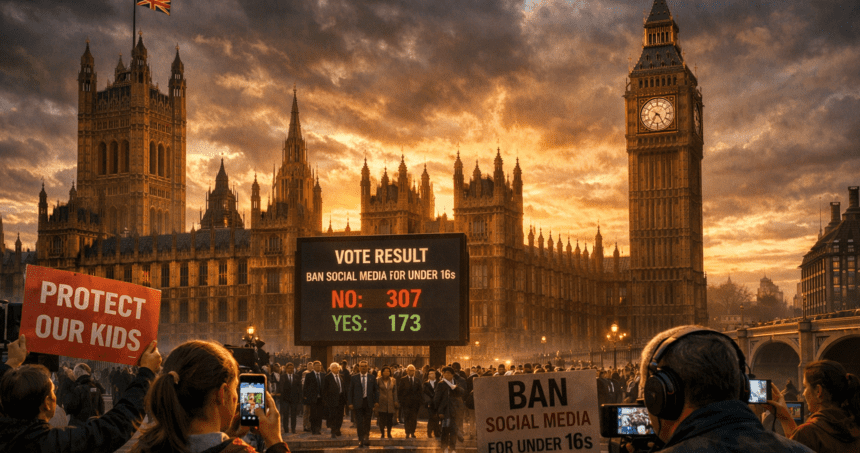
In a closely watched debate on youth online safety, Members of Parliament (MPs) in the United Kingdom have voted against a proposal to ban children under the age of 16 from accessing social media platforms. The vote took place on March 9, 2026, in the House of Commons in London, where lawmakers rejected the proposed measure by 307 votes to 173. The amendment had been introduced as part of the Children’s Wellbeing and Schools Bill, a broader piece of legislation aimed at improving child protection and education policy in the country.
The proposal had earlier gained traction after it was supported by some members of the House of Lords, the upper chamber of the UK Parliament. Advocates argued that a strict age limit could help protect children from harmful online content, cyberbullying, addictive algorithms, and exploitation. Supporters also pointed to international examples, such as Australia’s recent law banning social media use for under-16s, as proof that governments can intervene to protect minors in the digital age.
However, when the amendment reached the House of Commons for final consideration, many MPs expressed concerns about implementing a complete ban. Government ministers and several lawmakers argued that a blanket prohibition might be difficult to enforce and could have unintended consequences. Critics warned that blocking young people from mainstream platforms might simply push them toward less regulated or hidden areas of the internet, potentially increasing rather than reducing risks.
During the debate, Education Minister Olivia Bailey told Parliament that although parents and campaign groups have raised serious concerns about children’s safety online, policymakers must consider both the risks and benefits of social media. She explained that the government has launched a public consultation process to examine potential age restrictions, safety rules, and technological safeguards before imposing sweeping regulations. According to ministers, a measured approach could ensure that new laws are effective and enforceable.

Despite rejecting the outright ban, lawmakers approved alternative provisions that would give government officials broader powers to regulate online platforms used by minors. Under the updated bill, ministers could impose targeted restrictions on certain features of social media, including addictive algorithms, autoplay functions, and messaging systems that could expose young users to harmful interactions. Authorities may also gain the ability to restrict minors’ use of Virtual Private Networks (VPNs) if they are used to bypass safety measures.
Supporters of the ban expressed disappointment with the outcome of the vote. Some opposition politicians and campaigners argued that the government is moving too slowly while children continue to face risks online. Conservative Shadow Education Secretary Laura Trott warned that many teenagers are already exposed to explicit or violent content through social media algorithms, sometimes without actively searching for it. She urged lawmakers to take stronger legislative action rather than relying on consultations or voluntary platform policies.
At the same time, several charities and child-protection groups were divided on the issue. While some organizations welcomed stronger action against harmful digital content, others said a strict ban could create new problems. The National Society for the Prevention of Cruelty to Children (NSPCC) cautioned that banning social media outright might drive teenagers toward unregulated digital spaces, making monitoring and protection more difficult.

Public opinion on the issue also remains mixed. Many parents have voiced growing concerns about the impact of social media on children’s mental health, attention spans, and safety online. High-profile campaigners and public figures have called for tougher regulations, arguing that platforms such as TikTok, Instagram, and Snapchat can expose young users to harmful material. However, critics argue that social media also plays a role in education, creativity, and communication, especially for teenagers growing up in an increasingly digital world.
The Children’s Wellbeing and Schools Bill will now continue its journey through Parliament, returning to the House of Lords for further scrutiny. Lawmakers say that while a blanket ban has been rejected for now, stronger rules for protecting children online are likely to remain a priority in future legislation. The government’s ongoing consultation could eventually lead to new policies that balance online safety with young people’s digital rights and freedoms.

As the debate continues, the UK joins a growing list of countries grappling with how to regulate social media use among minors. Governments worldwide are increasingly exploring age limits, verification systems, and stricter platform responsibilities as part of broader efforts to create a safer digital environment for children and teenagers.