
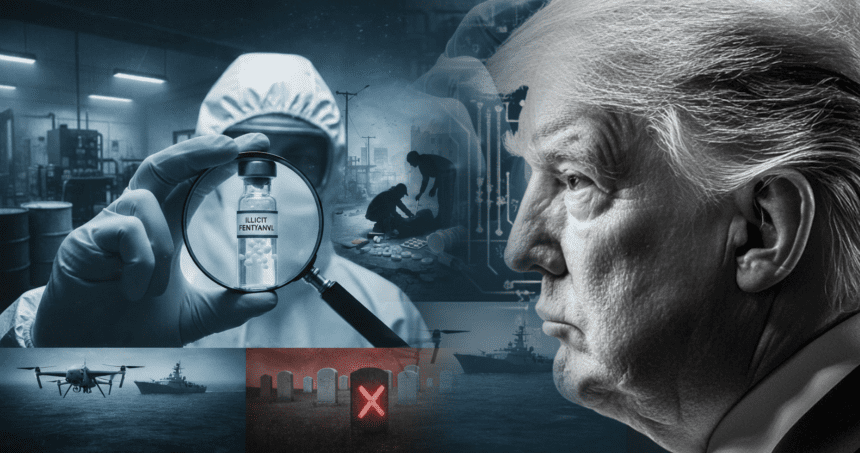
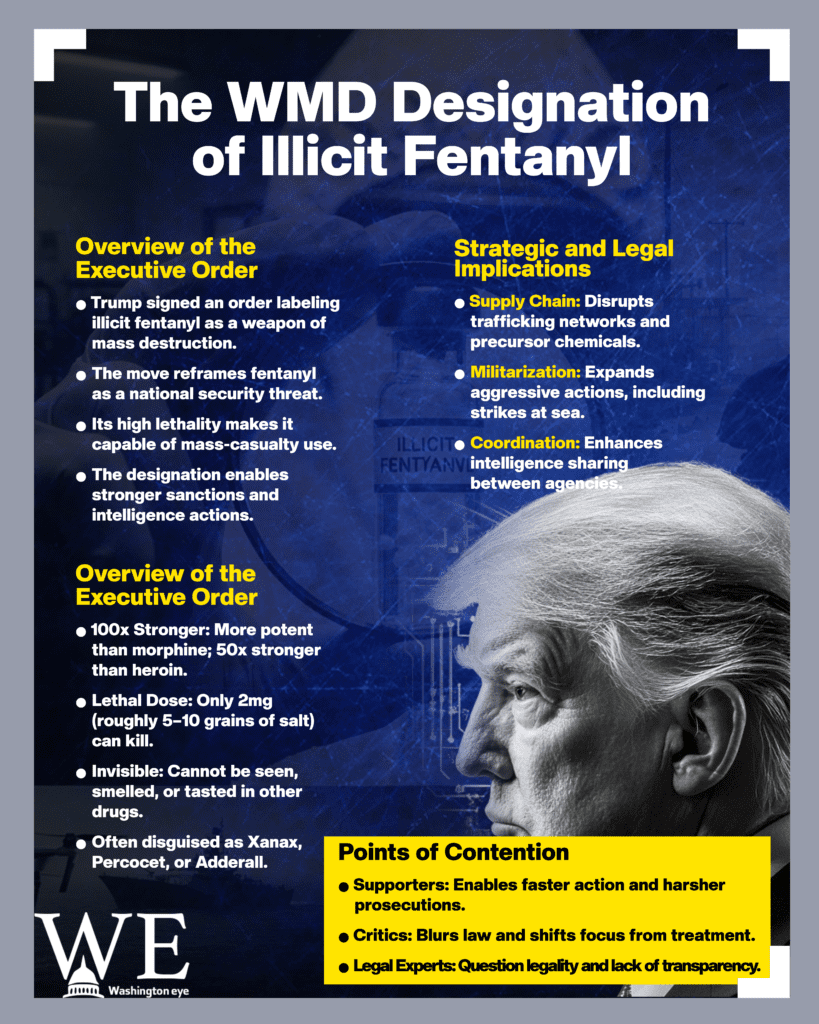
President Donald Trump on Monday, December 15, signed an executive order at the White House designating illicit fentanyl, and a “core precursor chemical” used to make it, as a “weapon of mass destruction” (WMD), a label traditionally associated with nuclear, chemical, and biological threats. The move is framed by the administration as a national-security escalation in the fight against opioid overdose deaths and transnational trafficking networks, and it signals a willingness to bring counter-WMD tools and agencies into what has long been treated primarily as a public-health and law-enforcement crisis.
At the signing, Trump portrayed fentanyl not just as a drug but as a mass-casualty threat that can be “weaponized” in concentrated attacks, arguing that its lethality makes it comparable to chemical agents. The executive order directs federal departments to treat the illicit supply chain, especially trafficking and precursor flows, as an urgent threat requiring stronger disruption, and it arrives amid a broader, more militarized anti-smuggling posture that has included U.S. strikes on suspected trafficking vessels in international waters, drawing sharp questions from legal experts and human-rights advocates.
Fentanyl’s danger lies in both its chemistry and its market. It is a synthetic opioid, made in laboratories, that was originally developed for legitimate medical use as a powerful pain medication and anesthetic. In clinical settings, pharmaceutical fentanyl can be prescribed for severe pain, including advanced cancer pain. But illicitly manufactured fentanyl has become a major driver of overdose deaths because it is potent, cheap to produce, and easy to mix into or press into counterfeit pills.
Health experts warn that even tiny quantities can kill. The U.S. National Institute on Drug Abuse notes fentanyl is 50 to 100 times more potent than morphine, and that as little as 2 milligrams, a few grains of salt, can be fatal, especially when someone consumes it unknowingly in a counterfeit pill or contaminated drug supply. Overdose typically involves slowed or stopped breathing, which can happen rapidly and without time for bystanders to react, making naloxone access and quick emergency response critical.
The fentanyl supply chain that alarms Washington is also international. U.S. officials have long argued that precursor chemicals are produced abroad, routed through complex shipping and financial networks, and then used by criminal groups to manufacture fentanyl for export. The new WMD designation is intended to give the administration added “ammunition” in policy terms, more diplomatic pressure, tougher sanctions and prosecutions, and potentially broader intelligence support, by framing fentanyl and its precursors as strategic threats rather than conventional contraband.
Supporters of the order say the label reflects the scale of loss and could unlock faster coordination across agencies that don’t always share information smoothly. The White House fact sheet casts illicit fentanyl as akin to a chemical weapon and argues the U.S. must respond with urgency to disrupt the chemicals, labs, and trafficking routes feeding the crisis. Some allies also point to parallel efforts in Congress that have sought to treat illicit fentanyl as a WMD threat within homeland-security structures.
Critics, however, warn that redefining a drug as a WMD risks blurring legal boundaries and shifting resources away from evidence-based treatment and harm reduction. They also argue the WMD frame can normalize extraordinary measures, especially cross-border or military approaches, that may face domestic and international legal challenges. Reuters reported that legal experts have questioned the legality of aspects of the administration’s broader anti-trafficking campaign, particularly where force is used with limited public disclosure of evidence.

Whether the WMD designation produces measurable results may depend on the details that follow: how agencies operationalize the order, whether it changes prosecutions and interdictions, and whether parallel investments expand treatment, prevention, and public education. Public-health authorities emphasize that fentanyl risk is amplified by counterfeit pills and mixed drug supplies, meaning interventions that help people detect fentanyl and access lifesaving care can matter as much as interdiction at borders and sea lanes.