
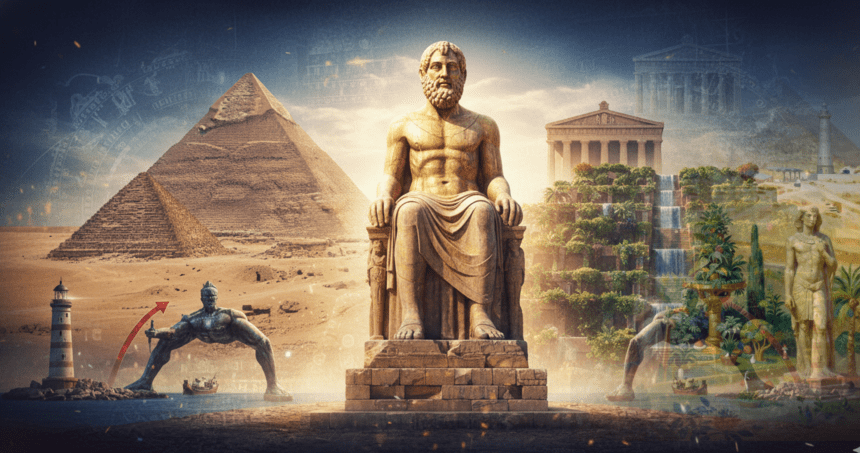
The idea of the “Wonders of the World” has fascinated humanity for more than two millennia, representing extraordinary achievements of nature and human civilization. First recorded in ancient Greek writings, the concept was initially meant to catalogue the most remarkable sights known to travelers of the classical world. Over time, the list has evolved, reflecting changes in geography, knowledge, and global consciousness. Today, the Wonders of the World are not just monuments or landscapes; they are symbols of shared human heritage, cultural pride, and historical continuity.
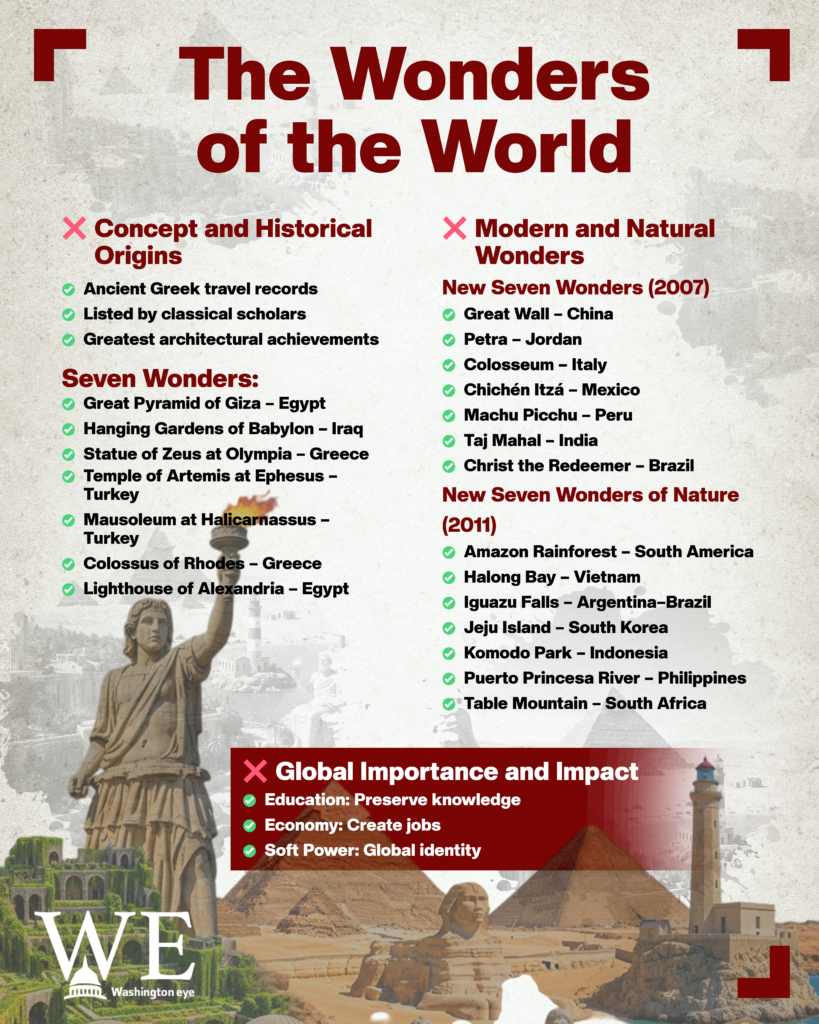
The earliest known reference to the Wonders dates back to the 3rd century BCE. Greek historians and travelers such as Antipater of Sidon and Philo of Byzantium described what became known as the Seven Wonders of the Ancient World. These included the Great Pyramid of Giza (Egypt), the Hanging Gardens of Babylon (modern-day Iraq), the Statue of Zeus at Olympia (Greece), the Temple of Artemis at Ephesus (Turkey), the Mausoleum at Halicarnassus (Turkey), the Colossus of Rhodes (Greece), and the Lighthouse of Alexandria (Egypt). These structures were celebrated because they represented the pinnacle of architecture, art, and engineering of their time.
Of the ancient wonders, only the Great Pyramid of Giza, built around 2560 BCE during the reign of Pharaoh Khufu, still stands today. Constructed as a royal tomb, it reflects advanced knowledge of mathematics, astronomy, and large-scale labor organization. The remaining six wonders were destroyed over centuries due to earthquakes, fires, or human conflict, highlighting the fragility of even the greatest human creations.

As global exploration expanded, the ancient list was increasingly seen as Eurocentric and outdated. In response, the New 7 Wonders Foundation, founded by Swiss-Canadian filmmaker Bernard Weber, launched a global initiative in 2001 to identify a new list of wonders through worldwide voting. In 2007, millions of people across continents participated, making it one of the largest global polls in history. The result was the announcement of the New Seven Wonders of the World, reflecting a more inclusive and modern perspective.

The New Seven Wonders include the Great Wall of China, built over centuries to defend against invasions; Petrain Jordan, a rock-cut city carved by the Nabataeans; Christ the Redeemer in Brazil, symbolizing peace and faith; Machu Picchu in Peru, the Incan citadel hidden in the Andes; Chichén Itzáin Mexico, a major Mayan city known for its astronomical precision; the Colosseum in Italy, an icon of Roman engineering and public life; and the Taj Mahal in India, a white marble mausoleum built by Emperor Shah Jahan in memory of his wife Mumtaz Mahal. These wonders were chosen for their architectural brilliance, historical depth, and enduring cultural significance.
Beyond human-made structures, the world has also recognized the power of nature itself. In 2011, the New Seven Wonders of Nature were announced, featuring natural phenomena such as the Amazon Rainforest and River (South America), Halong Bay (Vietnam), Iguazu Falls (Argentina–Brazil), Jeju Island (South Korea), Komodo National Park (Indonesia), the Puerto Princesa Underground River (Philippines), and Table Mountain (South Africa). These sites underscore the planet’s ecological richness and the urgent need for environmental protection.
The importance of the Wonders of the World extends far beyond tourism. They serve as educational tools, reminding societies of ancient knowledge systems, cultural exchange, and the human desire to create meaning through art, architecture, and storytelling. Economically, they generate millions of jobs through tourism and conservation. Politically and socially, they act as soft-power assets, shaping national identity and international recognition.

In a time of rapid urbanization, climate change, and conflict, the Wonders of the World stand as reminders of what humanity can achieve and what it risks losing. Whether carved in stone by ancient hands or shaped by nature over millions of years, these wonders continue to inspire awe, curiosity, and a collective responsibility to preserve them for future generations.