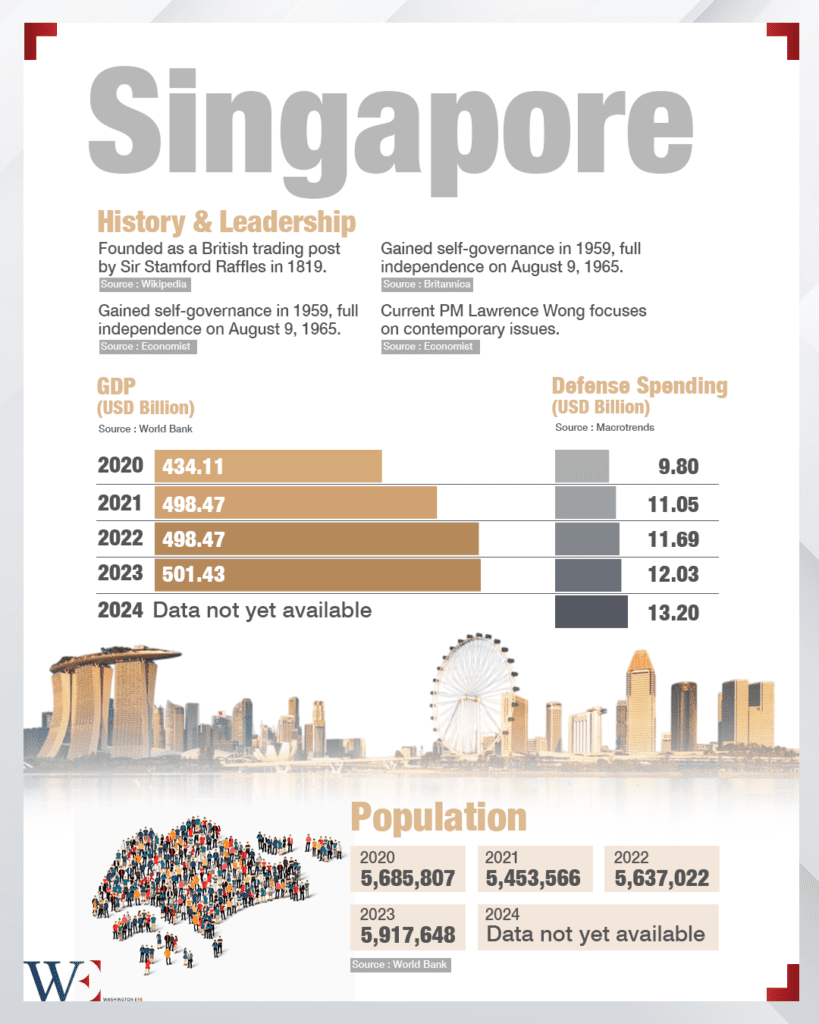

For decades, Singapore has perfected the art of strategic balance, positioning itself as a friend to both China and the United States. As a small yet influential middle power in Asia, the city-state has built its reputation as a hub for diplomacy, trade, and defence partnerships. However, as great power competition intensifies, particularly under the disruptive policies of U.S. President Donald Trump, Singapore faces a renewed challenge in managing its delicate equilibrium.
At the heart of this balancing act lies a calculated approach to defence and economic policy—one that ensures security while maintaining strong trade ties with both superpowers. Yet, with escalating U.S.-China trade disputes, increased tariffs, and growing military tensions, Singapore and other middle powers in Asia must adapt swiftly to a shifting geopolitical landscape.
The Art of Balance: Singapore’s Tightrope Walk
Singapore’s geographical position at the crossroads of global trade has always been its greatest strength and most significant vulnerability. Despite being a small state with a population of just 5.9 million, its strategic location along the Malacca Strait—a key maritime chokepoint—gives it an outsized role in global commerce and security.
For years, Singapore has carefully maintained robust defence ties with the U.S. while deepening economic interdependence with China. The challenge, however, is managing this dual relationship amid increasing pressure from both sides. In a recent speech at the BMW Foundation Leaders Roundtable, Singapore’s Minister of Defence, Dr. Ng Eng Hen, acknowledged that Washington’s shift toward prioritising national interests, even at the cost of long-standing partnerships, presents a new challenge.
“America’s primacy has become the overriding consideration… It has now become the Pole Star of foreign policy, even at the expense of bilateral ties or multilaterals,” Dr. Ng noted, underscoring the impact on allies and partners alike.
Despite these concerns, Singapore remains steadfast in its relationship with the U.S., particularly in defence cooperation.
The U.S.-Singapore Fighter Jet Deal: Defence as Diplomacy
Defence has long been a cornerstone of Singapore’s strategy for maintaining relevance in global affairs. The city-state invests heavily in military modernisation, ensuring that its defence forces remain among the most advanced in the region.
A key example of this commitment is Singapore’s acquisition of the F-35B fighter jets from the United States. In 2020, Singapore became the first Southeast Asian country to purchase the stealth aircraft, initially ordering four jets with an option for eight more. The deal, valued at around $2.75 billion, is part of Singapore’s broader strategy to enhance its air combat capabilities.
This move is as much about military capability as it is about strategic positioning. The purchase reinforces Singapore’s defence ties with Washington at a time when U.S. influence in the region faces growing challenges. By aligning itself with America’s advanced military technology, Singapore secures not just modern weaponry but also a continued commitment from Washington in regional security matters.
However, this decision does not mean Singapore is tilting toward the U.S. at China’s expense. On the contrary, Singapore remains one of China’s top trading partners and has been a strong advocate of economic engagement between Beijing and ASEAN.
Economic Pressures: The Impact of Trump’s Tariffs
While defence partnerships with the U.S. provide a sense of security, Singapore’s economic ties with China cannot be ignored. The city-state’s economic model depends on free trade, global supply chains, and open markets. However, Trump’s protectionist policies, including a 10% tariff on all Chinese imports, have rattled the foundations of global trade, forcing Singapore and other middle powers to reassess their strategies.

In retaliation, China has imposed 10-15% tariffs on various U.S. goods, including energy products and machinery. This ongoing trade war has disrupted supply chains, with Singapore’s trade-dependent economy caught in the crossfire.
The global slowdown resulting from U.S.-China tensions has already impacted Southeast Asia. During the previous trade war between 2018 and 2019, U.S.-China bilateral trade declined by 10%, while Europe’s real GDP growth slowed significantly due to similar trade disruptions. Dr. Ng has highlighted that these shifts in trade dependencies often translate into shifts in security alliances—an outcome Singapore is keen to avoid.
Singapore’s response has been pragmatic. Instead of taking sides, it has worked to diversify trade partnerships, strengthening ties with both Western economies and China. The signing of the Regional Comprehensive Economic Partnership (RCEP), the world’s largest trade pact, has been part of this effort. By anchoring itself in broader economic frameworks, Singapore ensures it is not overly reliant on any single major power.
Security in an Era of Great Power Competition
Trade and security are increasingly intertwined. As the U.S. and China engage in economic and technological competition, military posturing in Asia has also intensified. Washington has strengthened its Indo-Pacific strategy, increasing military exercises with allies such as Japan, Australia, and the Philippines, while Beijing has expanded its naval footprint in the South China Sea.
For Singapore, these developments underscore the importance of maintaining a strong defence posture. The city-state’s military doctrine is built around deterrence, ensuring that despite its small size, it remains capable of defending its sovereignty.
Beyond the F-35 fighter acquisition, Singapore has also deepened cooperation with ASEAN partners, the UK, and Australia in areas like cyber defence and maritime security. The country’s Total Defence strategy, which integrates military, civil, economic, social, and digital defence, ensures that security is approached holistically.
At the same time, Singapore has been vocal in calling for stability and diplomacy. Prime Minister Lee Hsien Loong has repeatedly urged both the U.S. and China to find common ground, warning that a fragmented global order would hurt all nations, especially smaller ones caught in the middle.
The Path Forward: Adapting to an Uncertain Future
As the world braces for Trump’s economic and defense shocks in 2025, Singapore must once again navigate the uncertainties of American foreign policy. If his previous tenure is any indication, this Trump presidency will see renewed trade wars, pressure on allies for greater military spending, and a more transactional approach to diplomacy.
For Singapore, this means doubling down on its strategy of pragmatism and adaptability.
- On defence, it will continue modernising its military while deepening regional partnerships to counterbalance rising tensions.
- On trade, it will pursue new agreements to mitigate the impact of U.S.-China disputes, ensuring its economic resilience.
- On diplomacy, it will maintain its role as a neutral convener, facilitating dialogue between superpowers and promoting regional stability.
In an era where global power shifts are increasingly unpredictable, middle powers like Singapore prove that size is not a limitation—it is an advantage when coupled with foresight, agility, and a deep understanding of global dynamics.
Conclusion
Singapore’s challenge is not unique but emblematic of the broader struggle faced by middle powers worldwide. As great powers like the U.S. and China continue their geopolitical contest, countries like Singapore must navigate the turbulence with precision. By strengthening its defence capabilities, diversifying economic ties, and upholding its commitment to diplomacy, Singapore is not merely surviving the global power struggle—it is shaping its own destiny amid uncertainty.