
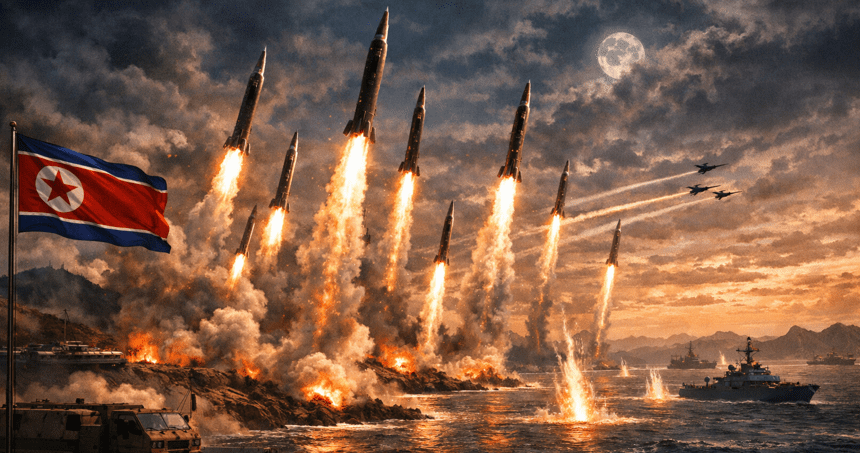
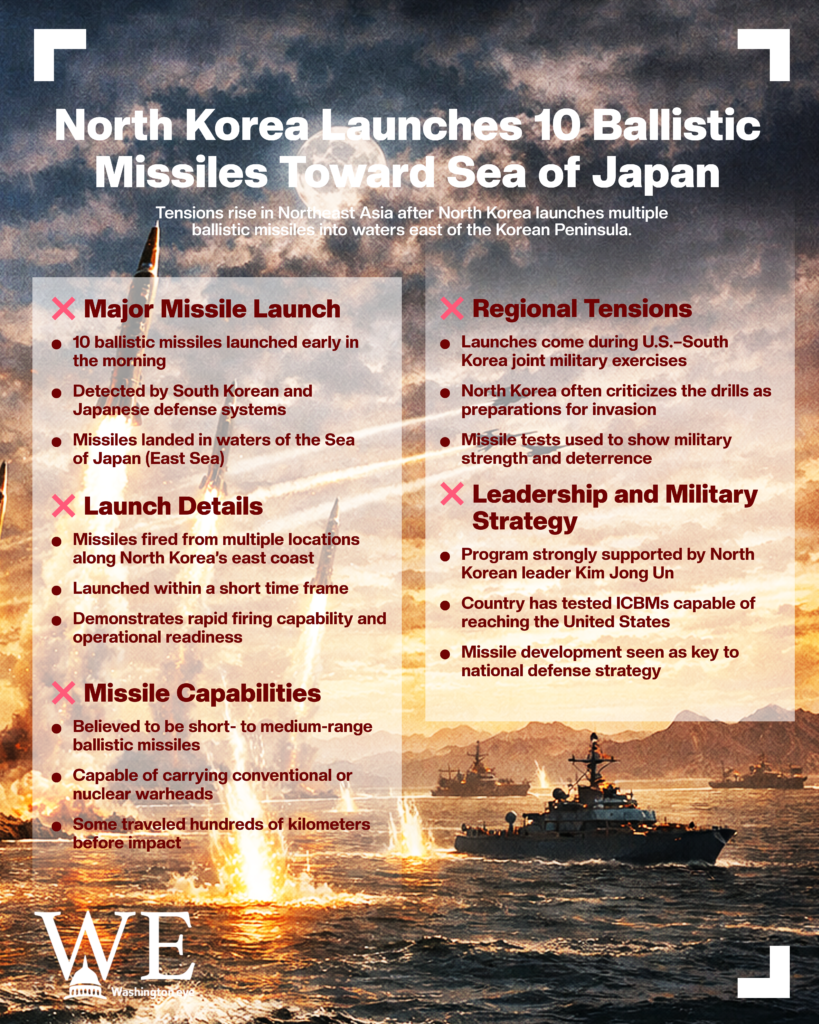
Tensions on the Korean Peninsula escalated sharply after North Korea launched 10 ballistic missiles toward the Sea of Japan, in what analysts describe as one of the most intense missile demonstrations by Pyongyang in recent months. The launches were detected by South Korean and Japanese defense authorities early in the morning, triggering regional security alerts and renewed international concern over North Korea’s expanding missile capabilities.
According to military officials in South Korea and Japan, the missiles were fired from multiple locations along North Korea’s eastern coast. The launches reportedly occurred within a short time frame, suggesting a coordinated test designed to demonstrate rapid firing capability and operational readiness. The missiles traveled varying distances before landing in waters east of the Korean Peninsula, in the area commonly known internationally as the Sea of Japan, which South Korea refers to as the East Sea. Authorities confirmed that none of the missiles landed in territorial waters or caused damage, but the launches were seen as a serious provocation.
Defense officials believe the missiles were short- to medium-range ballistic missiles, potentially similar to systems North Korea has tested in previous years. Some of these missiles are capable of carrying conventional or nuclear warheads and can reach targets across the Korean Peninsula and parts of Japan. Radar tracking indicated that several of the projectiles flew hundreds of kilometers before splashing into the sea.
The launch comes amid rising geopolitical tensions in Northeast Asia. Analysts say the tests could be linked to joint military exercises between the United States and South Korea, which North Korea has long criticized as preparations for invasion. Pyongyang often responds to such drills with weapons tests to demonstrate its military strength and deterrence capabilities.

North Korea’s leader Kim Jong Un has repeatedly emphasized the importance of strengthening the country’s missile and nuclear programs. Over the past decade, the country has significantly advanced its weapons technology, testing a wide range of ballistic missiles, including intercontinental ballistic missiles (ICBMs) capable of reaching the United States. These tests have drawn global condemnation and multiple rounds of sanctions imposed by the United Nations.
Historically, missile launches toward the Sea of Japan have been a common testing route for North Korea. The sea lies east of the Korean Peninsula and provides a relatively open area for missile trajectories without immediately crossing major land masses. However, such launches often trigger alarm in neighboring countries because of the risk of missiles passing near Japanese territory.
Japan’s government quickly condemned the launches, calling them a serious threat to regional security. Japanese Prime Minister and defense officials stated that the tests violated United Nations Security Council resolutions that prohibit North Korea from conducting ballistic missile launches. Japan’s Self-Defense Forces monitored the missiles closely and confirmed their impact points in international waters.

South Korea’s military also strongly criticized the launches and warned that repeated provocations could destabilize the region. Seoul stated that it is maintaining close coordination with the United States and Japan to monitor further developments. Military officials indicated that enhanced surveillance and defense readiness measures are already in place. The United States expressed concern over the tests and reiterated its commitment to defending South Korea and Japan. U.S. officials urged North Korea to refrain from actions that increase tensions and to return to diplomatic dialogue aimed at denuclearization of the Korean Peninsula.
International observers note that North Korea has conducted dozens of missile launches in recent years, using them to test new technologies such as solid-fuel rockets, maneuverable reentry vehicles, and hypersonic glide systems. These advancements are seen as part of Pyongyang’s broader strategy to improve the survivability and effectiveness of its nuclear deterrent. Despite repeated international pressure and sanctions, North Korea continues to expand its weapons program. Experts believe the country sees missile development as essential for both national defense and political leverage in negotiations with the international community.
Security analysts warn that continued missile testing could further escalate tensions in East Asia, particularly if launches become more frequent or involve longer-range missiles capable of crossing Japan or reaching the Pacific Ocean. At the same time, diplomatic efforts to restart nuclear negotiations with North Korea have remained largely stalled in recent years. For now, regional governments remain on high alert, closely monitoring North Korea’s military activity and preparing for the possibility of additional missile tests in the coming weeks.