
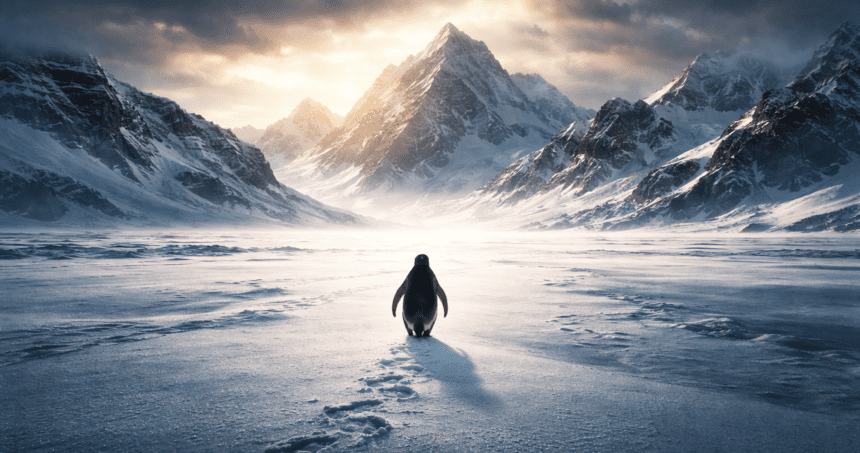
In the first weeks of 2026, a seemingly simple clip of a lone penguin striding across a frozen landscape toward distant mountains has captured the world’s imagination and swiftly become one of the year’s most unexpected viral sensations. Dubbed the “Nihilist Penguin,” this flightless Antarctic bird, whose identity remains unknown, has sparked a global wave of memes, philosophical debate, geopolitical mockery, and artistic commentary, turning what was once an obscure nature documentary moment into a full-blown cultural phenomenon.
The footage that ignited this craze does not actually come from a recent wildlife expedition. Instead, it originates from Werner Herzog’s 2007 documentary Encounters at the End of the World, a film exploring the stark beauty and existential extremes of Antarctica. In a brief but haunting scene, an Adélie penguin inexplicably abandons its colony near the sea, where food, shelter and survival lie, and begins walking inland toward remote mountains on the ice. Herzog’s narration in the original film frames the behaviour as a kind of “death march,” provoking both awe and puzzlement at the bird’s apparent choice to turn its back on safety.
For nearly two decades this clip periodically surfaced online among nature fans and film buffs, but it was only in January 2026 that the moment exploded into mainstream internet culture. Short-form video platforms, social feeds and meme accounts seized upon the penguin’s solitary trek, reframing it with layers of irony, humour and philosophical commentary. Users have interpreted the penguin variously as a symbol of existential angst, a metaphor for individual rebellion against social conformity, and even as an emblem of modern burnout culture, with captions like “When you walk away from everything you should do” trending across platforms.

The phoenix-like rise of the “Nihilist Penguin” meme coincided with a side-story that further propelled it into the headlines. On January 23, 2026, the official White House social media team posted an AI-generated image showing former U.S. President Donald Trump striding across snowy terrain beside a penguin holding an American flag, with the Greenlandic flag visible in the background and the caption “Embrace the penguin.” While seemingly an attempt to fuse a light-hearted meme with political messaging about renewed U.S. interest in Greenland, the post unintentionally sparked ridicule because penguins do not inhabit Greenland or the Arctic at all; they are native to the Southern Hemisphere and Antarctica.

Political commentators, wildlife enthusiasts and social media users alike seized on the error with a mix of humour and critique. Some described the misstep as emblematic of incoherent messaging; others treated it as another layer of surreal absurdity woven into the “Nihilist Penguin” narrative. “You don’t get penguins in the Arctic,” one journalist pointed out, underscoring the geographic gaffe that only deepened the internet’s fascination with how a bird from an old documentary had suddenly become a global talking point.
Scientists and animal behaviourists have also weighed in, seeking to temper the online storytelling with grounded context. Experts explain that while penguins sometimes display unusual movements on land, there is no evidence that the individual penguin from Herzog’s film survived its inland march, the trek would have taken it far from food sources and into harsh, uninhabitable ice fields. Wildlife biologists caution against anthropomorphising animal behaviour too readily, noting that what may appear intentional from a human perspective can arise from confusion, disorientation or environmental stress.
Despite, or perhaps because of, the mix of humour, heart and philosophical resonance attached to the penguin, reactions continue to accumulate. Social media users have embraced the bird as an unlikely mascot for resilience and self-determination, while memes built around text like “Be the penguin who walks toward the mountain” flood feeds on TikTok, X, Instagram and Reddit. Some online threads even juxtapose the penguin with motivational quotes about chasing dreams without guarantees, while others lean into darker, existential humour.

Photographers and digital artists have also joined the conversation. AI-enhanced and hand-illustrated renditions of the penguin walking across icy plains or gazing toward distant peaks have circulated widely, often accompanied by remix culture that merges landscapes, music and narrative titles. Though the original documentary shot was taken nearly 20 years ago, contemporary creators are giving the imagery new life, blending natural wonder with human interpretation.
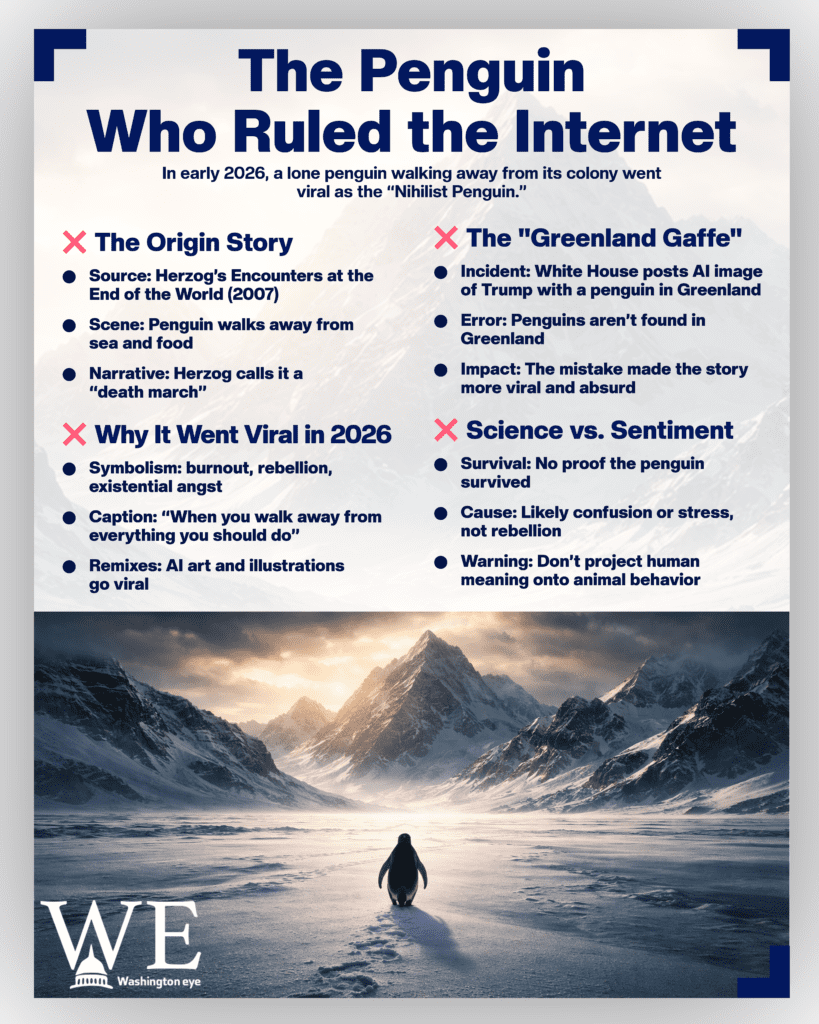
In an age where internet culture can propel anything into global awareness overnight, the “Nihilist Penguin” stands as a uniquely layered phenomenon, at once a natural mystery, a memetic icon, and a mirror reflecting collective hopes, fears and humour. Whether viewed as a philosophical muse or a quirky viral distraction, one thing is clear: a lone penguin striding across ice has captured far more than mere attention; it has sparked a conversation about choice, purpose, and the narratives we project onto the natural world.