Israel’s parliament has passed a highly contentious law that could reshape how Palestinians accused of deadly attacks are punished, with critics warning it creates a legal system that applies the harshest sentence based not just on the crime, but on who commits it.
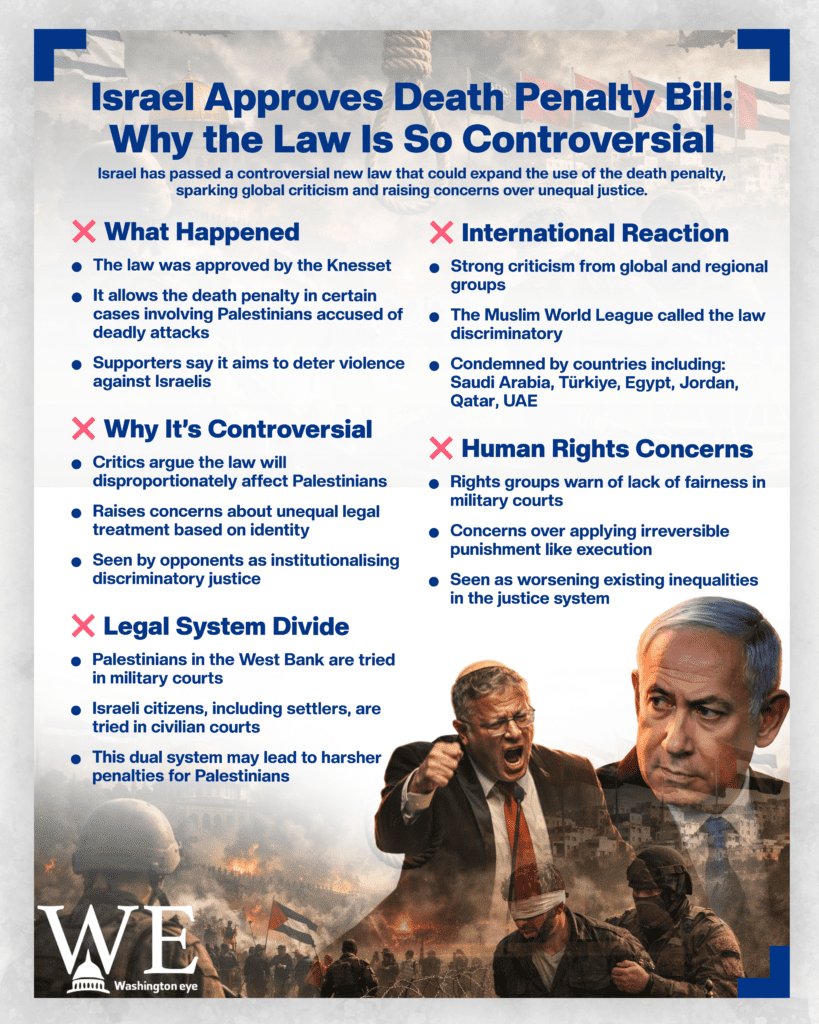
The bill, approved this week by the Knesset, has triggered strong political and international backlash because it is expected to apply primarily and in practice, almost entirely to Palestinians, especially those living in the occupied West Bank. Supporters argue the law is meant to deter attacks against Israelis. Opponents say it institutionalizes a form of unequal justice.
The most controversial part of the legislation is not simply that it introduces the death penalty more aggressively, but that it does so within a legal framework already sharply divided along political and territorial lines. Palestinians in the West Bank are generally prosecuted in military courts, while Israeli citizens, including Jewish settlers living in the same territory, are tried under civilian law. That distinction means the new law is likely to fall far more heavily on Palestinians than on Israelis accused of similar acts of violence.
For critics, that is what makes the law so politically explosive. Rather than presenting a universal legal standard, they argue, the measure deepens an already unequal justice system in which two populations living under the same broader authority can face very different consequences.
The law has also drawn condemnation from across the Muslim world. The Muslim World League described the move as discriminatory and accused Israel of advancing policies that undermine Palestinian rights and dignity. Similar criticism has come from several regional governments, which see the measure as another escalation in a conflict already marked by deep mistrust, military occupation and competing narratives of security and resistance.

The timing is also significant. The law comes at a moment of heightened tension, when questions around detention, military trials and the treatment of Palestinians are already under intense international scrutiny. Human rights organisations have long criticised Israel’s military court system, arguing that it lacks the safeguards and fairness expected in civilian judicial systems. Introducing a punishment as final and irreversible as execution into that structure is likely to intensify those concerns.
Although Israel has historically used the death penalty only in exceptional circumstances, this law signals a clear political shift. It reflects a harder line from lawmakers who believe harsher punishment is necessary in the face of ongoing violence.
But for many observers, the bigger issue is what this legislation represents beyond the courtroom: a legal and moral debate over whether justice can be considered legitimate when it is seen as applying differently to Israelis and Palestinians.