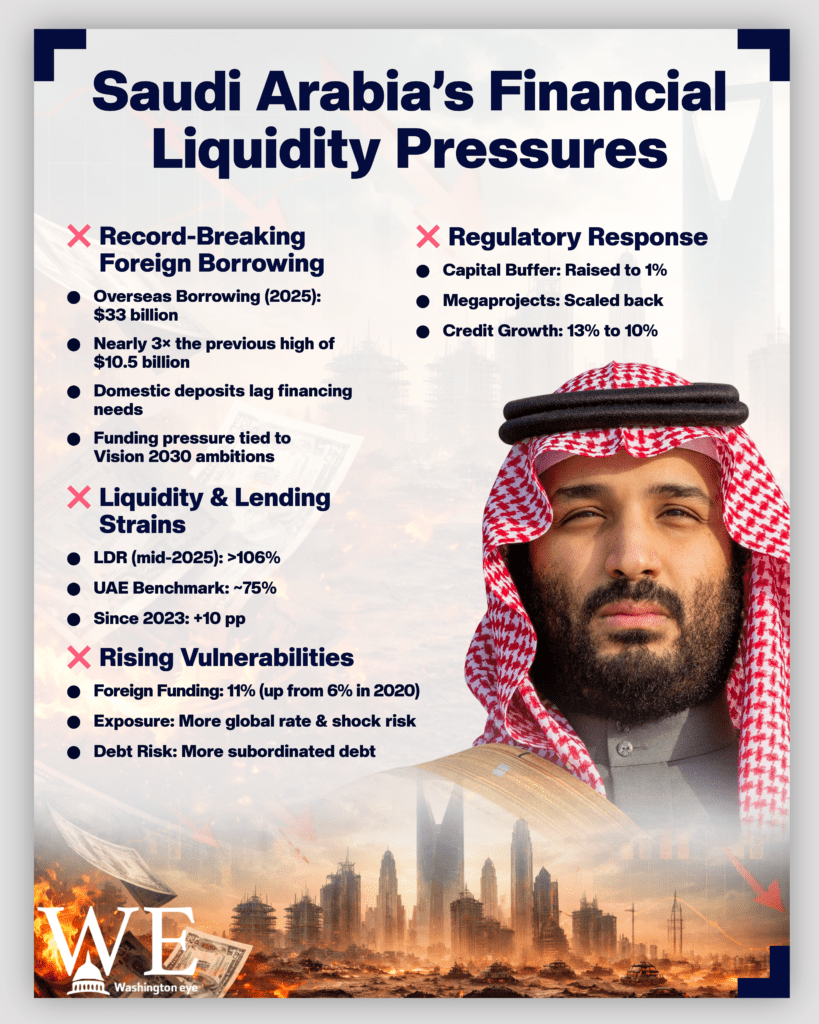

Saudi Arabia is not bankrupt yet, but the warning lights inside its financial system are flashing brighter than at any point in recent years. The kingdom’s banks are borrowing from international markets at record speed, which is indeed a sign that domestic liquidity is under strain after years of aggressive lending tied to the government’s economic overhaul.
In 2025 alone, Saudi lenders raised about $33bn from overseas, a historic high that far surpasses previous borrowing levels. This surge is not driven by opportunity, but by necessity. Banks have spent the past five years financing Vision 2030, which is the Crown Prince Mohammed bin Salman’s trillion-dollar plan to reshape the economy, while deposit growth has failed to keep pace.
As a result, Saudi banks are lending more money than they comfortably hold. By mid-2025, the loan-to-deposit ratio at the country’s largest banks exceeded 106%, meaning lenders are effectively stretching their balance sheets to maintain momentum. In simpler terms, they are running out of cash at home and increasingly relying on foreign money to stay afloat.
This does not mean the Saudi financial system is collapsing. Although the banks remain profitable, well regulated and backed by a powerful state, it does highlight a growing vulnerability where the economic growth is being financed with debt rather than savings, a risky model if oil revenues weaken or investor confidence fades.
Foreign funding now makes up 11% of total bank liabilities, nearly double the level seen five years ago. While global investors remain willing lenders, who are attracted by Saudi Arabia’s regulatory stability, this dependence exposes banks to rising global interest rates and external shocks.
More Read

Meanwhile, government finances are also tightening. Lower oil prices, higher public spending and expanding deficits have forced Riyadh to scale back flagship megaprojects, including parts of Neom. The slowdown suggests that even the world’s largest oil exporter must recalibrate its ambitions when funding becomes expensive.
Saudi regulators have taken notice. The central bank has ordered lenders to rebuild capital buffers, signalling concern about risk accumulation. Credit growth is already cooling, and analysts expect lending expansion to slow further in 2026 as financing costs climb.
Economists caution against dramatic conclusions. Saudi Arabia is far from insolvency, with vast reserves and strong state backing. But the current trajectory shows a system under pressure , the one where debt is rising faster than deposits, and foreign borrowing is filling the gap.