
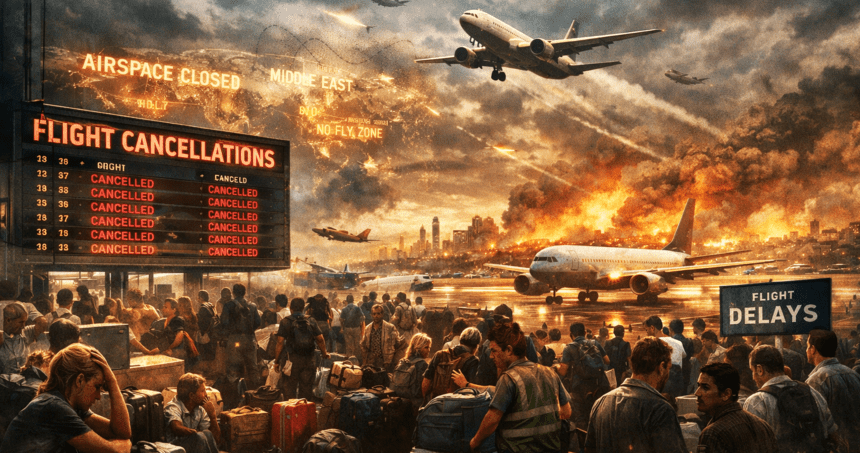
Global air travel has faced significant disruption in recent weeks as geopolitical tensions, airspace closures, and operational challenges forced airlines to cancel or reroute thousands of flights across multiple continents. The crisis intensified in late February and early March 2026 after the outbreak of conflict involving the United States, Israel, and Iran, which led to widespread airspace shutdowns across the Middle East, one of the world’s busiest aviation corridors. The cascading effect of these closures has rippled through Europe, Asia, and other regions, causing delays, cancellations, and travel chaos for hundreds of thousands of passengers worldwide.
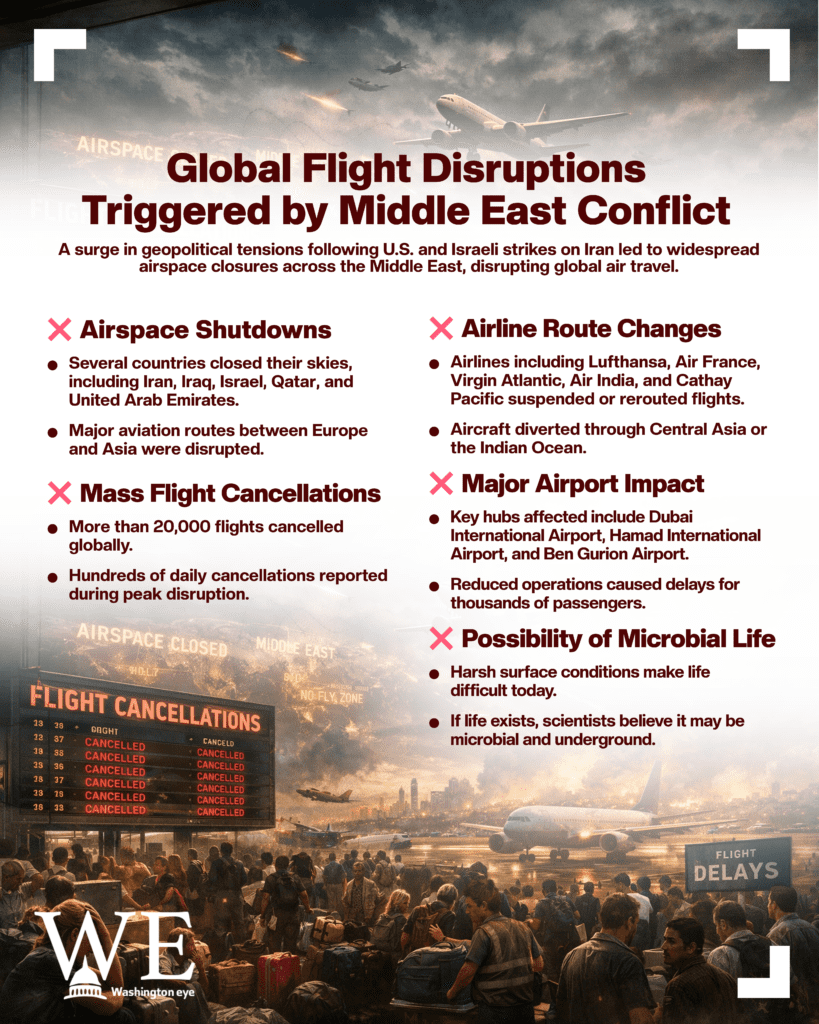
The disruption began on February 28, 2026, when coordinated U.S. and Israeli strikes on Iranian targets triggered a regional conflict. In response, several Middle Eastern countries, including Iran, Iraq, Israel, Qatar, Kuwait, Bahrain, Syria, and the United Arab Emirates, temporarily closed their airspace for security reasons. With these closures affecting a major air corridor connecting Europe, Asia, and Africa, airlines had little choice but to suspend flights or reroute aircraft over longer and costlier paths.
Within days, the aviation industry saw massive disruptions. Aviation analysts reported that more than 20,000 flights were cancelled globally as airlines attempted to navigate the changing security environment. On a single day in early March, over 700 flights were cancelled as the crisis escalated and major hubs in the Gulf region reduced operations. Meanwhile, airports in India, including Delhi and Mumbai, cancelled more than 100 international flights due to the closure of west-bound routes through the Middle East.

Airlines from around the world quickly suspended or altered routes to avoid dangerous airspace. European carriers such as Lufthansa, Air France, and Virgin Atlantic halted flights to several Middle Eastern destinations, while Asian carriers including Air India and Cathay Pacific also adjusted operations. Budget airlines like Wizz Air and regional operators cancelled services to Israel, Dubai, and other cities. Some flights that had already departed were forced to turn back mid-air or land at alternate airports due to sudden airspace closures.

The disruption has affected major global aviation hubs including Dubai, Doha, Abu Dhabi, and Tel Aviv. Dubai International Airport, one of the world’s busiest transit points, experienced temporary shutdowns and reduced schedules, forcing airlines to reschedule thousands of passengers. Qatar’s Hamad International Airport also suspended normal commercial flights before gradually reopening under restricted conditions for emergency or repatriation services.
Because the Middle East sits between Europe and Asia, many airlines have had to reroute flights around the conflict zone. Some long-haul routes now pass through Central Asia, Turkey, or the Indian Ocean rather than crossing the Gulf region. For example, certain flights between Australia and Europe that normally cross the Gulf are now stopping in Singapore or other cities for refueling due to the longer travel distance. These diversions have added hours to travel times and increased fuel consumption for airlines.
The economic impact of these disruptions is also significant. Airlines face rising operational costs due to longer routes, increased fuel use, and compensation claims from passengers whose flights were cancelled or delayed. Aviation experts warn that global airfreight capacity has also been affected, disrupting supply chains between Asia and Europe. Reports indicate that airfreight costs between the two regions have surged sharply as aircraft availability decreases and shipping demand rises.

Passengers have been among the hardest hit by the crisis. Hundreds of thousands of travelers have been stranded at airports or forced to reschedule trips as airlines scramble to reorganize schedules. Governments in several countries have set up emergency helplines and assistance desks to support citizens stuck abroad. Pakistan, for instance, established 24-hour helplines and airport teams to assist travelers and pilgrims affected by flight disruptions in Saudi Arabia and other Gulf states.
Beyond the Middle East crisis, other factors have worsened global flight disruptions. Weather conditions, staff shortages, and air-traffic congestion in some regions have caused additional delays and cancellations. In Europe, for example, more than 200 flights were cancelled and over 800 delayed in early March due to a combination of redirected aircraft, operational constraints, and bad weather.
Although some airlines have begun restoring limited operations as certain airspaces reopen, aviation authorities warn that the situation remains volatile. Airlines continue to monitor security conditions and may suspend or adjust routes at short notice if tensions escalate further. Experts say the aviation industry could take weeks or even months to fully stabilize, especially if the geopolitical crisis continues. For now, travelers worldwide are being advised to check flight status before heading to the airport, expect possible delays, and remain flexible with travel plans as airlines navigate one of the most challenging aviation disruptions in recent years.