
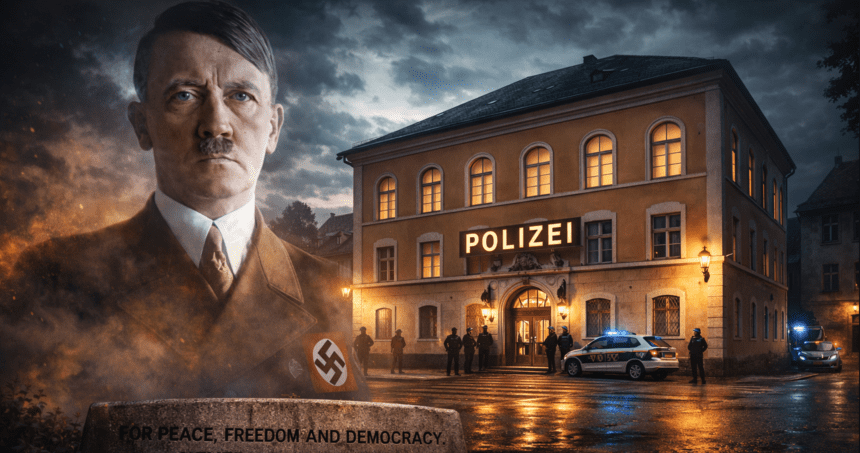
Austria has officially begun transforming the house where Nazi dictator Adolf Hitler was born into a police station in an effort to prevent the building from becoming a site of extremist pilgrimage and to redefine its place in history. The controversial property is located in the small Austrian town of Braunau am Inn, near the German border, where Hitler was born on April 20, 1889. For decades, the building has symbolized one of Europe’s darkest historical legacies, prompting long debates over what should be done with it.
The three-story yellow house has stood in Braunau’s historic center for more than a century. Although Hitler spent only a short time there as an infant before his family moved elsewhere, the building later gained notoriety because of his role as the leader of Nazi Germany during World War II. Under Hitler’s rule from 1933 to 1945, Europe witnessed devastating war, genocide and the murder of six million Jews during the Holocaust. Because of this history, the birthplace has long been viewed as a sensitive and controversial site.
For many years, Austria’s government struggled to determine the future of the property. Authorities feared the building could become a symbolic gathering place for neo-Nazi supporters or far-right extremists who might attempt to glorify Hitler’s legacy. At the same time, demolishing the house raised concerns among historians who argued that erasing the structure could be seen as an attempt to hide history rather than confront it.

The building was used for various purposes over the decades, including as a library, school and charity center. However, the government eventually rented it from the private owner in the 1970s to ensure it would not be used for extremist purposes. After years of legal disputes, Austria passed legislation in 2016 allowing the state to seize the property in the public interest, paving the way for a new plan to repurpose the site.

Officials later announced that the house would be redesigned as a police station. Austrian authorities say the decision sends a strong message that the building will represent law, democracy and public safety rather than dictatorship. The project includes significant reconstruction, with parts of the building being redesigned while maintaining the exterior structure to preserve its historical context.
Interior renovations are intended to transform the property into a modern police training and operations facility. When completed, the station will host officers responsible for security and community policing in Braunau am Inn and surrounding areas. Austrian officials say placing a law-enforcement institution there symbolizes a clear rejection of extremist ideology and reinforces democratic values.
The transformation has sparked debate among historians, residents and international observers. Some critics initially argued that changing the building’s function could diminish its historical significance. Others suggested turning it into a museum dedicated to the victims of Nazism. However, supporters of the police-station plan believe the practical use of the building is the best way to neutralize its symbolic power and prevent it from attracting extremist attention.

Local residents in Braunau have long expressed frustration with their town being associated primarily with Hitler’s birth. Many have supported the government’s decision, hoping it will finally shift attention away from the past and toward the community’s present and future. Braunau itself is a quiet Austrian town with medieval architecture, cultural institutions and a population of about 17,000 people, but its connection to Hitler has often overshadowed its identity.
Austria has also taken steps to ensure the site continues to acknowledge history responsibly. A memorial stone placed outside the building decades ago honors victims of fascism and warns against the dangers of dictatorship. The inscription reads, “For peace, freedom and democracy. Never again fascism.”
Experts say the decision reflects a broader European effort to confront historical memory while preventing the revival of extremist ideology. Rather than turning the building into a shrine or erasing it entirely, Austria hopes the transformation into a police station will redefine its meaning. By placing law enforcement inside the house once linked to one of history’s most notorious dictators, the government aims to send a powerful symbolic message.
Construction work on the building has already begun, with completion expected in the coming years. Once finished, the former birthplace of Adolf Hitler will stand not as a monument to tyranny but as a reminder of democratic institutions designed to protect society.

The decision marks another chapter in Europe’s ongoing struggle to address the legacy of World War II and the Nazi era. Austria’s plan to convert the building reflects an effort to transform a painful historical symbol into a place representing law, order and a commitment to preventing the return of extremist ideologies.