
The United States has announced the killing of Héctor Rusthenford Guerrero Flores, better known as “Niño Guerrero,” the long-time leader of the Venezuelan criminal organization Tren de Aragua, in what officials described as a coordinated military operation carried out alongside Venezuelan authorities. The strike marks one of the most significant actions yet in Washington’s campaign against transnational criminal groups that it has increasingly classified as terrorist organizations.
U.S. President Donald Trump announced the operation on June 13, stating that U.S. Southern Command conducted a “swift and lethal kinetic strike” that successfully targeted Guerrero. According to statements from both Washington and Caracas, the operation took place in Venezuela’s southeastern Bolívar state, a region known for illegal mining, smuggling routes, and the presence of armed criminal groups. Venezuelan officials confirmed that clashes occurred during the operation and that Guerrero was killed during the confrontation.
Guerrero, widely known as “Niño Guerrero,” was one of Latin America’s most wanted fugitives. Born in Venezuela, he rose from a criminal background to become the undisputed leader of Tren de Aragua, a gang that originated inside the Tocorón prison in the state of Aragua. Over the years, the organization expanded beyond prison walls and evolved into one of the region’s most powerful transnational criminal networks. Authorities in several countries accused the group of involvement in drug trafficking, human trafficking, extortion, kidnapping, money laundering, illegal mining, contract killings and migrant smuggling operations.

Guerrero had become a symbol of the gang’s power after allegedly transforming Tocorón prison into a criminal headquarters complete with luxury amenities and operational command centers. He escaped from the prison in 2023 during a major government crackdown and had remained a fugitive ever since. The United States had offered a multi-million-dollar reward for information leading to his capture and had sanctioned him for his role in organized crime and terrorism-related activities.
The operation comes amid growing concern over the international reach of Tren de Aragua. The gang emerged during Venezuela’s economic and political crisis and expanded across South America as millions of Venezuelans migrated abroad. Authorities in countries including Colombia, Peru, Chile, Brazil and the United States have linked members of the organization to a range of violent crimes. Just days before Guerrero’s death, Brazilian police arrested dozens of suspected gang associates in a nationwide crackdown targeting Tren de Aragua’s regional networks.
Washington designated Tren de Aragua a Foreign Terrorist Organization in 2025, arguing that its cross-border criminal activities posed a threat to regional security. The designation allowed U.S. authorities to pursue more aggressive measures against the group and its leadership. Critics, however, have questioned whether criminal organizations should be classified as terrorist entities, arguing that such designations blur the line between law enforcement and military operations.
Trump described Guerrero as the leader of one of the world’s most violent criminal organizations and framed the strike as a major victory against organized crime. U.S. Defense Secretary Pete Hegseth later confirmed that intelligence assessments had verified Guerrero’s death following the operation. The strike also underscored a rare moment of cooperation between Washington and Venezuelan authorities, who reportedly provided intelligence and operational support.

Security analysts say the killing of Guerrero could disrupt Tren de Aragua’s command structure in the short term, but they caution that criminal organizations often adapt quickly after losing senior leaders. The gang’s extensive network across multiple countries means that succession battles or splinter factions could emerge in the coming months. Some experts warn that violence may temporarily increase as rival figures compete for control of trafficking routes and illicit businesses previously overseen by Guerrero.
The operation also signals a broader shift in U.S. strategy toward transnational criminal groups. In recent months, Washington has intensified efforts against cartels and organized crime networks throughout Latin America, using intelligence-sharing, sanctions and, increasingly, military capabilities. Supporters argue that such measures are necessary to combat organizations responsible for large-scale violence and drug trafficking. Human rights advocates, however, have raised concerns about the use of lethal force outside conventional battlefields and have called for greater transparency regarding the legal basis for such operations.
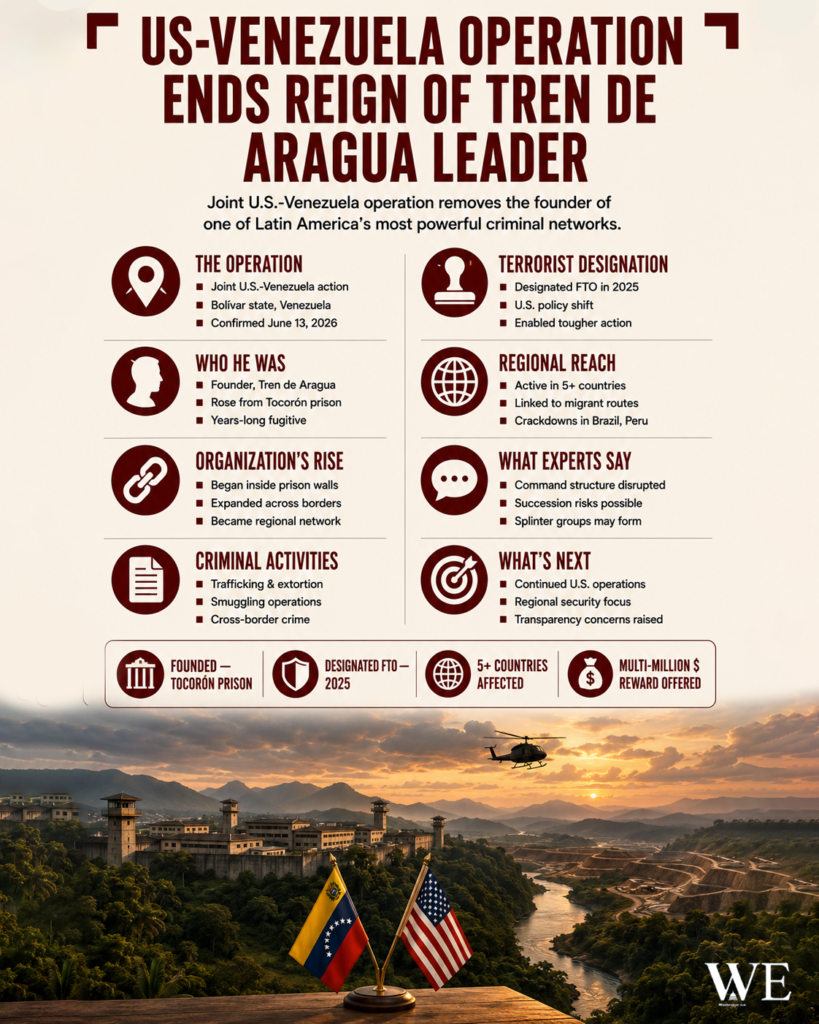
For now, the death of Niño Guerrero represents a major symbolic and operational blow to Tren de Aragua. Whether it leads to the long-term weakening of the organization or simply ushers in a new generation of leadership remains uncertain. What is clear is that the strike has intensified the international spotlight on one of the Western Hemisphere’s most notorious criminal networks and highlighted the growing willingness of governments to use extraordinary measures against organized crime.