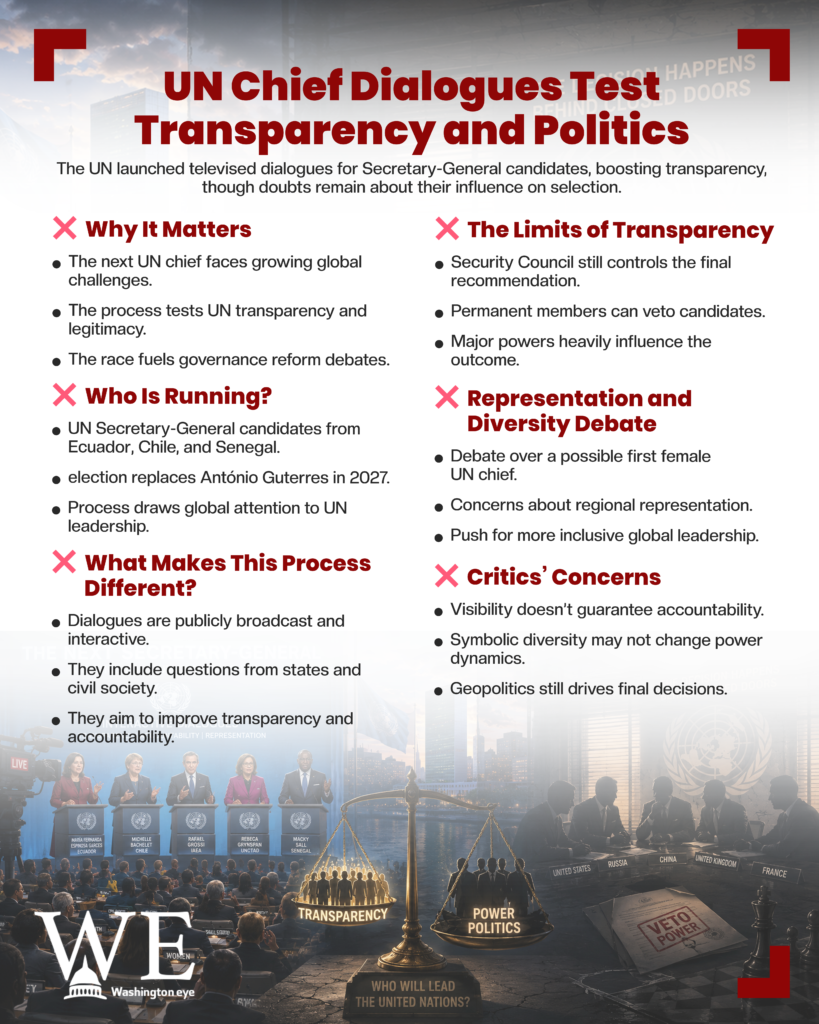
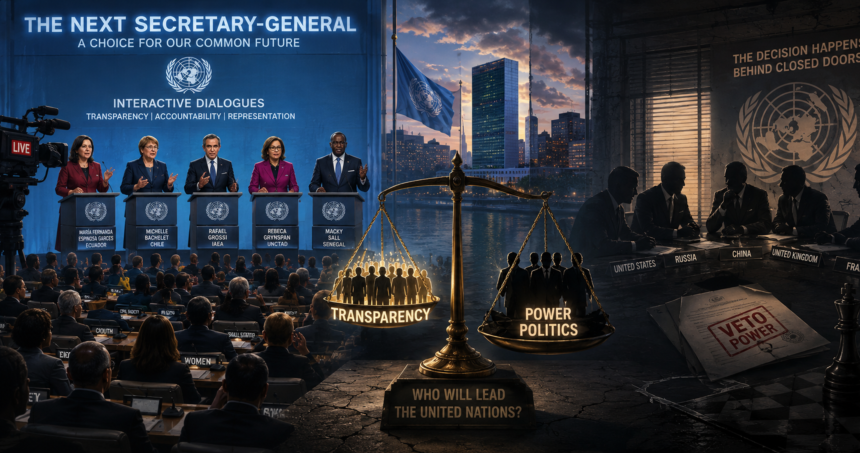
The televised interactive dialogues for United Nations Secretary General hopefuls mark a visible opening of what has long been a closed diplomatic ritual, but they also expose how limited transparency can be when the decisive bargaining still takes place elsewhere. As candidates set out ambitious reform and leadership visions before the General Assembly and civil society, the real contest is over whether this process meaningfully shifts power in multilateralism or merely rebrands an entrenched system.
A Public Stage for A Traditionally Private Job
Five candidates are currently presenting their visions to Member States and civil society representatives in a series of three hour interactive dialogues at UN Headquarters in New York. They include former foreign minister María Fernanda Espinosa Garcés of Ecuador, former Chilean president and UN human rights chief Michelle Bachelet, International Atomic Energy Agency director Rafael Grossi, UN trade and development head Rebeca Grynspan, and former Senegalese president Macky Sall. The winner will succeed António Guterres on 1 January 2027, taking over at a moment defined by geopolitical fragmentation, wars in multiple regions, and severe budgetary constraints on UN operations.
General Assembly President Annalena Baerbock has framed the choice as a pivotal decision that will shape the course of the United Nations and signal whether the institution truly reflects the more than eight billion people it serves, half of whom are women and girls. She has described the post as one of the toughest jobs in the world, stressing that the next Secretary General will be the main defender of the UN Charter and of what she called the rules based international order. This narrative elevates the moment beyond a personnel change, presenting the selection as a test of the UN’s credibility at a time when international law and multilateralism are openly contested.
Transparency Gains Meet Structural Limits
The interactive dialogues, broadcast live and open to questions from states and civil society, respond to long standing criticisms that UN leadership selection has been opaque and dominated by back room deals. Candidates must now deliver ten minute opening statements and then engage on their experience, leadership style, and positions on peace and security, development, human rights, and institutional reform. In principle, this format increases accountability by putting each contender’s record and ideas on the public record and allowing smaller states and non governmental actors to probe their priorities.
Yet the formal decision making architecture has not fundamentally changed. The Security Council still recommends a single candidate to the General Assembly, and the process hinges on whether the five permanent members can reach consensus and avoid a veto. As research on global governance has stressed, key UN appointments and elections often remain non competitive or heavily pre negotiated, reflecting power asymmetries rather than open contestation. The televised dialogues therefore coexist with, rather than replace, a diplomatic bargaining process in which major powers retain disproportionate leverage over the outcome.
Gender, Geography and the Politics of Representation
This year’s field illustrates how questions of gender and regional balance are now central to the politics of legitimacy at the UN. Reporting on the race has highlighted that the choice of the tenth Secretary General will send a signal about whether member states are prepared to match rhetorical commitments to gender equality with the appointment of a woman to the top job for the first time. With three women and two men from Latin America, Africa, and Europe linked to the race, the current slate speaks directly to demands for broader representation beyond the traditional dominance of candidates from a few powerful states.
At the same time, analysts caution that symbolic diversity does not automatically transform underlying power structures. Academic and civil society critiques of global governance note persistent under representation of developing countries and marginalized groups in agenda setting and decision making, despite visible efforts to balance regional and gender profiles. If the final choice appears to reflect geopolitical bargaining more than the preferences expressed in the dialogues, the exercise risks being seen as legitimacy theater rather than substantive democratization of UN leadership selection.
Reform Agendas and the Future of Multilateralism
The candidates are being pressed on how they would make the organization fit for the future against a backdrop of deep political divisions, overlapping crises, and financial strain. All are expected to address reforms tied to peace and security, development financing, human rights protection, and proposals under the UN80 agenda that seek to update institutional tools without reopening the most sensitive issues such as Security Council veto power. Their responses will signal whether the next Secretary General is likely to prioritize incremental managerial reform or push more assertively on questions of power redistribution inside the system.
Commentary from policy institutes has underlined that this selection will be interpreted as a political signal about how far major powers are willing to go in reshaping multilateral institutions to handle climate risks, digital governance, and persistent conflicts. In recent years, some states have increasingly relied on alternative coalitions and regional bodies to pursue their agendas, reflecting frustration with UN gridlock and lengthy processes. A Secretary General perceived as cautious or constrained could reinforce that drift, whereas one able to leverage the moral authority of the office and alliances with middle powers and civil society might slow or partially reverse it.
A Final Note
The interactive dialogues for Secretary General hopefuls therefore matter less as a definitive decision forum than as a barometer of how the United Nations negotiates the tension between transparency and entrenched hierarchy. Their real impact will be measured not only by who is chosen in 2026 but by whether that person’s mandate and the manner of their selection strengthen or further erode confidence in multilateral governance.