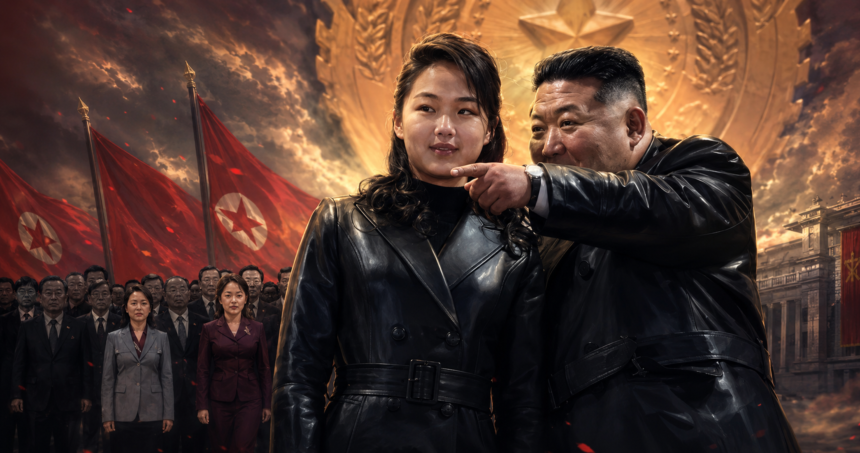
In the highly choreographed political world of North Korea, even clothing can carry strategic meaning. The growing international focus on the luxury outfits worn by Kim Ju Ae, the daughter of North Korean leader Kim Jong Un, has sparked debate among analysts over what her carefully curated public image reveals about the future leadership of the isolated nuclear state.
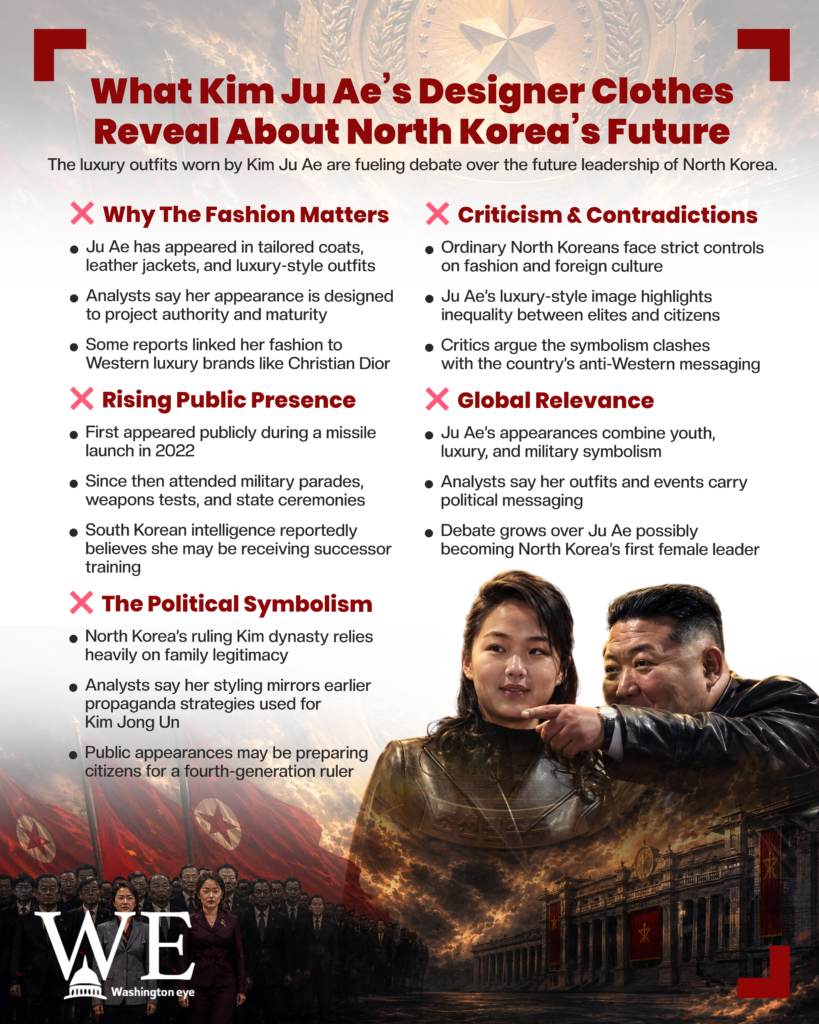
Kim Ju Ae first appeared publicly in November 2022 during an intercontinental ballistic missile launch, walking beside her father in front of a Hwasong missile. At the time, she was believed to be around nine or ten years old. Since then, her appearances at military parades, weapons tests, state ceremonies and official inspections have steadily increased. Her visibility has been accompanied by increasingly sophisticated fashion choices, including tailored coats, leather jackets, fur-trimmed outfits and reportedly luxury Western brands such as Christian Dior.
South Korea’s National Intelligence Service has repeatedly suggested that Ju Ae may be preparing to become Kim Jong Un’s successor. In early 2026, intelligence officials reportedly assessed that she had completed “successor training” and was increasingly involved in symbolic political and military events. Analysts say her public image is therefore unlikely to be accidental.
Experts on North Korean propaganda argue that Ju Ae’s clothing serves several purposes at once. Firstly, it projects maturity and authority despite her young age. She is often dressed in formal outfits resembling those worn by her mother, Ri Sol Ju, or in matching dark leather coats similar to her father’s attire. According to analysts quoted by BBC Korean, this “image replication” strategy mirrors earlier efforts by Kim Jong Un himself to resemble his grandfather and North Korea’s founder, Kim Il Sung.

The symbolism is particularly important in a country where political legitimacy is tied heavily to family lineage. North Korea’s ruling Kim dynasty has governed the country since 1948, creating a quasi-monarchical political culture centered on hereditary leadership and personality cults. By publicly presenting Ju Ae as calm, polished and authoritative, state media may be attempting to normalize the idea of a fourth-generation Kim ruler.
Critics, however, point to the contradictions embedded in Ju Ae’s appearance. While ordinary North Koreans face strict controls on fashion and foreign influence under laws banning “reactionary ideology and culture,” Ju Ae has appeared wearing luxury Western-style clothing and hairstyles reportedly prohibited for regular citizens. Some observers argue this highlights the deep social inequality inside North Korea, where the ruling elite remains exempt from restrictions imposed on the population.
Others believe her image is designed not only for domestic audiences but also for the outside world. Her appearances alongside missile launches and advanced weapons systems may present her as the symbolic “future generation” that North Korea claims to defend through its nuclear programme. Analysts say the combination of youth, luxury and military symbolism creates a carefully balanced image of continuity and strength.

Questions also remain over whether North Korea, traditionally patriarchal and male-dominated, would ultimately accept a female supreme leader. Some former South Korean intelligence officials have argued that Ju Ae’s visibility could be symbolic rather than definitive proof of succession planning. Others suggest her prominence may also divert attention away from any possible sons or alternative heirs within the Kim family.
Little is publicly known about Ju Ae’s private life or education. Reports suggest she may be receiving elite tutoring similar to that experienced by previous Kim family members, possibly with exposure to foreign languages, military affairs and state ideology. Like her father, who reportedly studied in Switzerland during his youth, Ju Ae’s education could combine international exposure with tightly controlled political training.
For many North Korea watchers, the issue extends beyond fashion itself. Clothing in authoritarian political systems often becomes part of state communication. In Ju Ae’s case, every hairstyle, jacket and public appearance may be contributing to a long-term succession narrative aimed at ensuring stability in one of the world’s most secretive states.
Whether she ultimately becomes North Korea’s first female ruler remains uncertain. Yet her growing presence in official propaganda, coupled with carefully managed luxury fashion and repeated military appearances, suggests that Pyongyang is gradually preparing both domestic and international audiences for a possible political future shaped by another generation of the Kim dynasty.