
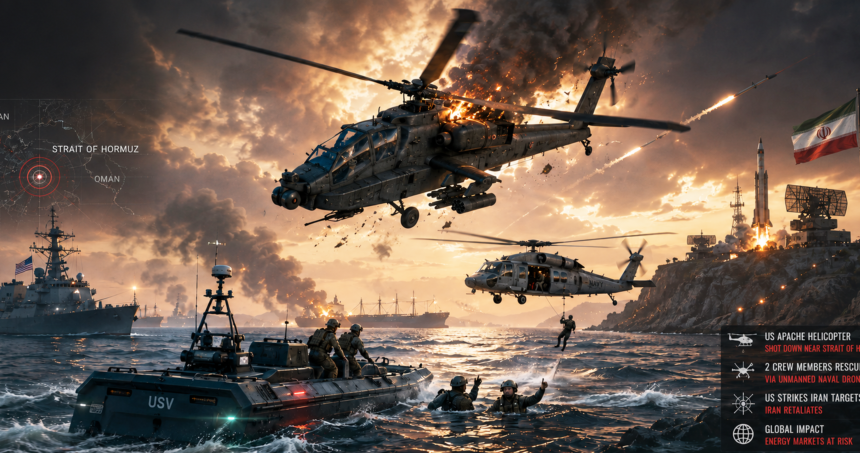
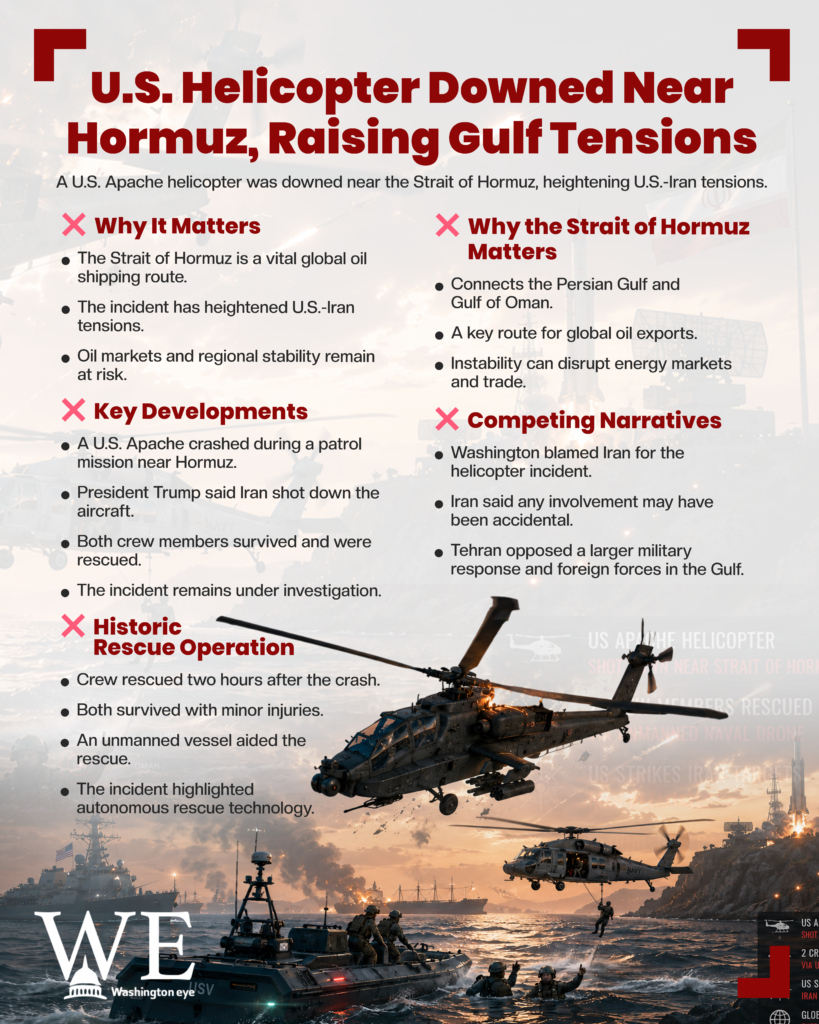
A U.S. Army AH-64 Apache patrol helicopter was brought down near the strategically vital Strait of Hormuz this week, marking one of the most serious incidents in the ongoing confrontation between the United States and Iran. The aircraft went down off the coast of Oman while conducting a routine patrol mission in waters surrounding the narrow maritime chokepoint through which a significant portion of the world’s oil supply passes. The incident has intensified fears of a broader regional conflict and raised concerns over the future stability of the Gulf region.
According to the U.S. Central Command (CENTCOM), the helicopter crashed during overnight operations in the Gulf region. Initial military statements described the cause as being under investigation, but U.S. President Donald Trump later publicly stated that the aircraft had been shot down by Iran. The president vowed that Washington would respond to what he described as an act of aggression against American forces operating in international waters.
The two American crew members aboard the Apache survived the incident and were rescued approximately two hours after the aircraft entered the water. Military officials confirmed that both servicemen were recovered alive and were in stable condition with no major injuries reported. The rescue operation itself became historic, as it marked one of the first known combat-zone rescues conducted with the assistance of an unmanned naval vessel. A U.S. navy autonomous surface drone located the downed crew and transported them to safety before they were evacuated by helicopter.
The Strait of Hormuz has remained one of the world’s most volatile waterways in recent months amid a wider conflict involving Iran, the United States, and regional allies. The passage connects the Persian Gulf to the Gulf of Oman and is considered a critical artery for global energy supplies. Military patrols in the area have increased significantly following repeated threats, drone attacks, and disruptions to commercial shipping.

While Washington directly blamed Iran for the shootdown, Tehran’s response was more cautious. Iranian officials suggested that if Iranian forces were involved, the strike may not have been intentional. Iranian Foreign Minister Abbas Araghchi reportedly indicated that the incident could have been accidental while warning the United States against using the event as justification for further military escalation. Iranian authorities simultaneously reiterated their opposition to foreign military presence in the Gulf region.
The incident occurred at a particularly sensitive moment. Reports indicate that diplomatic efforts aimed at reducing tensions between Iran and its adversaries had been underway, with ceasefire arrangements and indirect negotiations showing signs of progress. Analysts fear that the helicopter’s destruction could derail those efforts and push both sides toward a new cycle of retaliation.
Following Trump’s pledge to respond, U.S. forces reportedly carried out limited strikes targeting Iranian military infrastructure associated with air-defense and surveillance systems near the Strait of Hormuz. American officials characterized the operation as a proportional response designed to deter further attacks rather than initiate a wider war. Nonetheless, the strikes prompted strong reactions from Tehran.
Iran’s Revolutionary Guard later announced retaliatory actions against U.S. military facilities and allied targets across the Gulf region. Reports indicated missile and drone launches directed toward American positions in Jordan and other regional locations, although several of the incoming threats were intercepted. The exchanges have renewed fears that the confrontation could evolve into a broader regional war involving multiple countries and military alliances.
Military experts note that the downing of an Apache attack helicopter represents a significant symbolic and operational event. The AH-64 Apache is among the most advanced combat helicopters in the U.S. arsenal and is routinely employed for reconnaissance, patrol, and strike missions. Losing such an aircraft in contested airspace highlights the growing risks facing military operations around the Gulf and underscores the increasing role of drones and advanced missile systems in modern warfare.
International observers have urged restraint as tensions continue to rise. Energy markets are closely monitoring developments because any disruption in the Strait of Hormuz can have immediate consequences for global oil prices and shipping routes. Governments across Europe, Asia, and the Middle East have called for diplomatic engagement to prevent further escalation.
Although the immediate crisis was eased by the successful rescue of the helicopter crew, the incident has become another flashpoint in an increasingly dangerous standoff between Washington and Tehran. With military strikes, retaliatory attacks, and diplomatic uncertainty unfolding simultaneously, the coming days are expected to be crucial in determining whether the region moves toward de-escalation or a deeper conflict.