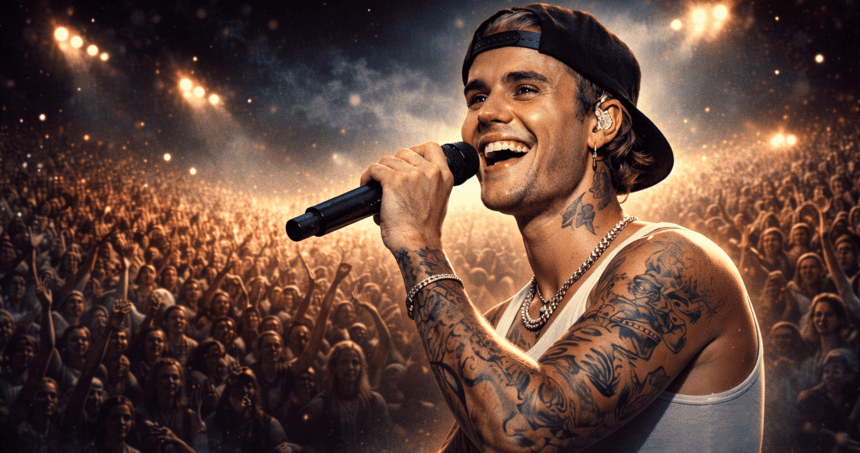
The 2026 edition of the Coachella Valley Music and Arts Festival 2026 witnessed one of its most talked-about moments as Justin Bieber headlined the iconic desert event in Indio, California, delivering a performance that sparked both admiration and debate across the global music community. Held over two weekends in April at the Empire Polo Club, the festival marked Bieber’s major return to the stage after years of reduced public performances due to health challenges and canceled tours.
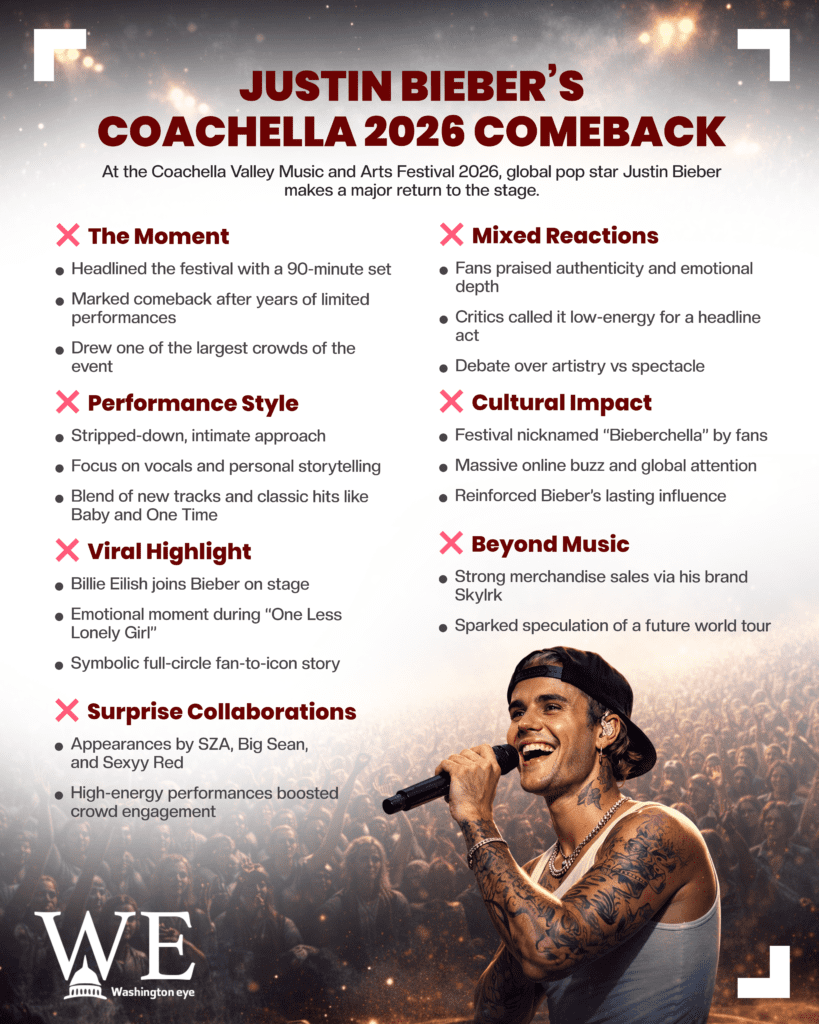
Bieber’s headline set, particularly during the second weekend on April 18–20, was structured as a 90-minute performance blending nostalgia with contemporary pop evolution. Rather than relying on elaborate staging or high-production theatrics, the singer adopted a stripped-down, intimate approach that emphasized vocals, personal reflection, and connection with the audience. Critics noted that the performance leaned heavily on songs from his recent 2025 releases, while also revisiting early hits such as “Baby,” “U Smile,” and “One Time,” creating a bridge between his past and present artistry.
One of the defining highlights of the performance came when Billie Eilish joined Bieber on stage during his classic song “One Less Lonely Girl.” The moment, which recreated a signature segment from Bieber’s early career, turned emotional as Eilish, long known as a devoted fan, appeared overwhelmed and visibly moved. The interaction quickly became one of the most viral and widely discussed moments of the festival, symbolizing a full-circle narrative in pop culture where a former fan shared the stage with her idol.

Beyond this emotional highlight, Bieber’s set was packed with surprise collaborations. Artists including SZA, Big Sean, and Sexyy Red joined him on stage, performing tracks such as “Snooze,” “No Pressure,” and “Sweet Spot.” These collaborations energized the crowd and contributed to one of the largest audience turnouts of the festival, reinforcing Bieber’s enduring global appeal.

However, the performance also sparked mixed reactions. While many fans praised the raw, introspective nature of the show and its focus on authenticity, some critics described it as unusually low-energy for a Coachella headliner. Reports highlighted moments where Bieber appeared relaxed to the point of minimal engagement, with sections of the performance lacking the spectacle typically associated with the festival’s biggest acts. Despite this, others interpreted the approach as a deliberate artistic statement reflecting his personal journey and evolving relationship with fame.
The broader context of Coachella 2026 amplified the significance of Bieber’s appearance. The festival, which sold out rapidly and featured major global artists, relied heavily on star power and nostalgia to drive its cultural impact. Bieber’s set, often described as a “comeback,” drew one of the largest crowds in the event’s history and even led fans to nickname the festival “Bieberchella” due to his dominance in attention, merchandise sales, and online engagement.
Commercially, Bieber’s presence was equally impactful. His fashion label Skylrk reportedly broke merchandise sales records during the festival, further cementing his influence beyond music. Meanwhile, speculation about a potential world tour began circulating after the performance, as fans and industry observers viewed Coachella as a possible re-entry point into large-scale touring.

Overall, Justin Bieber’s Coachella 2026 performance stood as a defining moment of the festival, less about spectacle and more about storytelling, reflection, and cultural resonance. Whether viewed as underwhelming or deeply authentic, the set succeeded in reigniting conversations about his artistry, legacy, and future direction in the global music industry.