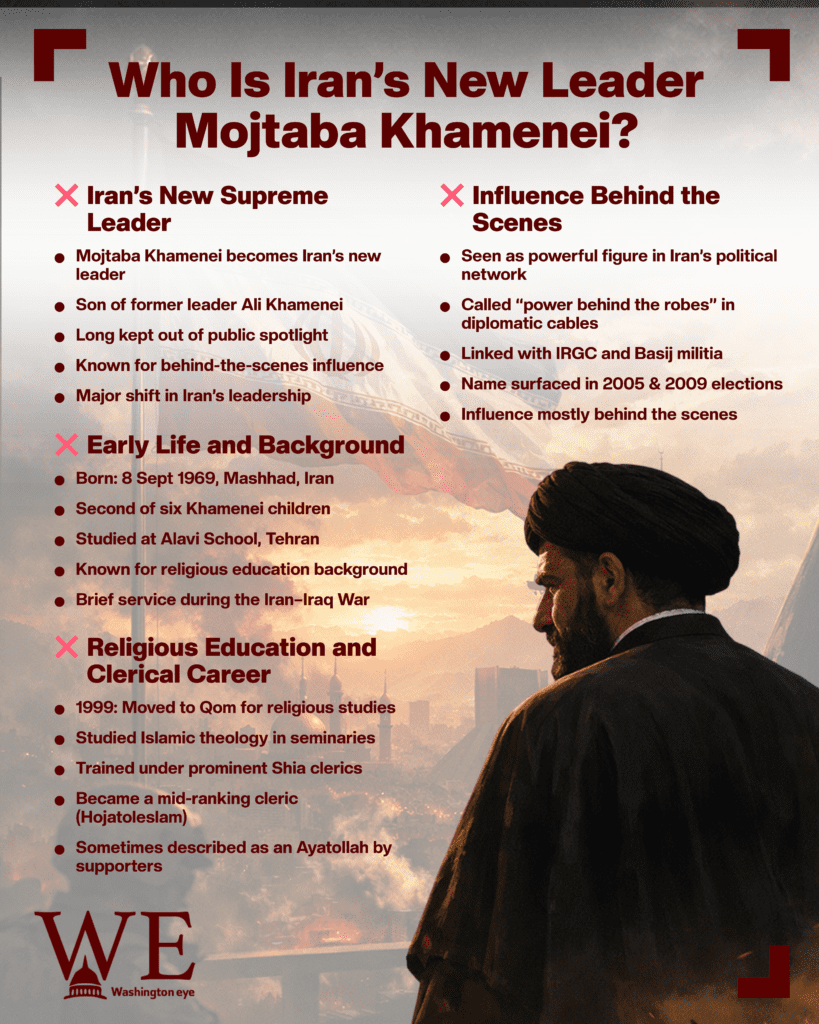
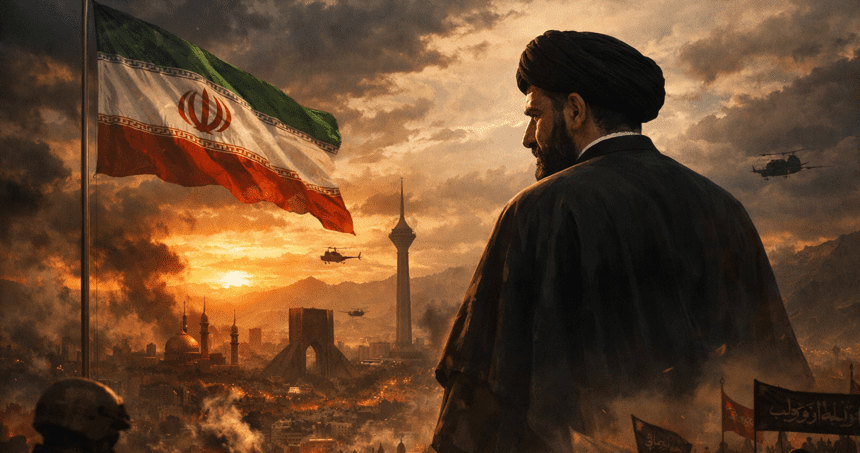
Mojtaba Khamenei has recently moved from the shadows of Iranian politics to the center of power. After the death of his father, Ali Khamenei, he was selected as Iran’s new supreme leader. For many years, Mojtaba remained a largely private figure, rarely speaking in public or appearing in the media. However, political observers have long believed that he played an important role behind the scenes in Iran’s power structure.
Born on 8 September 1969 in Mashhad, Mojtaba is the second of six children in the Khamenei family. Mashhad is one of Iran’s most important religious cities and has long been a center of Shia Islamic culture. Growing up in a family deeply involved in politics and religion meant Mojtaba was closely connected to Iran’s leadership from an early age.
He completed his secondary education at the Alavi School in Tehran, a well-known institution that focuses on religious studies and traditional education. During his youth, Iran was experiencing the devastating Iran–Iraq War. Like many young Iranians at the time, Mojtaba reportedly spent short periods serving in the military during the war. The conflict had a lasting impact on Iran’s leadership and strengthened the country’s distrust of Western powers.
In 1999, Mojtaba moved to Qom, one of the most important centers of Shia religious scholarship. There he began formal studies in Islamic theology at the city’s seminaries. Entering the seminary at around the age of 30 was somewhat unusual, as many clerics begin their studies much earlier. It was also around this time that he started wearing clerical clothing and establishing himself within Iran’s religious institutions. Today he is considered a mid-ranking cleric, though some supporters have referred to him as an ayatollah in recent years.
Although Mojtaba rarely held official government positions, he has often been described as a powerful figure behind the scenes. Diplomatic cables published by WikiLeaks once referred to him as “the power behind the robes,” suggesting he had strong influence within Iran’s political and security networks. He is also believed to have close ties with organizations such as the Islamic Revolutionary Guard Corps and the Basij militia, which play important roles in maintaining the political system of the Islamic Republic.
His name first became widely known during Iran’s 2005 presidential election, which brought Mahmoud Ahmadinejad to power. Reformist candidate Mehdi Karroubi accused Mojtaba of interfering in the election by supporting Ahmadinejad through political and security networks. Similar accusations appeared again during the disputed 2009 presidential election, which led to massive protests known as the Green Movement.
Challenges and Risks
Mojtaba Khamenei’s leadership record remains largely untested, and the perception that Iran’s leadership is becoming hereditary could further increase public discontent. He is also now a marked man on the international stage. Israel’s defense minister stated that whoever succeeded Ali Khamenei would be “an unequivocal target for elimination.”
In late February, Mojtaba was injured in an attack that killed six members of his family, including his father. According to Alireza Salarian, speaking from the Iranian embassy in Nicosia, Mojtaba suffered injuries to his legs, hand, and arm but survived the strike that destroyed his father’s residence. He has not appeared publicly since succeeding his father, with Salarian noting that Mojtaba “is not comfortable to give a speech” due to his injuries. The attack coincided with the start of US-led airstrikes in Tehran during Ramadan and claimed the lives of several family members, including Mojtaba’s wife.
Despite these challenges, Mojtaba Khamenei now holds the highest position in Iran. How he navigates the complex political, social, and security challenges ahead will define his leadership and shape the future of the Islamic Republic.