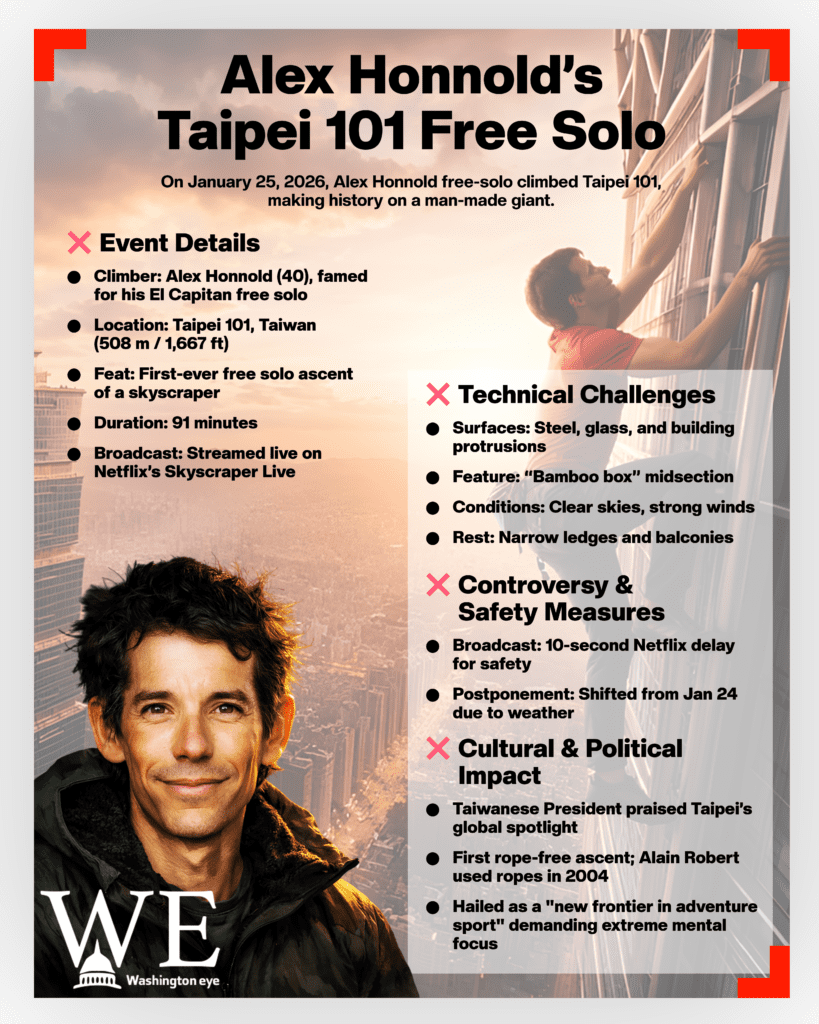
In a breathtaking feat that captivated the world, American rock climber Alex Honnold successfully scaled the 101-story Taipei 101 skyscraper without any ropes or safety gear on January 25, 2026. The 508-metre (1,667-foot) tower, once the tallest building in the world, became the stage for a daring “free solo” ascent that fused extreme sport with global entertainment. The climb was broadcast live on Netflix’s “Skyscraper Live”, drawing millions of viewers and widespread reaction across social media, politics, and the climbing community.
Honnold, 40, is widely regarded as one of the most accomplished free solo climbers in history, best known for his 2017 ropeless ascent of El Capitan in Yosemite National Park, a feat immortalised in the Academy Award-winning documentary Free Solo. His Taipei 101 challenge marked his first major climb of a man-made structure and added a new chapter to his storied career.
The event was originally scheduled for January 24, but organisers postponed the attempt by 24 hours due to unsettled weather conditions. When Honnold began his ascent on Sunday morning, the skies over Taiwan’s capital were clear, though winds buffeted sections of the building’s exterior. Over the next 91 minutes, he crept upward, using only his hands, feet and the building’s architectural features, including its signature “bamboo boxes” on the midsection, to gain height.

Unlike typical sport climbs on natural rock, the Taipei 101 ascent tested Honnold’s ability to find grip on steel and glass, navigating ornamental structures and slight protrusions as makeshift holds. At several points, he paused on narrow ledges and balconies, breathing deeply and chalking his hands before continuing upward. Below, crowds gathered along the tower’s base and inside office windows, cheering and taking photos as the climber steadily climbed toward the spire.

When Honnold reached the summit, a wave of applause and relief swept through onlookers. “What a beautiful way to see Taipei,” he said at the top, reporting a mix of exhilaration and exhaustion. The climber described the panoramic city views and expressed appreciation for the organisation that made the legal, authorised climb possible.
The project wasn’t without controversy. Some members of the climbing community and media questioned the ethics of broadcasting such a perilous stunt live, given the inherent risks and the potential influence it could have on public perceptions of what constitutes responsible climbing. Netflix mitigated some concerns by incorporating a 10-second broadcast delay to cut the stream in the event of a fall.
Taipei 101, located in Xinyi District, is one of Asia’s most recognisable skyscrapers. Completed in 2004, it held the title of the world’s tallest building until 2010 and remains a major tourist attraction and symbol of Taiwan’s modern skyline. French urban climber Alain Robert once climbed it in 2004 using safety ropes; Honnold’s ascent marked the first rope-free building climb of its kind.

Taiwanese officials, including President Lai Ching-te, lauded the climb for its international visibility and positive spotlight on the country’s vibrant capital. In televised remarks, the president thanked Honnold and Netflix for showcasing the city’s landmark to a global audience beyond the typical technological or geopolitical news that frequently defines Taiwan’s presence in international media.
Reactions poured in from around the world. Climbers and extreme-sport fans praised Honnold’s focus and finesse, with many commentators calling the climb a “new frontier in adventure sport” that blurred the lines between urban architecture and natural rock challenges. Others urged caution, reminding the public that free solo climbing remains one of the most hazardous pursuits in athletics, with no room for error.
Despite the risks, Honnold’s accomplishment adds a bold headline to a career defined by pushing human limits while maintaining meticulous preparation and mental calm. As one climbing commentator noted, his Taipei 101 ascent was not merely about physical strength but the psychological mastery of fear, patience and precision.
For now, Honnold’s ropeless urban ascent has entered the annals of climbing history, a testament to both the climber’s extraordinary skills and the evolving intersection of extreme sport, live global media and architectural spectacle.