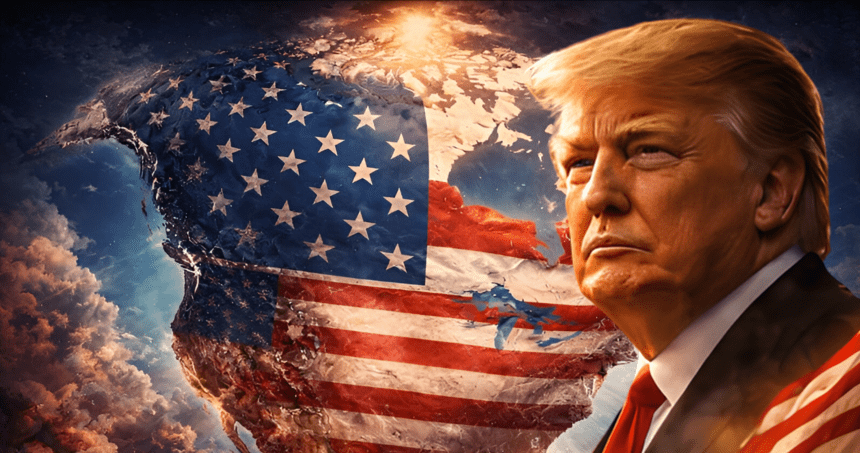
A map shared by former US President Donald Trump depicting the United States as including Greenland and Canada has reignited international debate over sovereignty, political rhetoric, and the blurred line between symbolism and policy. The image, which circulated widely on social media and was amplified by Trump’s supporters and critics alike, appeared in early 2026 amid renewed discussion of Trump’s foreign policy worldview as he remains a dominant figure in American politics. Though not accompanied by any formal policy proposal, the map quickly drew reactions from governments, analysts, and the public across North America and Europe.
The map showed the continental United States expanded northward to include Canada and eastward to encompass Greenland, an autonomous territory within the Kingdom of Denmark. While Trump did not formally announce any intention to redraw borders, the imagery echoed his earlier controversial remarks from 2019, when he publicly expressed interest in purchasing Greenland from Denmark, calling it a “large real estate deal.” At the time, the idea was dismissed by Danish and Greenlandic officials as absurd, but it revealed Trump’s transactional and territorial view of geopolitics, one that continues to resurface symbolically.
Historically, the United States has expanded through territorial acquisition, including the Louisiana Purchase (1803), the annexation of Texas (1845), and the purchase of Alaska from Russia (1867). These precedents are often cited by Trump supporters to argue that US expansionism is not without historical basis. However, modern international law, shaped after World War II, strictly upholds national sovereignty and self-determination, making such acquisitions politically and legally implausible today.
Greenland, despite its strategic importance in the Arctic, is not a free asset. It is home to around 56,000 people, predominantly Inuit, and has its own parliament and government. While Denmark manages its defense and foreign policy, Greenland has steadily moved toward greater autonomy, with independence remaining a long-term aspiration. Greenlandic leaders have repeatedly stressed that the island is “not for sale” and that its future will be decided solely by its people. The resurfacing of Trump-linked imagery has been criticized locally as dismissive of Greenlandic identity and political agency.
Canada’s inclusion in the map provoked even stronger reactions. Canada is a fully sovereign state, a G7 economy, and a close US ally with deeply intertwined economic, military, and cultural ties to Washington. Canadian officials and commentators treated the map as political theatre rather than a serious threat, but many noted that such imagery feeds nationalist anxieties and undermines diplomatic norms. Social media users in Canada responded with humor, sarcasm, and firm reminders of Canadian independence, while analysts warned against normalizing rhetoric that trivializes borders.
The reaction from Denmark was equally firm. Danish officials reiterated their long-standing position that Greenland’s status is not open for negotiation and criticized the symbolism as disrespectful. European observers viewed the episode as part of a broader pattern in Trump-era politics, where provocative statements and visuals are used to dominate news cycles, mobilize political bases, and challenge established international conventions.
From a political strategy perspective, analysts argue that the map serves multiple purposes. Domestically, it appeals to Trump’s “America First” base by projecting strength, dominance, and a revisionist view of US power. Internationally, it functions as a provocation that keeps Trump at the center of global conversation, even when out of office. Critics say such gestures blur the line between satire, symbolism, and serious diplomacy, potentially eroding trust among allies.

The episode also comes at a time when the Arctic is gaining renewed geopolitical importance due to climate change, melting ice routes, and competition over natural resources. Greenland’s location has made it strategically valuable to the US, China, and Russia, particularly for military installations and rare earth minerals. Against this backdrop, even symbolic gestures are scrutinized for deeper strategic messaging.
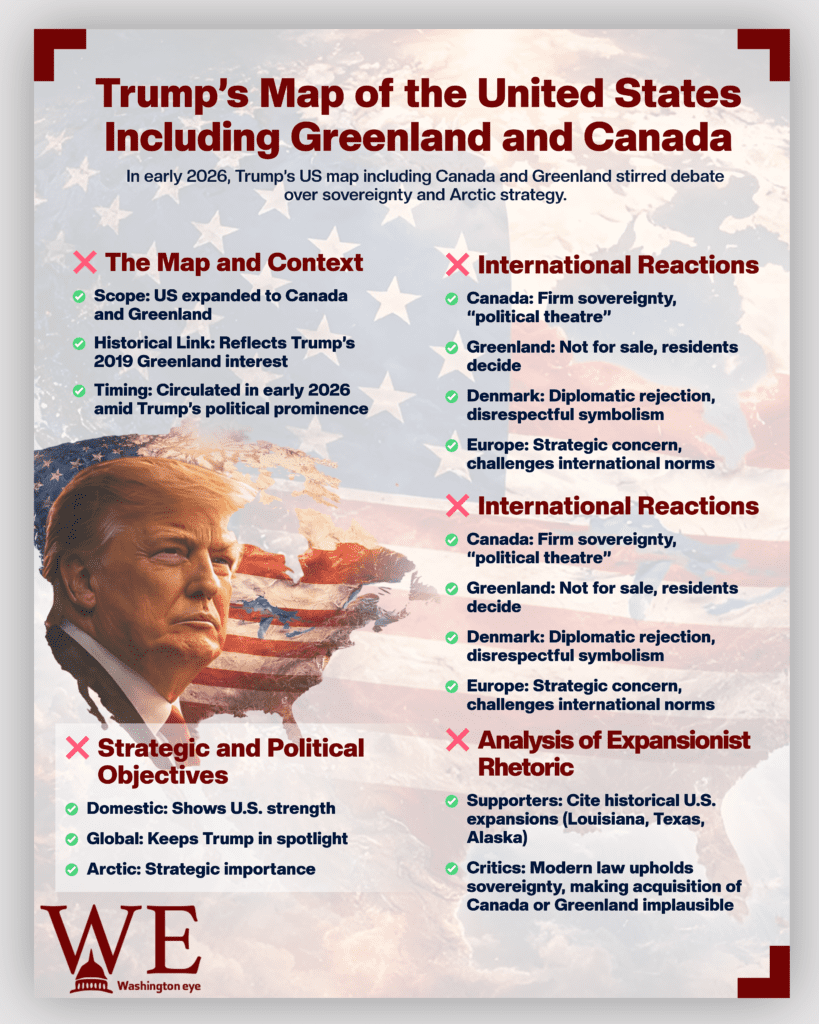
Ultimately, Trump’s map does not signal an imminent policy shift, but it highlights enduring tensions in global politics: between power and principle, history and modern law, symbolism and sovereignty. For Greenland and Canada, the response has been clear; identity, independence, and self-determination are non-negotiable. For the international community, the episode serves as a reminder that maps, even when unofficial, carry political weight far beyond their lines and colors.