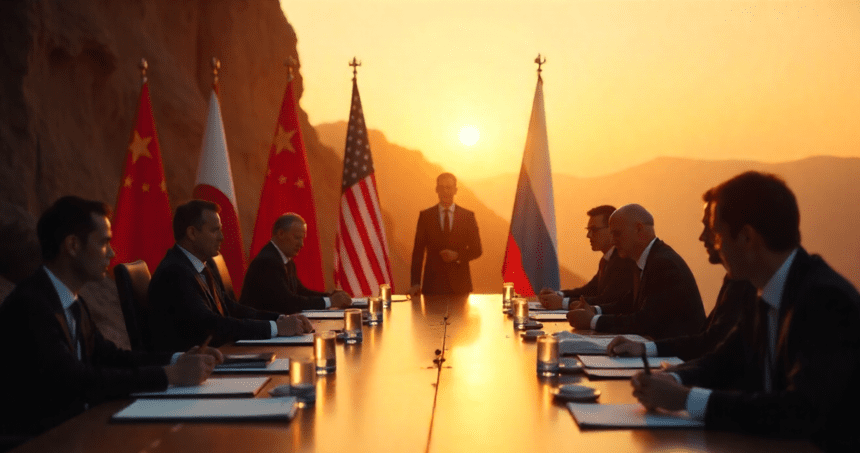
The Middle East’s regional order is undergoing a quiet but consequential reshaping, driven by shifting security priorities, economic diversification goals, and the growing involvement of global powers. Rather than a single unified bloc, the region is witnessing the rise of overlapping regional alliances, issue-based coalitions, and strategic pacts that bring together Gulf states, Levant countries, North Africa, and external actors such as the United States, China, Russia, and the European Union.
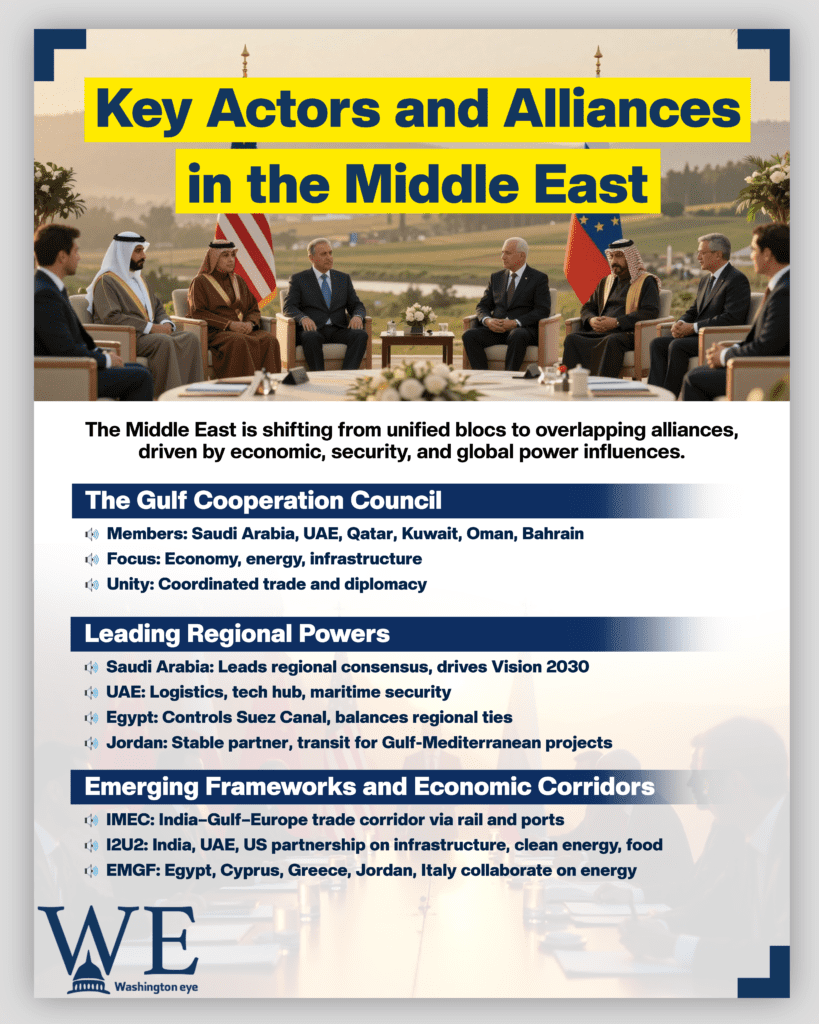
At the core of this evolving architecture is the Gulf Cooperation Council (GCC), comprising Saudi Arabia, the United Arab Emirates, Qatar, Kuwait, Oman and Bahrain. Originally established in 1981 as a political and security grouping, the GCC has in recent years shifted its focus toward economic coordination, joint infrastructure projects and energy transition strategies. Despite internal tensions in the past, Gulf states now present a more coordinated front on trade, investment and regional diplomacy, particularly in response to global energy market volatility and regional instability.
Saudi Arabia has emerged as a central regional actor, using its economic weight and diplomatic reach to shape alliances across the Arab and Islamic worlds. Through platforms such as the Arab League, the Organization of Islamic Cooperation (OIC) and ad hoc summits on Gaza, Yemen and Red Sea security, Riyadh has positioned itself as a convener of regional consensus. Its Vision 2030 economic agenda has also encouraged deeper ties with neighbors through investment funds, energy partnerships and transport connectivity.
The United Arab Emirates has taken a complementary but distinct approach, positioning itself as a hub for trade, logistics and technology-driven cooperation. Abu Dhabi is an active participant in multiple groupings, including the I2U2 Group, which links India, the UAE and the United States, focused on food security, clean energy and infrastructure development. The UAE has also played a visible role in maritime security initiatives in the Red Sea and Gulf of Aden, areas that have gained strategic importance amid repeated disruptions to global shipping.
Another emerging framework is the India–Middle East–Europe Economic Corridor (IMEC), announced as a long-term connectivity project linking India, the Gulf states, Jordan and Europe via ports, railways and digital infrastructure. While progress has slowed due to regional tensions, countries such as Saudi Arabia, the UAE and Jordan continue to see IMEC as a strategic alternative trade route that could reduce dependence on traditional maritime chokepoints and boost regional integration.
Egypt remains a critical regional actor due to its control of the Suez Canal, one of the world’s most important trade arteries. Cairo plays a balancing role between Gulf partners, African states and Mediterranean actors, while also engaging in Eastern Mediterranean groupings such as the East Mediterranean Gas Forum (EMGF). The forum, which includes Egypt, Cyprus, Greece, Jordan and Italy, reflects how energy cooperation has become a driver of new regional alignments beyond traditional political blocs.
In the Levant, Jordan continues to punch above its weight diplomatically. As a stable partner with strong ties to Gulf states, Western allies and regional institutions, Jordan is frequently included in corridor, energy and security discussions. Its geographic position makes it a natural transit point for regional infrastructure plans linking the Gulf to the Mediterranean.
Beyond Arab-led frameworks, Iran remains a decisive factor shaping regional alliances, often indirectly. Its influence across parts of Iraq, Syria, Lebanon and Yemen has reinforced threat perceptions among Gulf states, encouraging deeper security coordination and defense partnerships. This dynamic has also drawn in external powers, particularly the United States, which maintains military partnerships with several Gulf countries and supports regional air and missile defense cooperation.
Turkey represents another independent pole in the region. Through its engagement in the Eastern Mediterranean, Syria and trade networks linking Europe and Asia, Ankara participates selectively in regional alignments while also competing with Arab powers for influence. Its role underscores the multipolar nature of Middle Eastern geopolitics, where cooperation and rivalry often coexist.
Although Israel features in some economic and security frameworks, it is not the sole or dominant driver of regional alliance-building. Current dynamics are increasingly shaped by Arab-led initiatives, Gulf economic strategies and shared concerns over trade security, energy stability and regional de-escalation.
Overall, the Middle East’s alliance landscape is becoming more modular and pragmatic. Countries are prioritizing flexible partnerships over rigid blocs, focusing on deliverables such as secure shipping lanes, energy cooperation, infrastructure connectivity, and economic resilience. While unresolved conflicts continue to limit the pace of integration, regional actors appear determined to build a network of alliances capable of withstanding political shocks and global uncertainty.