
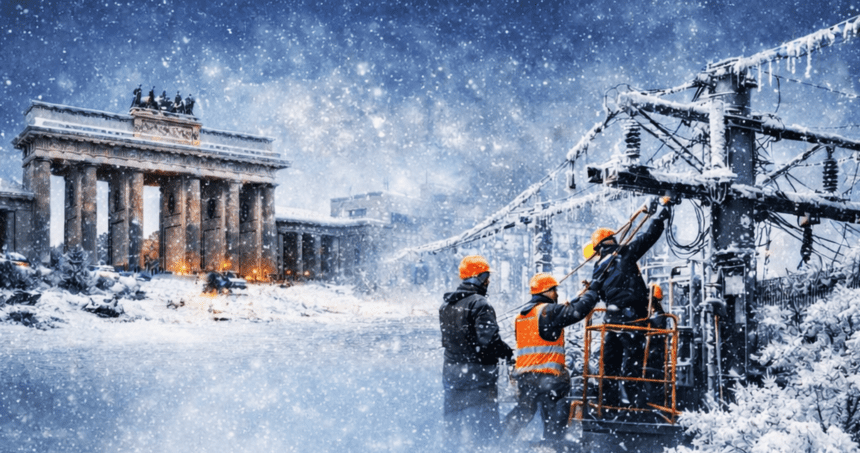
Berlin experienced widespread power outages this week as extreme winter weather battered large parts of Germany, disrupting daily life in the capital and renewing concerns about the resilience of Europe’s urban infrastructure in an era of climate volatility. The outages, reported across several districts including Pankow, Reinickendorf, Charlottenburg-Wilmersdorf and parts of Mitte, left thousands of households without electricity for hours, with some areas facing repeated disruptions over multiple days.
The first major outage was recorded late Sunday evening, when heavy snowfall, freezing rain, and strong winds swept through Berlin and Brandenburg. According to grid operator Stromnetz Berlin, the immediate cause was damage to above-ground power lines and substations strained by falling trees, ice accumulation, and sudden spikes in electricity demand as temperatures dropped sharply below seasonal averages. Emergency services confirmed that at least three consecutive days of weather-related grid stress were observed before full stabilization efforts began.
By Monday morning, repair crews were deployed across the city, working around the clock in freezing conditions to restore supply. While electricity was largely recovered within 12 to 24 hours in most neighborhoods, pockets of disruption persisted into Tuesday, particularly in areas with older grid components or dense tree cover. Authorities described the situation as “serious but under control,” emphasizing that hospitals, transport hubs, and critical services were prioritized to avoid major humanitarian consequences.

The outage had a tangible impact on Berlin’s daily rhythm. Public transport faced intermittent delays as signaling systems briefly went offline, traffic lights failed at several intersections, and mobile networks experienced short-term instability due to backup power limitations. Residents reported difficulties heating homes, charging devices, and working remotely, while small businesses, especially bakeries, cafés, and corner shops, were forced to close temporarily, citing losses during peak winter trading hours.

Meteorologists linked the incident to a broader pattern of extreme weather affecting Central Europe. Germany’s weather service warned that rapid temperature swings, intense snowfall followed by freezing rain, and storm-force winds are becoming more frequent due to climate change. This winter system, they noted, was unusual not only for its intensity but also for its persistence, keeping pressure on infrastructure for several consecutive days rather than a single storm event.
City officials acknowledged that Berlin’s power grid, while modern in parts, still carries structural vulnerabilities rooted in its history. Much of the network was originally built before or shortly after World War II, then repeatedly repaired and expanded during the Cold War era, when the city was divided. While extensive modernization has taken place since reunification, some sections, particularly underground cabling and suburban connectors, remain decades old. Experts argue that such legacy infrastructure was never designed to withstand the compounded stresses of today’s extreme weather events.
In response, Berlin’s Senate Department for Economics, Energy and Public Enterprises reiterated its commitment to long-term investment in grid resilience. Over the past five years, the city has invested hundreds of millions of euros in upgrading substations, burying power lines, and integrating smart-grid technologies. Following this week’s outage, officials confirmed that additional funds will be allocated to climate adaptation measures, including stronger weather-proofing, faster fault detection systems, and improved coordination with emergency services.

Energy analysts say the Berlin outage reflects a wider European challenge. As countries transition to renewable energy while facing harsher climate conditions, power grids are under pressure to be both greener and more robust. “Decarbonization must go hand in hand with resilience,” said one energy policy expert, warning that without accelerated investment, similar outages could become more common across major cities.
Looking ahead, forecasters predict continued cold conditions with intermittent snowfall and strong winds through the coming week, though no storm of the same intensity is expected in the immediate forecast. Authorities have urged residents to prepare by keeping emergency supplies, charging power banks, and checking on vulnerable neighbors, especially the elderly. Grid operators remain on high alert, with repair teams and backup systems ready should further disruptions occur.
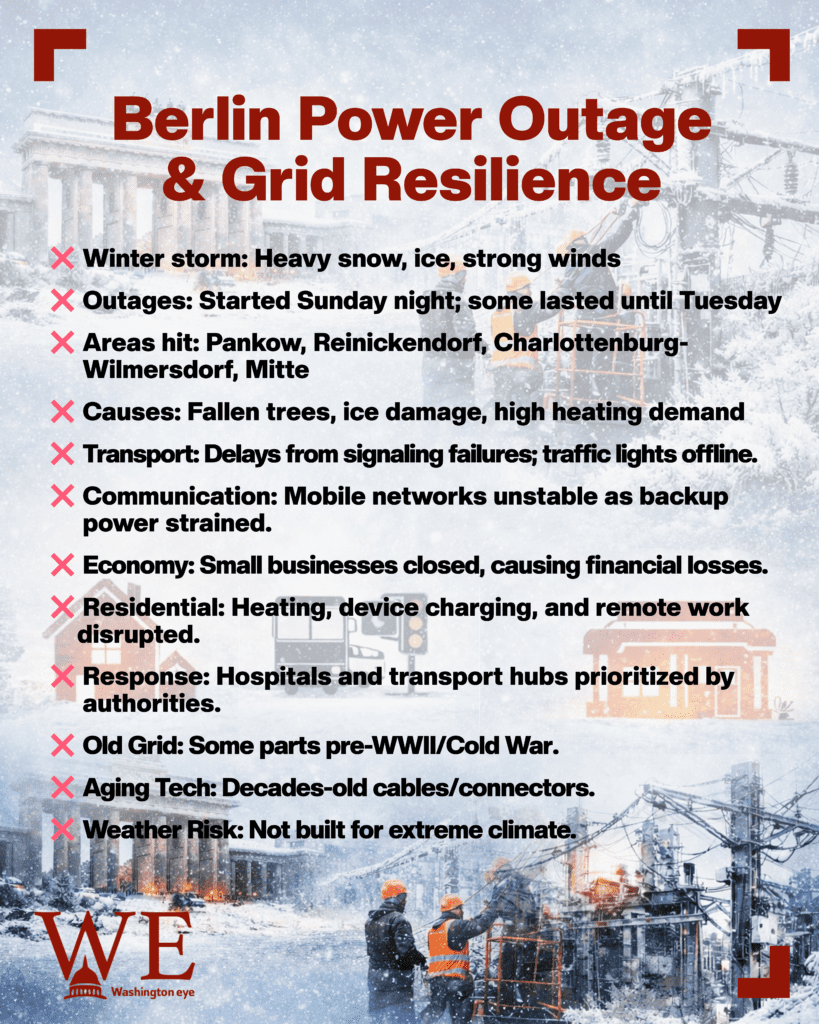
While Berlin has largely returned to normal, the outage has left a lasting impression. For many residents, it served as a stark reminder that even in one of Europe’s most developed capitals, modern life remains deeply dependent on infrastructure that can be shaken by nature. As climate extremes intensify, the city now faces a pressing question: how to future-proof a power system shaped by history, war, and division for an increasingly unpredictable world.