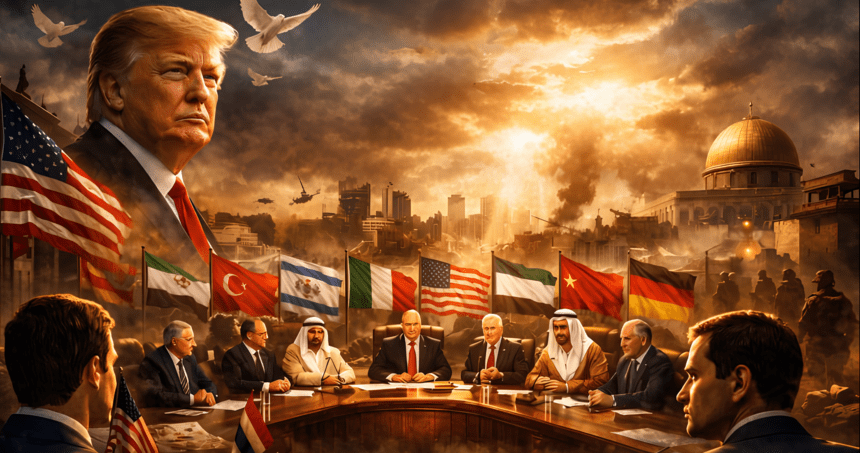
Trump’s proposed Board of Peace is gradually moving from concept to reality, drawing both endorsements and sharp criticism from across the international community. Framed as the diplomatic backbone of Trump’s 20-point peace plan for Gaza, the initiative aims to oversee post-conflict stabilization, reconstruction, and political transition in the territory. Although the support grows, so do concerns about its structure, legitimacy, and long-term implications.
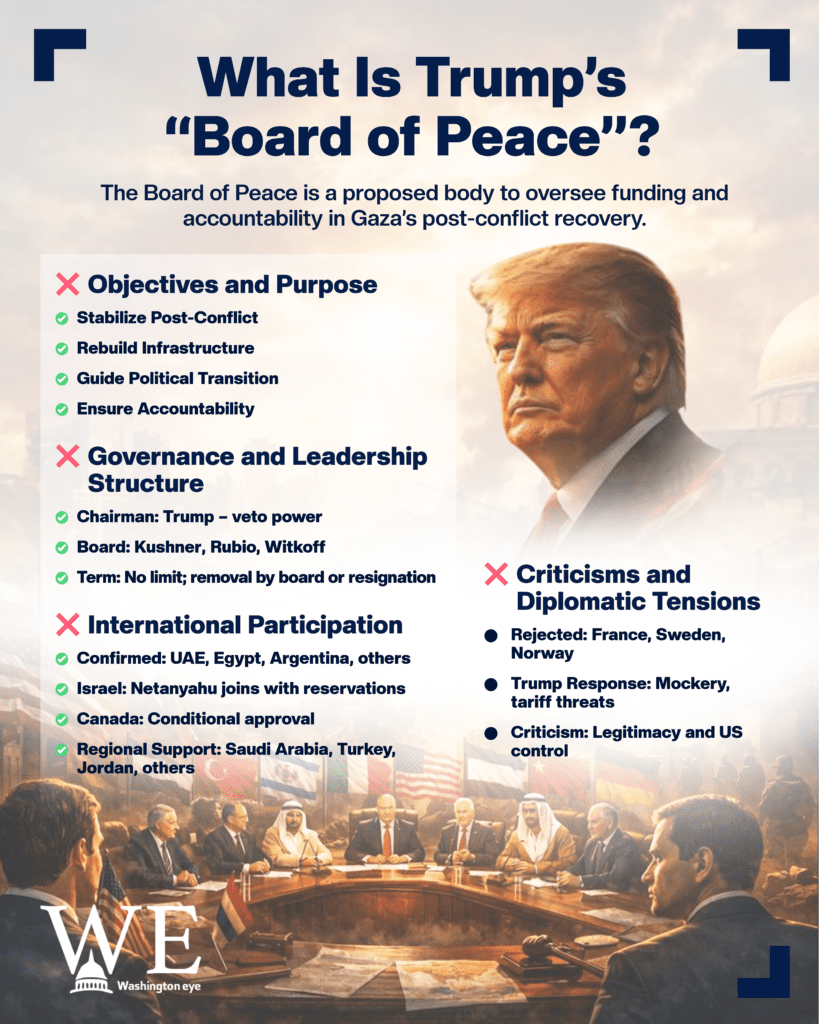
More than ten world leaders have already accepted invitations to join the board. Among them are the presidents of the United Arab Emirates, Egypt, Argentina, Kazakhstan, Uzbekistan, and Belarus, as well as the prime ministers of Armenia and Hungary. Israel’s Prime Minister Benjamin Netanyahu has also agreed to participate, despite reservations in Jerusalem about certain aspects of Trump’s Gaza strategy. Canada has offered conditional approval, agreeing “in principle” while awaiting greater clarity on governance and authority.
In a joint statement, foreign ministers from countries including Saudi Arabia, Turkey, Jordan, Qatar, Pakistan, and Indonesia welcomed Trump’s invitation and voiced support for US-led peace efforts. In total, 60 nations have been invited, ranging from regional stakeholders such as Jordan and Pakistan to global powers including China and Russia. However, participation is tightly controlled. According to the draft charter, only states invited by the chairman may become members.
The White House has described the board as a central mechanism for delivering the president’s peace vision, tasked with strategic oversight, mobilizing international funding, and enforcing accountability. Trump hopes to secure formal endorsement of the board on the sidelines of the World Economic Forum in Davos.
Despite this momentum, skepticism is mounting in Europe and beyond. French President Emmanuel Macron swiftly rejected the invitation, arguing that the board’s charter conflicts with United Nations principles. Sweden has also declined to join, while Norway stated it could not participate under the plan’s current framework. Trump responded to Macron’s refusal with public mockery and threats of steep tariffs on French wine and champagne.
One of the most controversial elements of the proposal is Trump’s potential role as chairman beyond his presidency. The draft charter names him as the inaugural chairman without specifying a term limit. Removal would require voluntary resignation or unanimous agreement of the executive board. That board, notably, would be appointed by Trump himself and includes figures such as Jared Kushner, Secretary of State Marco Rubio, and special envoy Steve Witkoff. All executive decisions would remain subject to Trump’s veto.