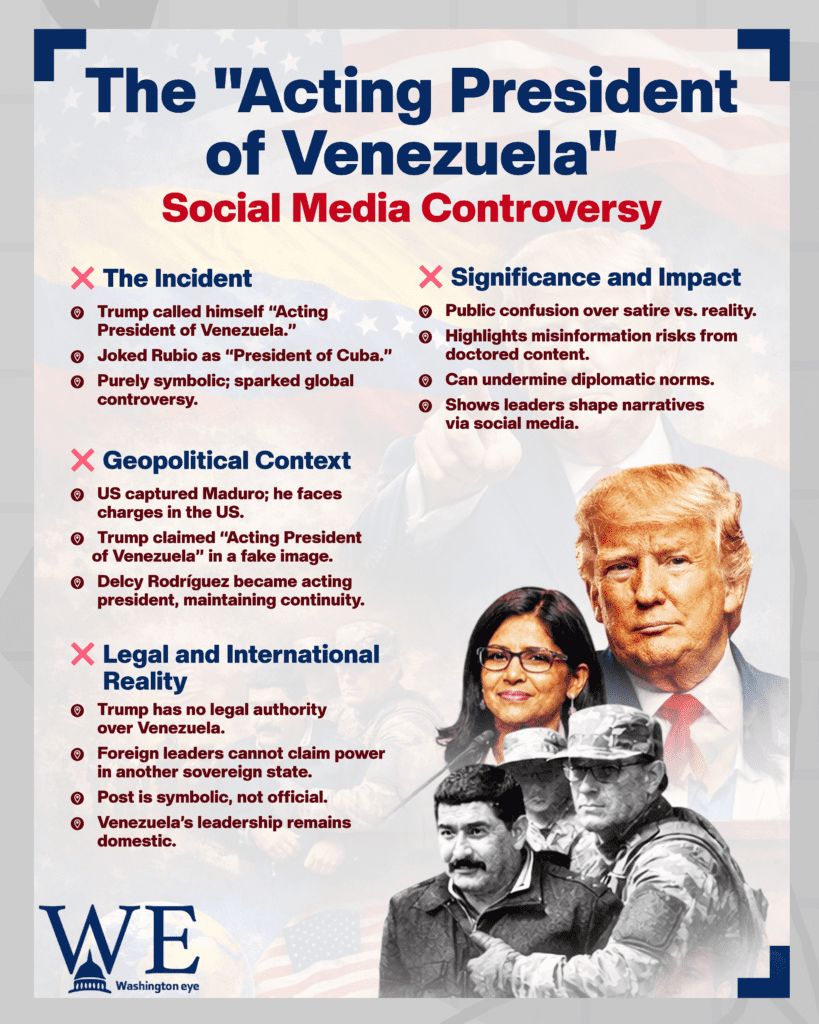
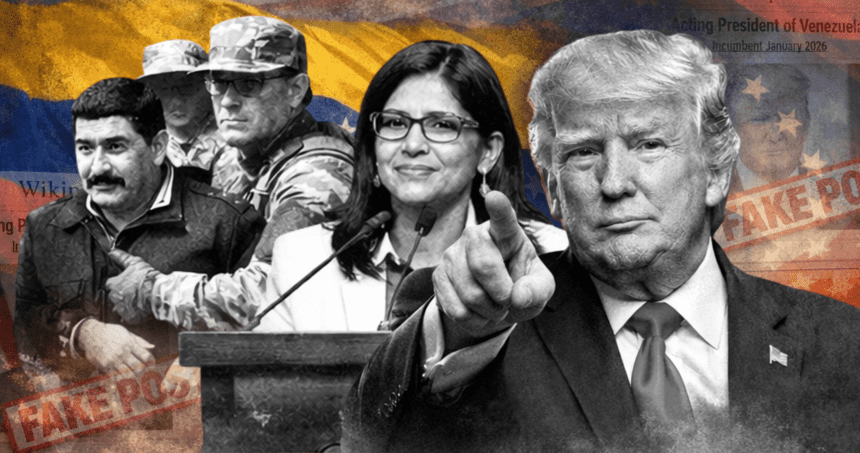
Trump sparked global controversy after posting a digitally altered image on his social media platform claiming that he is the “Acting President of Venezuela,” a claim that has no legal or constitutional basis and is not recognized by any government or international body. The widely shared post, which appeared on Truth Social on Sunday night, used a mock-Wikipedia graphic showing Trump’s official portrait with the title “Acting President of Venezuela, Incumbent January 2026.
Trump’s post came amid intense international focus on Venezuela following a dramatic US military operation earlier this month that resulted in the capture of Venezuelan President Nicolás Maduro and his wife, Cilia Flores. US forces removed Maduro from power during airstrikes and raids in Caracas, subsequently transporting him to the United States where he faces federal indictments on narco-terrorism and drug trafficking charges.
Under Venezuelan law, the country’s Supreme Tribunal of Justice designated Vice President Delcy Rodríguez as acting president to ensure continuity of governance. Her appointment was later recognized domestically as part of the constitutional succession process. Trump’s post, styled to resemble a Wikipedia entry, does not reflect this legal reality and has been widely described as a provocative or symbolic gesture rather than an official assumption of executive authority.
The Truth Social post also drew additional attention because Trump accompanied it with comments about other political figures, including joking references to Secretary of State Marco Rubio as hypothetical “President of Cuba.” These remarks appeared to blend political satire with real geopolitical tension, further confusing public understanding of the events unfolding in Latin America.
Experts emphasise that the image and its claims have no standing in international law and do not alter Venezuela’s constitutional governance. Under both US and Venezuelan legal frameworks, no foreign president can legitimately claim executive authority over another sovereign state. The interim leadership in Venezuela remains a matter for Venezuelan institutions and political actors, not foreign executives.
Political analysts say the episode highlights growing use of social media by world leaders to shape narratives and exert influence, even in ways that blur the line between official communication and personal branding. Critics argue that such posts can mislead global audiences and undermine established diplomatic norms.