
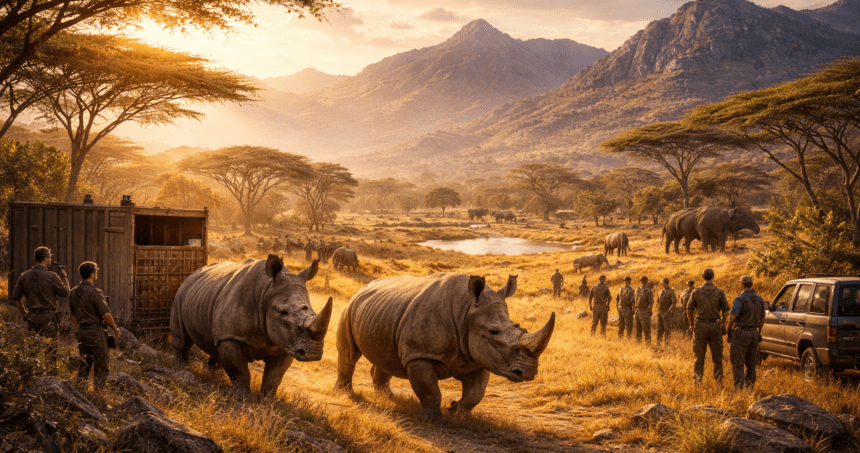
In a landmark moment for wildlife conservation, rhinos have returned to Uganda’s wild landscapes after more than four decades, marking a historic ecological restoration effort in the country’s remote northeastern region. The reintroduction took place in Kidepo Valley National Park, where the species had been extinct since 1983 due to widespread poaching and years of political instability.
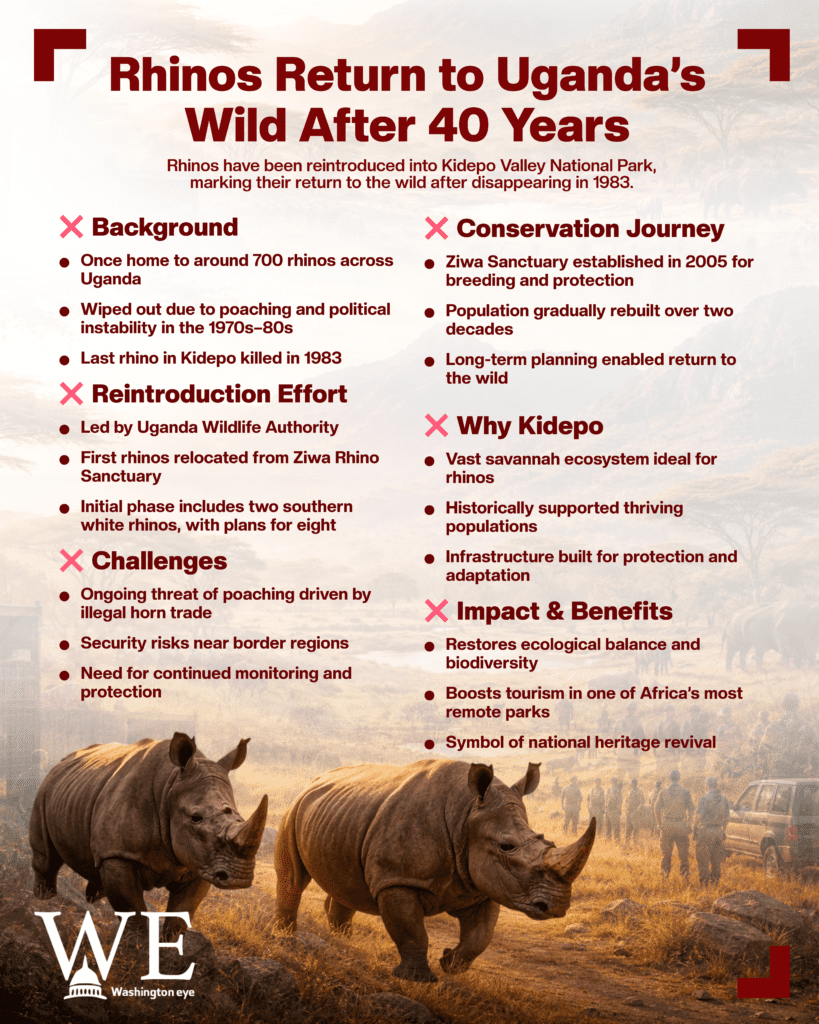
The Uganda Wildlife Authority (UWA), in collaboration with conservation partners, successfully relocated the first group of southern white rhinos to the park on March 17, 2026. The initial phase involved two rhinos transported over 400 kilometers from Ziwa Rhino Sanctuary, a protected breeding ground in central Uganda. Authorities plan to gradually introduce a total of eight rhinos in the park to establish a sustainable population.
This return comes after a painful chapter in Uganda’s environmental history. During the 1970s and early 1980s, rampant poaching, fueled by demand for rhino horn and exacerbated by political unrest, led to the complete disappearance of rhinos from the country’s national parks. Once numbering around 700 across Uganda, the species was wiped out in the wild, with the last rhino in Kidepo reportedly killed in 1983.
The revival of Uganda’s rhino population began decades later with long-term conservation planning. In 2005, the Ziwa Rhino Sanctuary was established to reintroduce and breed southern white rhinos in a secure environment. Starting with a handful of animals imported from Kenya and other reserves, the sanctuary has since grown into a successful conservation hub, producing dozens of rhinos and laying the groundwork for their return to the wild.

Officials say the decision to reintroduce rhinos into Kidepo Valley National Park followed years of research confirming the area’s ecological suitability. Known for its vast savannah landscapes and rich biodiversity, Kidepo once hosted thriving rhino populations before their extinction. Preparations for the reintroduction included building secure enclosures, ranger outposts, access roads, and water infrastructure to ensure the animals’ protection and adaptation.
“This moment marks the beginning of a new rhino story,” said UWA Executive Director James Musinguzi during the launch ceremony, emphasizing that the translocation is only the first step in restoring a species that once formed a key part of Uganda’s natural heritage.
The move is also part of Uganda’s broader National Rhino Conservation Strategy, which aims to restore rhinos across their historical range and strengthen biodiversity. Beyond ecological benefits, the return of rhinos is expected to boost tourism in the region, attracting visitors to one of Africa’s most remote and pristine parks.

However, conservationists caution that challenges remain. Poaching continues to threaten rhino populations across Africa, driven largely by demand for their horns in illegal markets, particularly in parts of Asia. Kidepo’s location near the South Sudan border also presents security concerns, including cross-border cattle rustling and armed activity. Despite these risks, improved anti-poaching measures and surveillance systems have helped reduce illegal hunting in recent years.
The reintroduction in Kidepo follows earlier efforts in 2026 to relocate rhinos to Ajai Wildlife Reserve in northwestern Uganda, signaling a nationwide push to rebuild populations across multiple protected areas. If successful, officials hope to expand the program further, potentially reintroducing additional rhino species in the future.
Globally, the return of rhinos to Uganda is being hailed as a rare conservation success story at a time when wildlife species face mounting threats from habitat loss, climate change, and illegal trade. Experts describe the initiative as a powerful symbol of resilience, demonstrating how long-term investment, international cooperation, and local commitment can reverse decades of environmental damage.
For Uganda, the sight of rhinos roaming freely once again is more than just a conservation milestone, it is a restoration of national heritage and ecological balance. As more rhinos are gradually introduced in the coming months, authorities remain cautiously optimistic that the species will once again thrive in the wild landscapes it once called home.