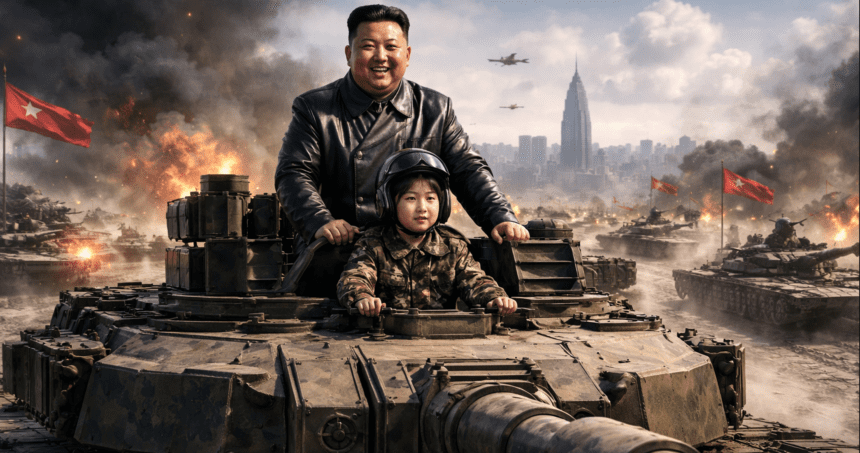
North Korean leader Kim Jong Un made headlines this week after state media released images showing him riding atop a military tank reportedly driven by his young daughter, a moment that analysts say blends symbolism, propaganda, and strategic messaging about succession and military strength. The event, which took place during a military inspection exercise near Pyongyang, comes at a time of heightened regional tensions and renewed focus on North Korea’s defense capabilities.
According to reports from North Korean state news agency KCNA, the tank ride occurred during a visit to armored units of the Korean People’s Army. The images showed Kim smiling and interacting with soldiers, while his daughter, believed to be Kim Ju Ae, was positioned prominently, reportedly at the controls of the armored vehicle. Though independent verification remains limited, the carefully staged visuals have been widely circulated and interpreted as a deliberate political signal.
The timing of the display is significant. North Korea has in recent months intensified its weapons testing program, including missile launches and military drills aimed at demonstrating deterrence capabilities against perceived threats from the United States and its allies in the region, particularly South Korea and Japan. By showcasing both military hardware and a potential successor figure, Kim appears to be reinforcing a dual narrative: strength in defense and continuity in leadership.
Observers note that Kim’s daughter has increasingly appeared in public alongside him, attending missile tests, military parades, and official ceremonies. This latest appearance, arguably the most symbolic yet, has fueled speculation that she is being groomed for a future leadership role, an unusual development in a regime historically dominated by male succession. Analysts argue that placing her in a military context is particularly strategic, linking her image with power, authority, and the state’s core ideology of military-first policy, or “Songun.”
From a domestic perspective, the imagery serves as a propaganda tool designed to project stability and legitimacy. By associating his daughter with the military, Kim reinforces the narrative of a secure dynastic transition, a critical concern in an opaque political system where uncertainty can lead to internal instability. The visuals also aim to humanize the leader, portraying him as a father figure while simultaneously emphasizing his command over the armed forces.
Internationally, reactions have been mixed. Some governments and analysts view the display as a calculated move to send a message of defiance and preparedness amid ongoing geopolitical tensions. Others interpret it as a softer signal, suggesting that North Korea is attempting to normalize the presence of a successor figure in global discourse. However, critics argue that the use of a child in military propaganda raises ethical concerns and underscores the regime’s prioritization of image over transparency.
Security experts caution against overinterpreting the succession angle, noting that North Korea’s political system remains highly centralized around Kim Jong Un himself. While the public appearances of his daughter are notable, there is no official confirmation of her status as heir apparent. Nonetheless, the frequency and prominence of her involvement suggest a deliberate effort to shape both domestic and international perceptions.
The tank ride also highlights North Korea’s continued emphasis on military modernization. State media described the exercise as a demonstration of advanced armored capabilities, though independent analysts remain skeptical about the actual technological progress. Still, the symbolic value of such displays cannot be underestimated, particularly in a region where military signaling plays a crucial role in diplomacy and deterrence.
Critically, the event reflects the evolving nature of North Korean propaganda in the digital age. Unlike earlier eras, where information was tightly controlled and rarely visual, the current regime appears more willing to share curated images that can influence global narratives. By presenting a blend of familial imagery and military strength, Kim Jong Un is crafting a multidimensional persona that appeals to both domestic loyalty and international attention.
Looking ahead, the implications of this development remain uncertain. If Kim’s daughter continues to appear in high-profile settings, it could mark a gradual shift toward preparing the public for a fourth-generation leadership transition. Alternatively, it may simply be a strategic move to reinforce the current regime’s image without signaling immediate succession plans.
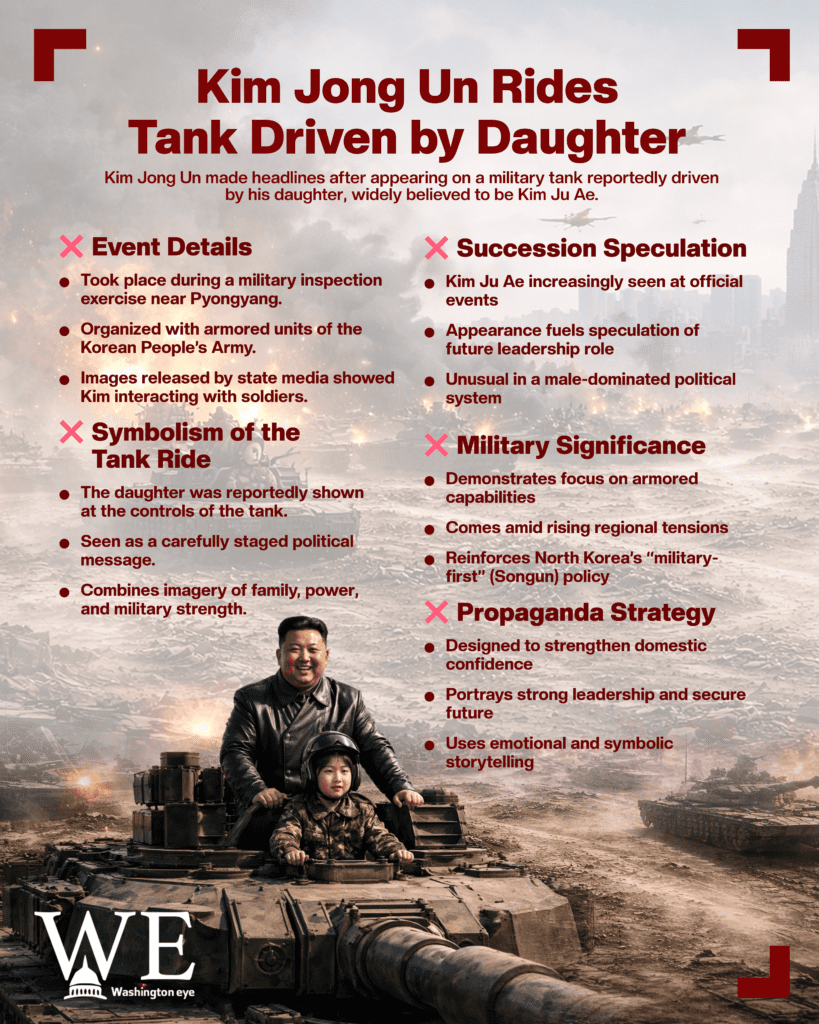
In either case, the image of a young girl driving a tank under the watchful eye of one of the world’s most secretive leaders encapsulates the paradox of North Korea itself, where symbolism, power, and narrative are tightly interwoven. As global tensions persist, such moments serve as reminders that in Pyongyang, even a single photograph can carry layers of political meaning.