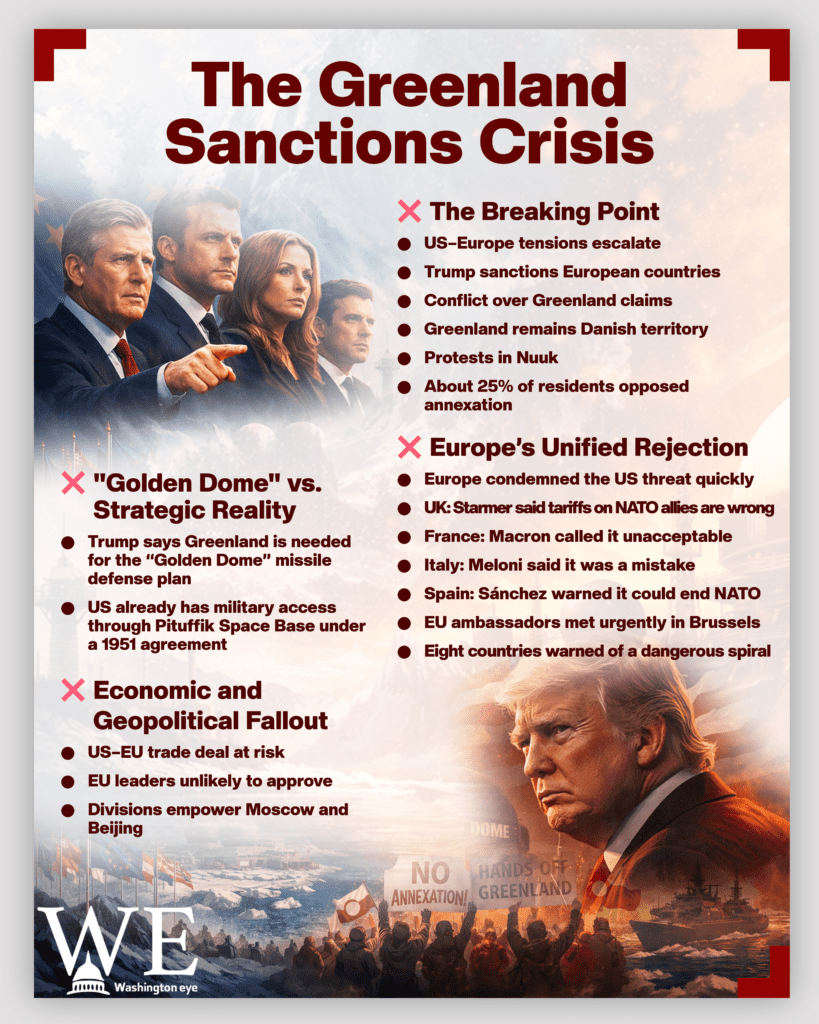
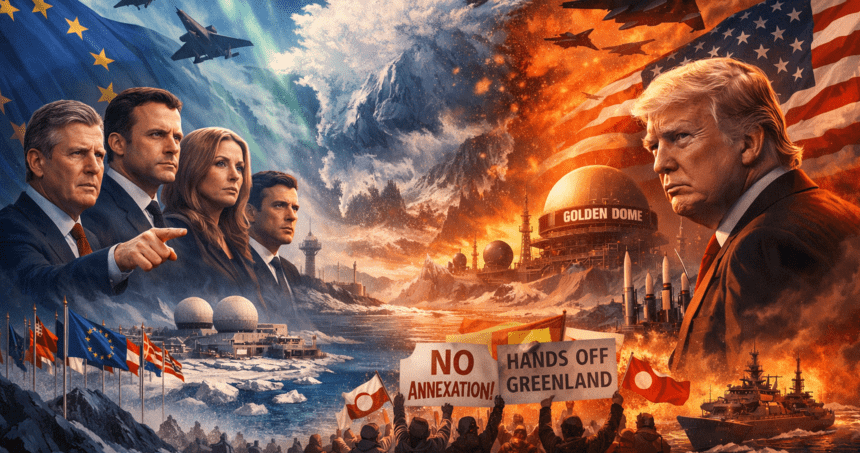
Europe has rarely moved as quickly or spoken as firmly with one voice as it did this weekend, after US President Donald Trump announced sanctions against European countries rejecting American claims over Greenland. The move, targeting allies over a Danish territory, triggered an emergency diplomatic response and deepened concerns that the transatlantic alliance is entering its most fragile phase in decades.
EU ambassadors convened an emergency meeting in Brussels on Sunday, just hours after Trump doubled down on his assertion that the United States “needs” Greenland for national security reasons. His remarks followed protests in Nuuk, Greenland’s capital, where roughly a quarter of the city’s population demonstrated against any potential US annexation of the Arctic island.
Across Europe, leaders who often respond cautiously to Washington reacted with unusual speed and clarity. British Prime Minister Keir Starmer told Trump directly that imposing tariffs on NATO allies for pursuing collective security was “wrong.” French President Emmanuel Macron called the sanctions threat “unacceptable,” warning that intimidation would not sway Europe’s position on Greenland or global security. Even Italian Prime Minister Giorgia Meloni, typically aligned with Trump on many issues, described the move as a mistake.
Eight European countries, including the UK, France, Germany and Spain, issued a joint statement warning that tariff threats undermine transatlantic relations and risk triggering a dangerous downward spiral. NATO Secretary General Mark Rutte confirmed he had also spoken with Trump, as European Council President Antonio Costa announced plans for an extraordinary summit focused on the growing rift.
Trump has defended his stance by accusing Denmark of failing to counter Russian and Chinese activity in the Arctic. In a social media post, he argued that US control of Greenland was necessary to protect North America and advance missile defence plans under what he has called the “Golden Dome.” However, security experts point out that the US already enjoys extensive military access to Greenland under a 1951 agreement with Denmark, including the strategically vital Pituffik Space Base.
European officials warn that Trump’s unilateral approach plays directly into the hands of Moscow and Beijing. EU foreign policy chief Kaja Kallas said divisions among allies only embolden shared adversaries, while Spain’s Prime Minister Pedro Sánchez cautioned that any US military action against Greenland would severely damage NATO and legitimize Russia’s invasion of Ukraine.
The dispute has also cast doubt over the future of the US-EU trade deal agreed last year. European Parliament leaders have indicated that approval is now unlikely amid escalating tensions.
For many in Europe, the Greenland episode signals a broader shift in Washington’s worldview. Senior figures in Trump’s administration have increasingly framed global politics as a contest governed by power rather than alliances, raising questions about whether a strong transatlantic partnership remains central to US strategy.